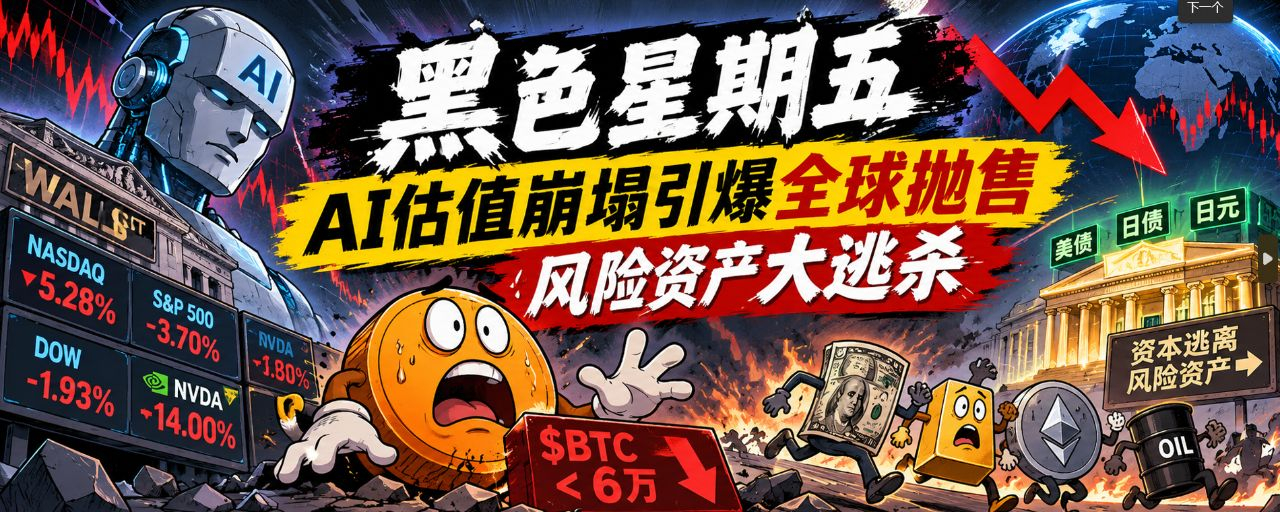
🚨 Breaking down Black Friday’s great capital exodus: Wall Street may have misjudged AI’s trajectory
At first glance, the “Black Friday” that swept global capital markets looked like panic selling. In essence, it was a fundamental reassessment of how AI tech stocks should be valued.
After the midterm elections, a wave of scrutiny targeting Nvidia and AMD followed. On the surface, it’s about restricting computing power and memory amid geopolitical rivalry; beneath the surface, it reflects a stark divergence in the paths taken by the U.S. and China to advance AI. U.S. large language models are primarily pursuing “closed-source commercialization,” while China’s have taken an “open-source, accessible-to-all” approach.
Shift the focus from macro-level geopolitical rivalry to the micro-level battleground where AI meets the real economy, and one fact that Wall Street has seriously underestimated becomes clear: in enterprise (B2B) and government (B2G) markets, restricting computing power alone cannot choke off real-world adoption—and in many respects, it is entirely unnecessary.
The reason is simple: B2B and B2G customers have never primarily needed AI to write copy or create slide decks. What they need is “consultative decision-making”—the ability to draw on deep insight into their business.
For AI to truly serve as a strategic aide and consultant, it must be able to directly access a company’s most critical financial records, real-time sales data, inventory levels, and even the inside track on customer follow-ups. When data sovereignty and trade secrets are at stake, a “closed-source black box” that sends data over the public internet is a nonstarter. The only viable path to real-world adoption is an “open-source foundation + private deployment + closed loop around core enterprise data.”
So what needs to be made clear is this:
AI’s fundamental demand and profit potential have not collapsed. On the contrary, as open-source foundations become deeply integrated with the real economy, AI is only now entering its true profit-generation phase.
In LaoYao’s view, this latest correction in AI tech stocks is likely, to a significant extent, a release of investor sentiment and an excessive downward adjustment in valuations.
#币圈心学 #AI