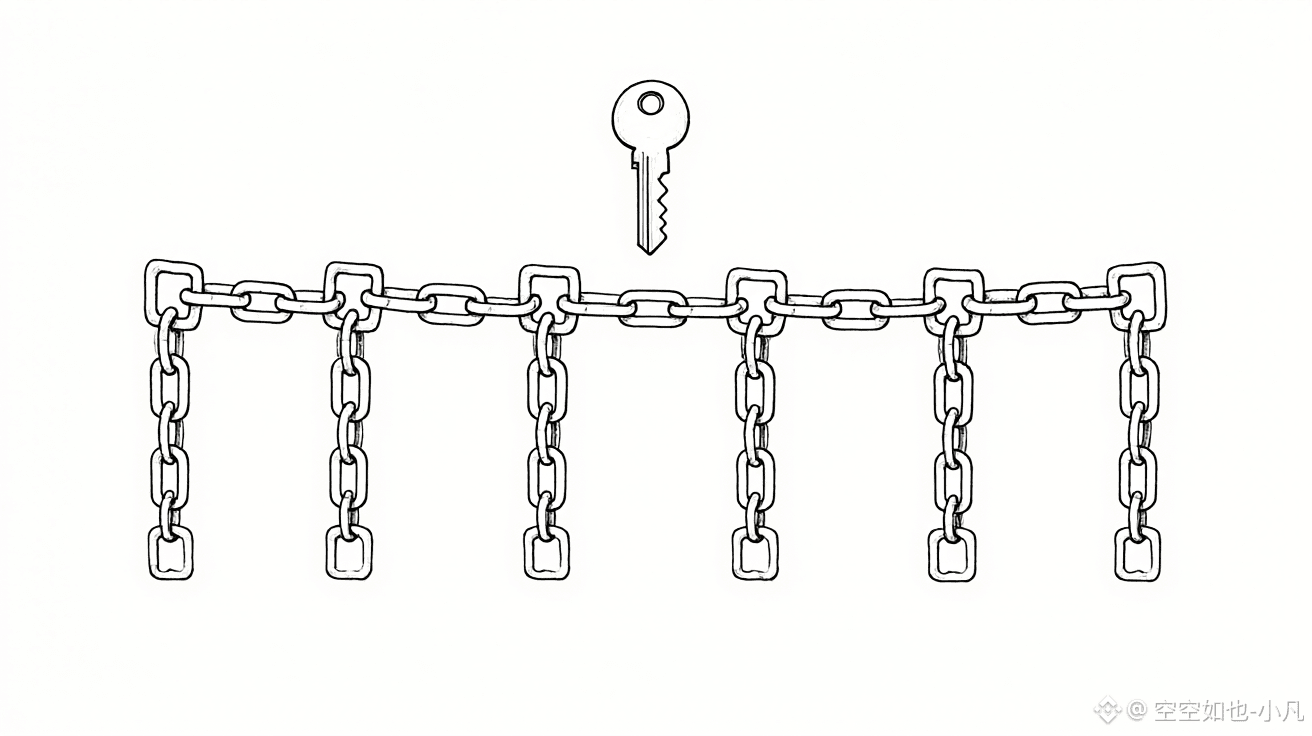
Scanning across six chains at once turned up 15 private keys—a pretty glaring number. None could be found by looking at any one chain alone; they only became visible when several chains were examined together. How did these 15 keys leak? $ZEC
The answer lies in the signing software. A batch of old wallets reused the same one-time number across chains: they signed a transaction on Chain A, then used that same number again on Chain B. If two signatures on the same chain share a number, you can set up a system of equations and work backward to recover the key. But with just one signature per chain, none of them alone is enough to solve it. Only after combining all six chains did there turn out to be enough data. At their peak, the addresses corresponding to these 15 keys held less than $2,100 in total, but the flaw was in the client software. $BTC
Speaking of client software, random number generators were a major weak point in the early days. If the seed quality was poor, the number could collide. That’s exactly the trap those Android devices fell into in 2013. Later, researchers showed that lattice methods could recover private keys even when the numbers weren’t completely repeated, just biased. $SOL
That’s why newer wallets changed their approach: instead of generating a random number on the spot, they derive one from the private key and the message using a fixed procedure. This approach uses a hash to bind the message to the number: the same message always produces the same number, while a different message produces a different one, closing off the possibility of collisions at its source. The signatures left on-chain by old wallets became a historical problem, uncovered only by digging through the past.
The breakdown by chain is worth noting, too. DOGE yielded 195 keys, ETH 119, and LTC, BCH, and DASH together accounted for just 16. The rougher the signing software on a chain, the more keys turned up.
The takeaway from these 15 keys is pretty clear: don’t reuse the same key across multiple chains. Wallet providers should have separated keys by chain long ago, and addresses holding funds in legacy systems should be moved if possible. The numbers have been sitting on-chain all this time. Nobody put them together back then; someone has now.
This is a personal opinion and not investment advice. You are responsible for your own gains and losses.
#比特币签名漏洞可被秒级利用
The answer lies in the signing software. A batch of old wallets reused the same one-time number across chains: they signed a transaction on Chain A, then used that same number again on Chain B. If two signatures on the same chain share a number, you can set up a system of equations and work backward to recover the key. But with just one signature per chain, none of them alone is enough to solve it. Only after combining all six chains did there turn out to be enough data. At their peak, the addresses corresponding to these 15 keys held less than $2,100 in total, but the flaw was in the client software. $BTC
Speaking of client software, random number generators were a major weak point in the early days. If the seed quality was poor, the number could collide. That’s exactly the trap those Android devices fell into in 2013. Later, researchers showed that lattice methods could recover private keys even when the numbers weren’t completely repeated, just biased. $SOL
That’s why newer wallets changed their approach: instead of generating a random number on the spot, they derive one from the private key and the message using a fixed procedure. This approach uses a hash to bind the message to the number: the same message always produces the same number, while a different message produces a different one, closing off the possibility of collisions at its source. The signatures left on-chain by old wallets became a historical problem, uncovered only by digging through the past.
The breakdown by chain is worth noting, too. DOGE yielded 195 keys, ETH 119, and LTC, BCH, and DASH together accounted for just 16. The rougher the signing software on a chain, the more keys turned up.
The takeaway from these 15 keys is pretty clear: don’t reuse the same key across multiple chains. Wallet providers should have separated keys by chain long ago, and addresses holding funds in legacy systems should be moved if possible. The numbers have been sitting on-chain all this time. Nobody put them together back then; someone has now.
This is a personal opinion and not investment advice. You are responsible for your own gains and losses.
#比特币签名漏洞可被秒级利用