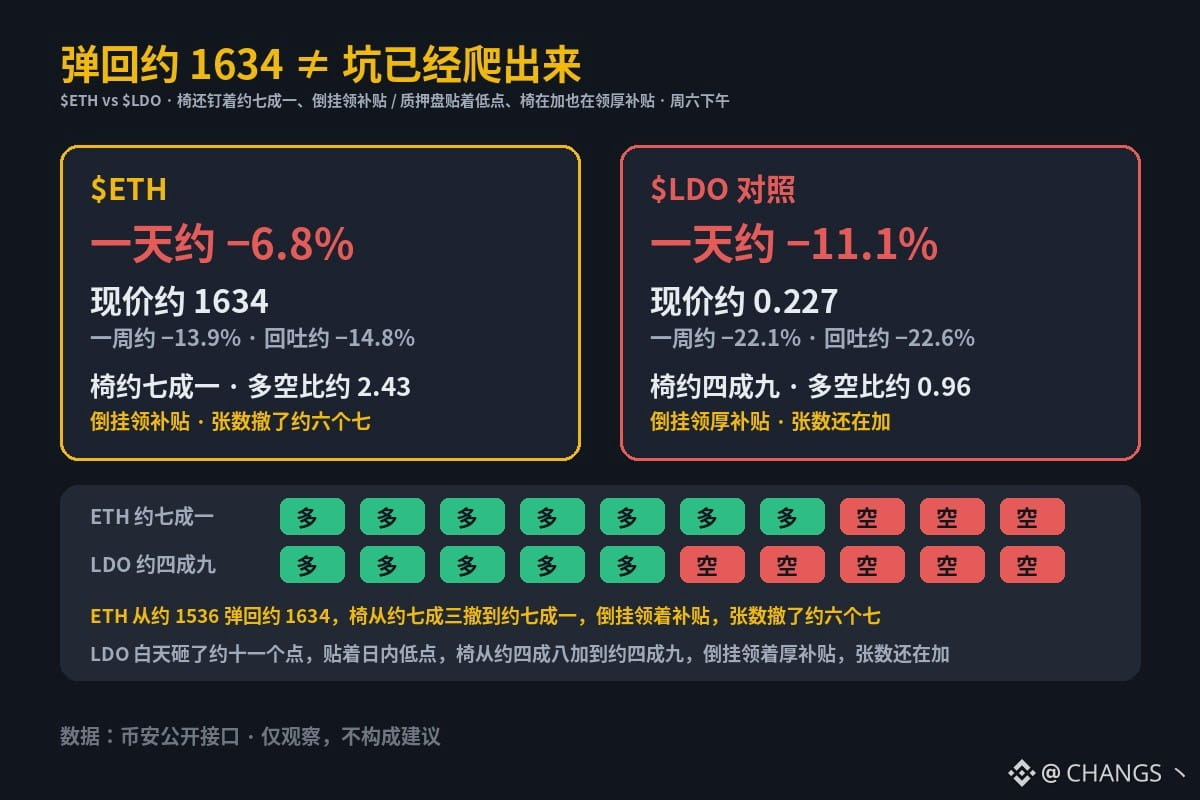
On Saturday afternoon, some people saw Ethereum touch around 1536 during the day and bounce back to around 1634, and took it to mean it had climbed out of the hole and they could call it a day for the weekend. The ledger says otherwise: on one side, the long share fell from around 73% to around 71%, still stuck around 71%; inverted funding was paying them, and contract count fell by around 6.7%, but was still well below the weekly high. On the other side, the staked-token market plunged another roughly 11% during the day, hugging its intraday low. The long share rose from around 48% to around 49%, just tipping to the short side; inverted funding was paying a hefty subsidy, contract count was still rising, and it was still in the weekly hole.
$ETH: down around 6.8% in a day / around 13.9% in a week, current price around 1634. Weekly high around 1919, a pullback of around −14.8%. Account long/short ratio around 2.43 (around 71% long; around a day ago it was around 2.66/73%, with the long share retreating). Funding inverted at around −0.0033%/8h, paying a subsidy. OI contract count over the past day around −6.7% (coin-margined around −12.7%; money is flowing out, and contract count is falling too). Price slid from the intraday high of around 1763, touched around 1536 at the day's low, then rebounded to around 1634, still well below the weekly high. The long share fell from around 73% to around 71%, while inverted funding was paying a subsidy—so don't take a bounce from around 1536 to 1634 in a single day as proof it has climbed out of the hole; even less so a slight retreat in the long share and a roughly 6.7% drop in contract count as proof that leverage has been fully unwound.
In the same session, $LDO was down around 11.1% in a day and around 22.1% in a week, with a current price around 0.227. Weekly high around 0.2933, a pullback of around −22.6%. Long share around 49% (long/short ratio around 0.96; around a day ago it was around 0.91/48%, with the long share rising). Funding inverted at around −0.0081%/8h, paying a hefty subsidy. OI contract count over the past day around +1.6% (coin-margined around −8.2%; mostly due to the price drop, while contract count is rising). Price slid from the intraday high of around 0.2568, staying close to the intraday low of around 0.2199. It is still in the weekly hole; the long share rose from around 48% to around 49%, just tipping to the short side, inverted funding is paying a hefty subsidy, and contract count is still rising. It plunged around 11% during the day and hasn't joined this rebound.
On one side, the main chain bounced from around 1536 to around 1634, the long share is still stuck around 71%, and inverted funding is paying a subsidy; on the other, the staked-token market is still near its low, the long share is rising, inverted funding is paying a hefty subsidy, contract count is still rising, and it is still in the weekly hole. Does a bounce back to around 1634 mean it has climbed out of the hole, or did the main chain merely bounce partway while the long share is still around 71% and the staked-token market is still near its low, collecting hefty subsidies—in other words, it hasn't climbed out of the hole yet? Post counterexamples in the comments.