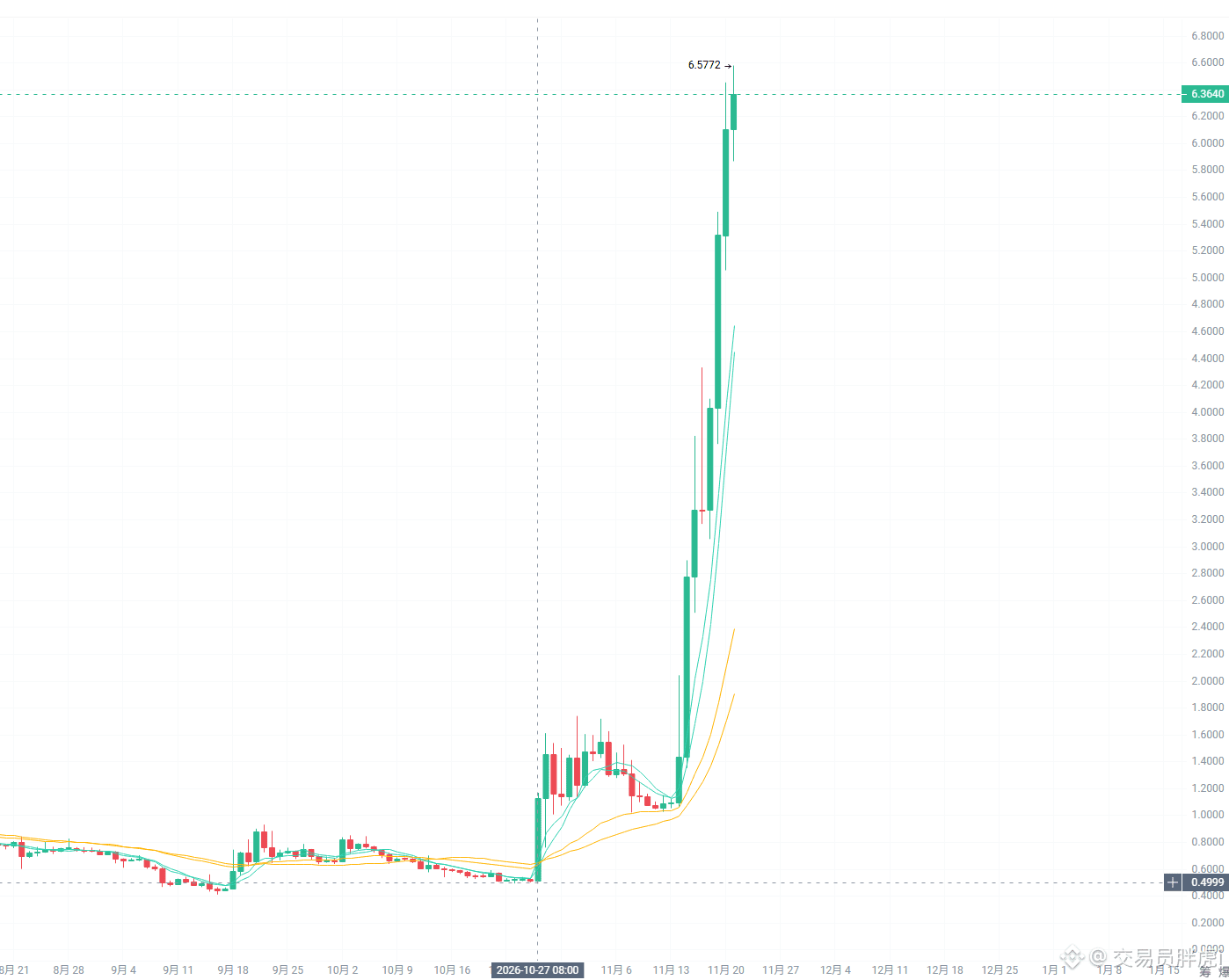
EVAA’s daily chart went from 0.5 to 6.57—a 13-fold gain in two months. This price action makes my scalp tingle
From late August to mid-October, EVAA hovered around 0.5 for a full two months. The candlesticks were small and tightly packed, the moving averages tangled together, and trading volume was sparse—a classic stretch of dead time when nobody was paying attention.
Then, on October 27, a huge bullish candle shot straight up.
It surged from 0.5 to 1.4, nearly tripling in a day. After that, it moved sideways between 1.2 and 1.6 for two weeks. Many people thought that was the end, but then it took off in mid-November.
It climbed all the way from 1.1 to 6.5772, nearly a sixfold gain in two weeks.
The price is now 6.3640, holding near the high. The moving averages are fully aligned in a bullish formation, with the yellow line steadily supporting the price—and there hasn’t even been one decent pullback.
In trading jargon, this is called a “main uptrend.”
Its defining feature is that it gives you no chance to get in. You wait for a pullback, but it doesn’t pull back; you chase it, and it keeps rising; you sell, and it makes a new high.
Here are a few key levels:
6.5772: The current all-time high and a psychological threshold. If the price holds above it, there’s no overhead supply, and the upside is wide open. 5.0–5.4: The high-volume trading zone during this rally, and the first support area. As long as the price doesn’t break below it, the trend remains intact. 2.4: The level where the moving averages catch up, and the “lifeline” of this rally. A break below this level would signal that the trend has genuinely deteriorated.
Honestly, when you look back at a 13-fold move like this, it all seems like an opportunity—but living through it is pure torment.
When it was bottoming around 0.5, nobody believed in it; when it started moving at 1.4, people called it a bull trap; at 3, they thought it was too high; now that it’s above 6, people are asking, “Is it still worth chasing?”
That’s the market for you—it has a way of punishing both defiance and hesitation.#比特币跌破6万美元,短期能否企稳反弹?
One final reminder: the most explosive phase of a main uptrend is also when the risk is greatest. Be sure to manage your position size and set stop-losses. Don’t give back the money you’ve made.
If market volatility has left you confused and unsure how to handle a losing position, or if you feel you’ve been misled while trading, feel free to get in touch.@交易员胖虎i