$BTC $ETH $ZEC
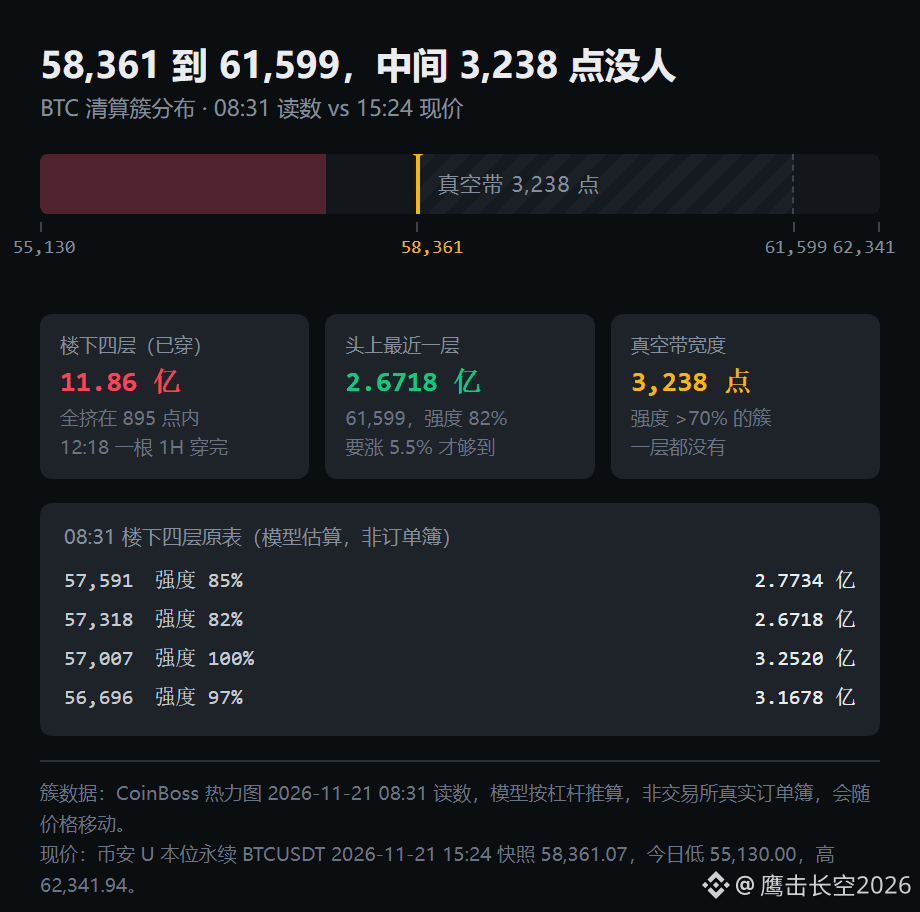
There were $1.186 billion in liquidation levels stacked below, yet the price bounced from 55,130 to 58,361.
The conclusion first: a liquidation cluster isn’t a floor; it’s a fuel gauge. It estimates who might get liquidated, not who will step in to buy.
Layer one: what everyone could see
At 08:31, the heatmap showed four levels below: 57,591, 57,318, 57,007, and 56,696, totaling $1.186 billion. All four were crammed into a 895-point range, and the 57,007 level had a strength reading of 100%. The consensus at the time was simple: there’s so much liquidity below that if price falls, it’ll get caught there; any bounce will have to wait until the liquidations are over.
Then, at 12:18, the 1-hour candle plunged from 57,655 all the way to 55,555.55, closing at 56,740. It cut through all four levels without pausing once, and later that evening it dipped even lower, touching 55,130.
Layer two: why none of the levels held
Because liquidation clusters attract positions, not buy orders. When price fell to 57,591, what got triggered was the liquidation of longs—not buyers stepping in to catch the dip. Liquidation orders are market sell orders: they don’t buy; they dump. The thicker the cluster, the more sell orders it unleashes. This so-called magnetic pull attracts fuel, not rescuers.
Today, that $1.186 billion stretch from 57,591 all the way down to 55,130 got swept. Once it was cleared, leveraged positions were wiped out, and selling pressure was cleared along with them. That’s the real reason price could rebound from 55,130 to 58,361: not because people suddenly turned bullish, but because nobody was left to get liquidated.
Layer three: this is the key
Now look overhead. From 58,361 to 61,599, the 08:31 readings showed no cluster with strength above 70%—a full 3,238 points of vacuum.
It’s vacuum below, too: 3,231 points down to 55,130. The ranges in both directions are almost identical, just 7 points apart.
So the real asymmetry isn’t in the distance; it’s in how the price travels. To go up 3,238 points, buyers have to push it higher bit by bit, because there are no liquidation clusters to help accelerate the move. To go down 3,231 points, all it takes is one shove from sellers, because there’s nothing to stop it either. Same distance: one direction needs a lot of people working together; the other just needs nobody to stand in the way. The difference in dollar value is even smaller: $1.053 billion in the four clusters above versus $1.186 billion in the four below—a gap of just 10%.
One more change to note: at 14:54, open interest stood at 93,960.7 contracts, down 1,200 from 13:43. The rally came with falling open interest, meaning shorts were being carried higher as they covered. By 15:24, open interest had climbed back to 95,094.5 contracts, up 1,133.8, and price had moved above 58,361. This half hour turned into a rally on rising open interest, with new longs entering and taking over. The same move had two different characteristics at either end, and the funding rate followed suit, rising from +0.000539% to +0.001138%—longs were paying twice as much.
My plan: keep holding the short; take half off at 59,030. I’ll only flip long if one condition is met: a 1-hour candle closes above 59,030 and open interest rises at the same time. If either is missing, I’m doing nothing. I won’t chase shorts below 55,130—that’s the only level today that proved there were buyers ready to step in.
The takeaway: liquidation clusters tell you who might blow up, not who will come to the rescue. If you mistake a fuel gauge for a floor, you’ll end up being the fuel.
Du Mu wrote, “The young men of Jiangdong are many and talented; who can say they won’t rise again?” Price can bounce after cutting through four levels, but a bounce doesn’t mean the story has turned around.
Would you dare go long in this band, with vacuum both above and below? Or, like me, would you wait for 59,030? Drop your position, leverage, and stop-loss while you’re at it—I’ll note them down and check tomorrow.
If you want to debate this live, tap the group chat link on my profile: Eagle Strikes the Sky · Crypto Study Club. It’s a small group, but someone will answer.