ZEC falls below $700: Is the privacy coin narrative over?
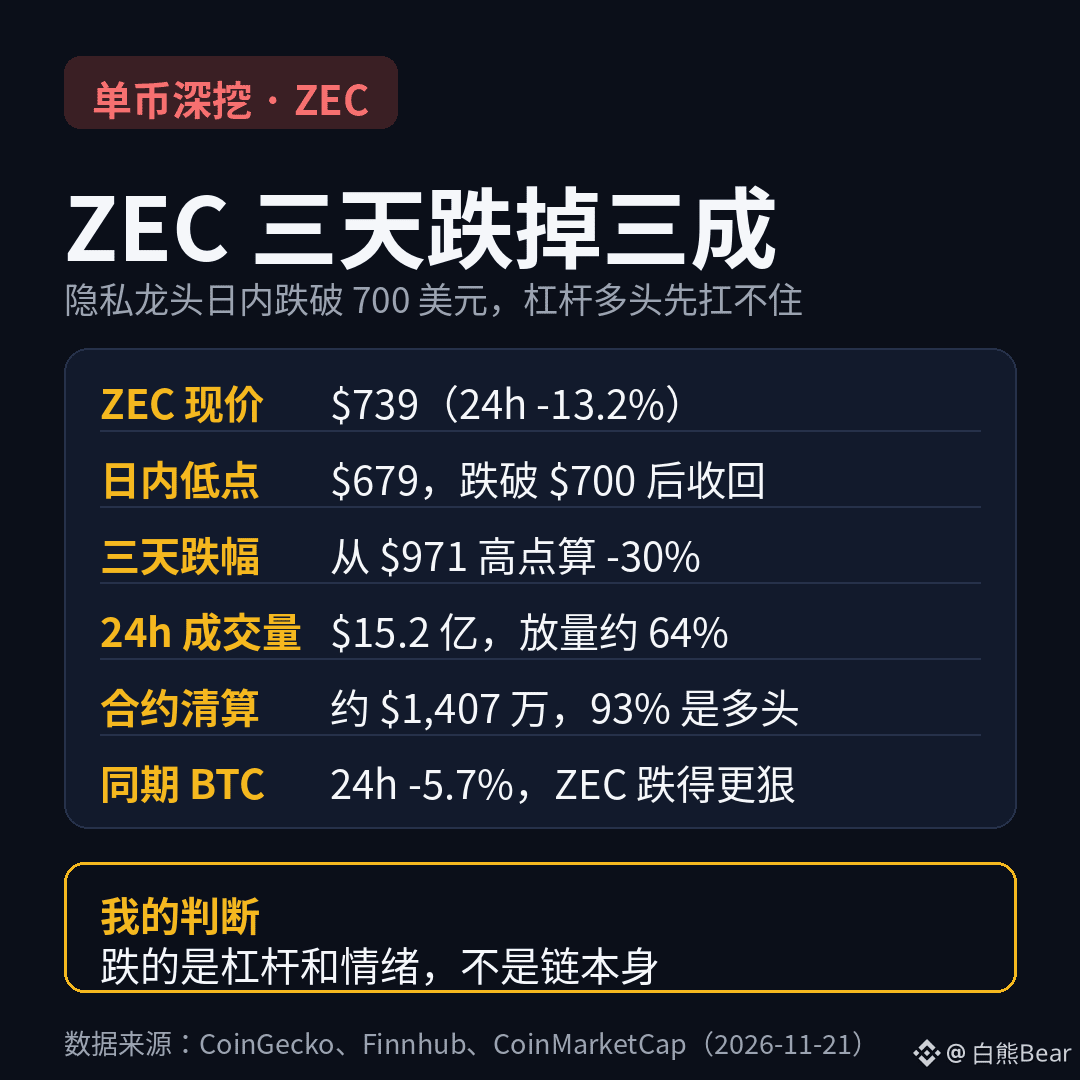
First, what happened. Zcash briefly fell below $700 intraday, hitting a low of $679. It was down more than 13% in 24 hours and is currently around $739. Bitcoin fell just 5.7% over the same period, and ZEC was the worst performer among the top 30. The timeline is even more striking: ZEC surged to $971 on November 18, then fell 30% from its peak in just three days. Trading volume climbed to $1.52 billion, more than 60% above normal.
My take is that this move wasn't triggered by any major negative news specific to ZEC, but by leveraged positions turning against traders after a sharp rally. I haven't seen any verifiable ZEC-specific bad news in public reports. What really amplified the drop was the bulls themselves: around $14.07 million worth of ZEC contracts were liquidated in 24 hours, 93% of them long positions. The privacy narrative drove ZEC up from its lows in early November. Everyone talked about privacy and freedom on the way up; on the way down, leveraged traders ran for the exits first, making the sell-off especially brutal.
But the claim that the fundamentals have collapsed doesn't hold up either. The NU7 upgrade went live on November 5, cutting block times from 75 seconds to 25 seconds. Mining company Fortitude's Zcash hashrate is still growing, and shareholders approved a merger on November 20. Nothing has gone wrong on-chain or with the code; it's the price and positions that have taken a hit.
What really hangs over the market are two unresolved threats. One is the EU: starting July 10, 2027, service providers will face restrictions on supporting privacy-enhancing coins, which could directly heighten volatility by increasing the risk of exchange delistings. The other is the vulnerability in Orchard's shielded pool, which was fixed in June; to this day, the team hasn't publicly proven that it was never exploited. The narrative can push ZEC up to $971, but these two issues could just as easily drag it back down at any time.
Here are three things I'm watching next: whether ZEC can climb back above $800, with the 200-day moving average sitting near $809; whether trading volume continues to rise; and whether the November 30 treasury governance vote gives the market a new narrative.
Do you think privacy coins have peaked this time, or is there another rally ahead after this oversold pullback?
$BTC $ZEC #隐私币 #Zcash