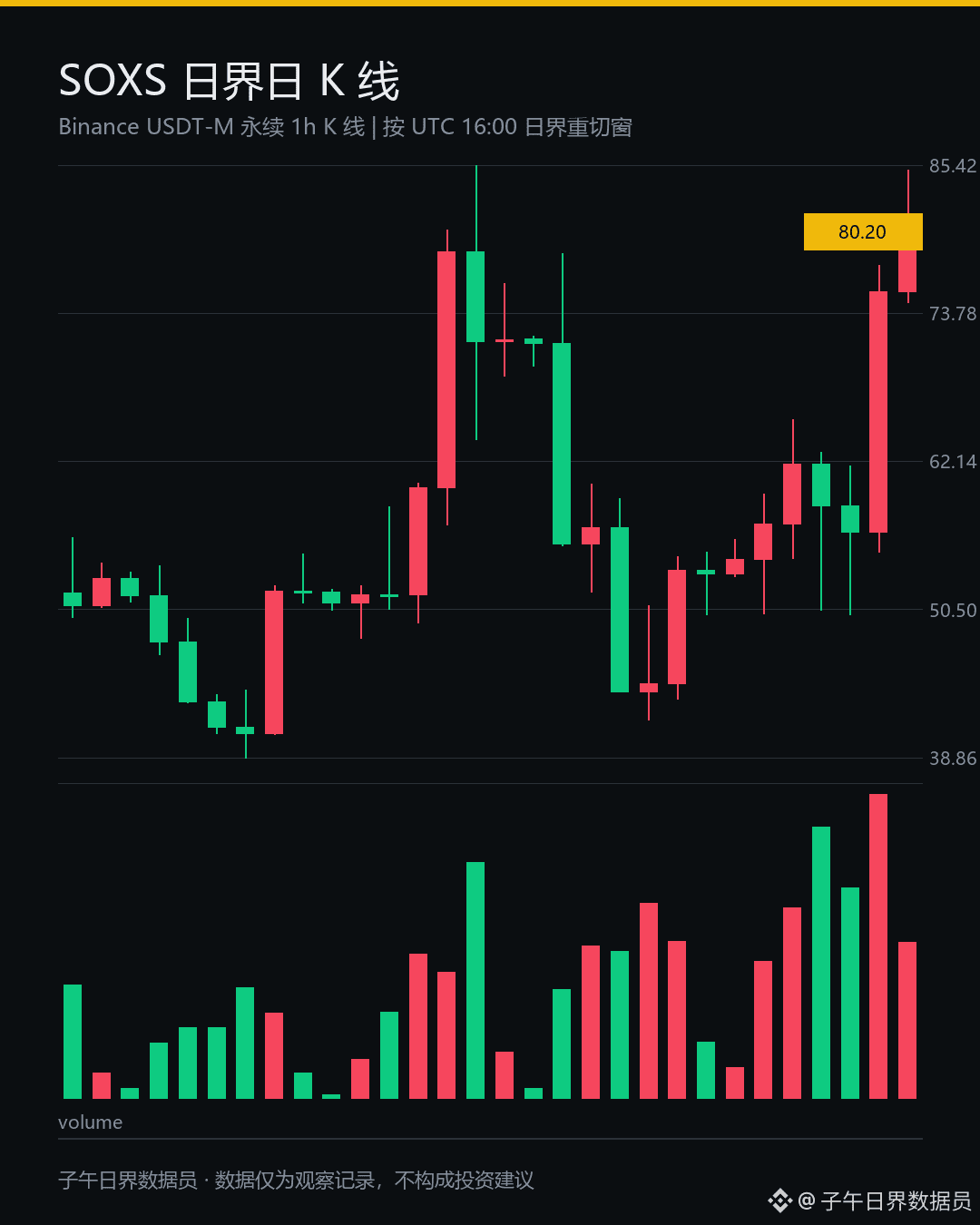
That 3x inverse semiconductor thing—looking back at it a day later, $SOXS is still in the same shape.
Leave it alone for now.
Yesterday morning, it was up 28.12% for the day, and this candle stood out most on the screen.
Its 20-day range was 41.83 to 85.42, and at the time it was sitting at the 61.14% mark.
It looked fierce, but really it had only filled back half the hole it had dug earlier.
I went over the positions column again: the number of shares was up 20.23% in a day, while the notional value rose 50.83%.
Notional value was rising faster than the share count. New positions were piling in at higher prices, but the support came in only one layer deep.
Long accounts were at 40.85%, while the perpetual funding rate had drifted down to -0.0132%.
There aren't many buyers; more people are betting on a rebound from the other side. This divergence still hasn't been resolved.
Honestly, at first glance I thought funds were piling into it together. It took checking twice before I believed the price itself had pushed the position value up.
It's like a pot that's nearly boiled dry: the heat is still high, but no ingredients have been added.
Moving sideways is a slow simmer for it. The pot stays hot, and the soup will only keep reducing.
A 3x leveraged product recalculates against its underlying asset at every daily close. After just two sideways days, it loses a bit of value on its own. That's not anyone dumping it; that's the rules collecting rent.
The people sitting on their positions are still waiting, but these holdings get worn down a little every day—and the closer they are to the pot, the faster they lose.
My take is to pay less attention and wait until it has moved sideways for two days before deciding.
What do you all think of these products that rely on daily resets to capture volatility? Let's discuss in the comments.
$BTC $ETH
#SOXS #比特币 #Cryptocurrency
The above is a record of my personal trading system and observations of data; it does not constitute investment advice