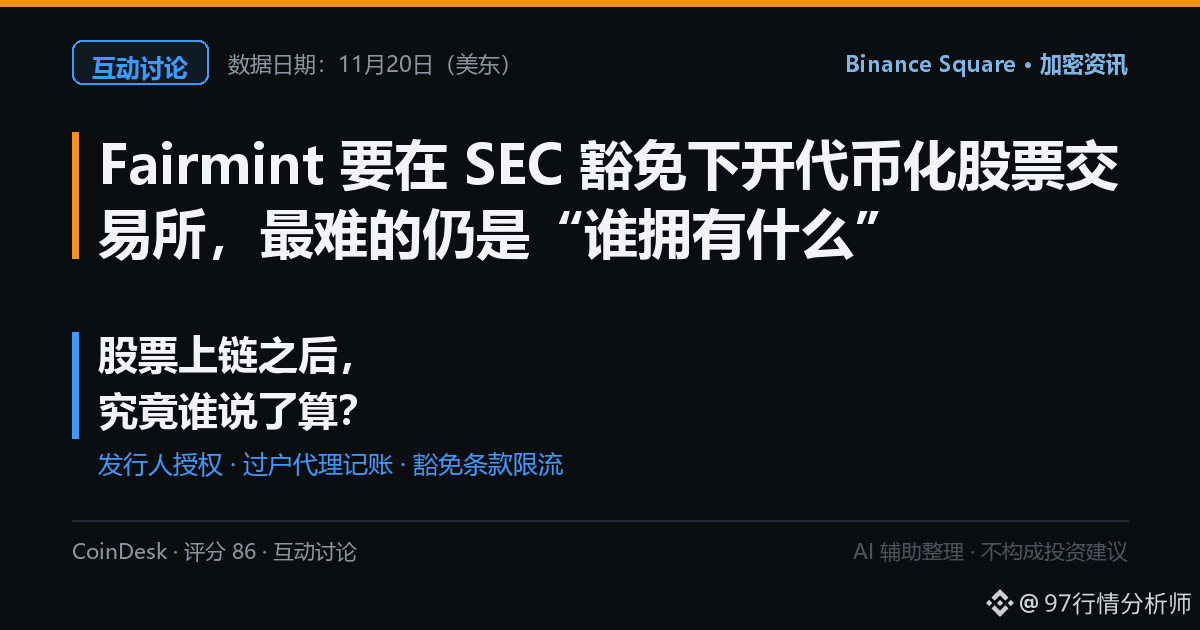
Fairmint plans to launch a tokenized stock exchange under an SEC exemption, but the hardest question remains: “Who owns what?”
On Friday, Fairmint said it plans to launch a tokenized stock trading venue on Canton under the SEC’s five-year “innovation exemption.” The company emphasized that trading has not yet begun, and it has not announced which stocks will be listed or when the venue will open.
It will handle only shares “authorized by the issuer”: once a publicly traded company gives its approval, Fairmint, as an SEC-registered transfer agent, will verify holders and process transfers, putting the official ownership records on-chain. Tradecraft will be the first market maker. Fairmint previously served as transfer agent for CNTN’s issuer; those shares were listed on another venue on November 4. A joint venture between OKX and the parent company of the New York Stock Exchange is also waiting in line.
The key isn’t “putting stocks on-chain,” but first establishing “who owns what”: without an accountable party and a registry, on-chain stocks are just a string of balances. The trade-offs are concrete, too: the range of tradable stocks, size limits, participant verification, and disclosure obligations all have to be addressed—effectively using compliance requirements to block permissionless issuance. In the short term, what people can buy hasn’t changed. Over the long term, if stocks can enter on-chain pools, RWA will expand from government bonds to equities, with the pace depending on issuers and regulators.
Here’s the question: if tokenized stocks require issuer approval, recordkeeping by a transfer agent, and restrictions under an exemption, does on-chain trading actually save costs—or does it just make settlement a faster form of recordkeeping? Do you care more about being able to trade at any time, or about who safeguards the ownership records?
On Friday, Fairmint said it plans to launch a tokenized stock trading venue on Canton under the SEC’s five-year “innovation exemption.” The company emphasized that trading has not yet begun, and it has not announced which stocks will be listed or when the venue will open.
It will handle only shares “authorized by the issuer”: once a publicly traded company gives its approval, Fairmint, as an SEC-registered transfer agent, will verify holders and process transfers, putting the official ownership records on-chain. Tradecraft will be the first market maker. Fairmint previously served as transfer agent for CNTN’s issuer; those shares were listed on another venue on November 4. A joint venture between OKX and the parent company of the New York Stock Exchange is also waiting in line.
The key isn’t “putting stocks on-chain,” but first establishing “who owns what”: without an accountable party and a registry, on-chain stocks are just a string of balances. The trade-offs are concrete, too: the range of tradable stocks, size limits, participant verification, and disclosure obligations all have to be addressed—effectively using compliance requirements to block permissionless issuance. In the short term, what people can buy hasn’t changed. Over the long term, if stocks can enter on-chain pools, RWA will expand from government bonds to equities, with the pace depending on issuers and regulators.
Here’s the question: if tokenized stocks require issuer approval, recordkeeping by a transfer agent, and restrictions under an exemption, does on-chain trading actually save costs—or does it just make settlement a faster form of recordkeeping? Do you care more about being able to trade at any time, or about who safeguards the ownership records?