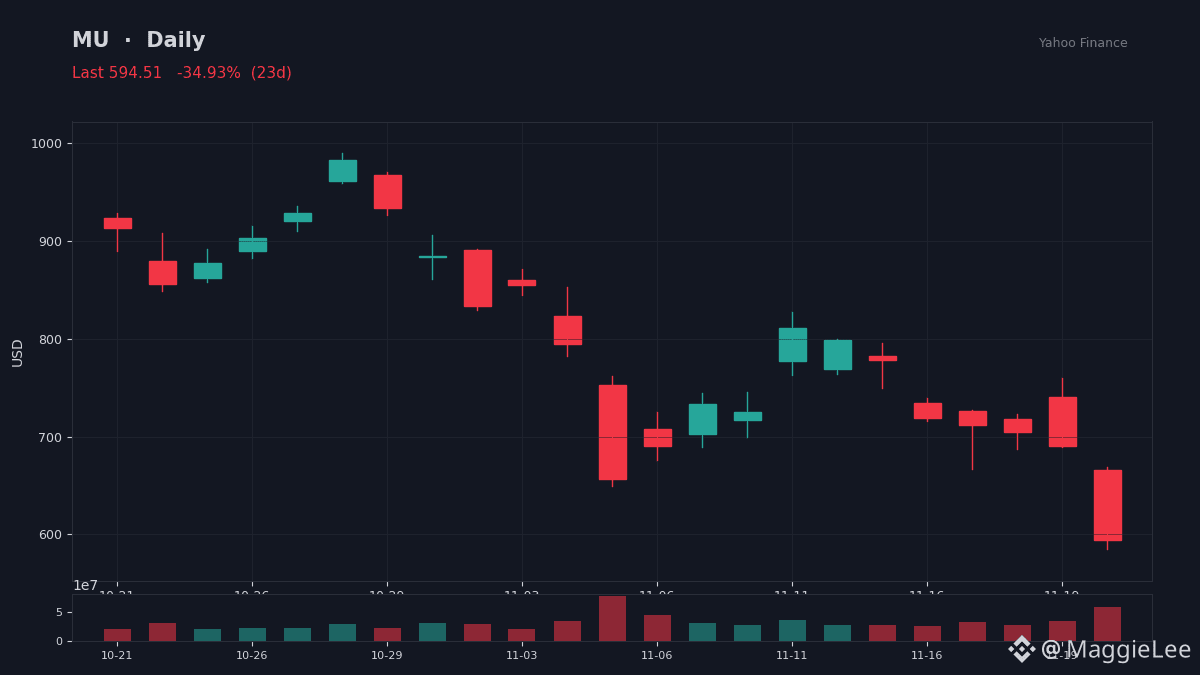
Can you believe a storage leader that’s more than doubled this year can lose 95.93 in a single day? Micron opened yesterday at 665.46, plunged to an intraday low of 585.25, and closed at 594.51, down 13.89% for the day, on nearly 60 million shares traded. It did bounce back to 610.60 after hours, up 2.71%, but that’s nothing compared with its daytime losses.
It hasn’t had a moment to catch its breath all week: Monday’s close was 719.02, Tuesday’s 712.42, Wednesday’s 705.27, Thursday’s 690.44, and on Friday it fell straight through 600. That’s a 25.54% drop in five trading days and 34.93% in a month. Looking further back, it touched 1,255 at the end of June. It’s now more than halved from its peak. Even so, it’s still up 108% year to date, and its P/E ratio is only a little over 9—the stock is down because of its valuation, not because the company suddenly became a bad business.
The trigger for the sell-off was the same one that hit SanDisk: TrendForce warned that flash memory prices would fall in 2027. As the case for rising memory prices started to weaken, investors rushed for the exits. SanDisk fell 16.05% that day, Nvidia dropped 14%, AMD 13.25%, Broadcom 12.19%, the Nasdaq 5.28%, and the Philadelphia Semiconductor Index 10.7%. Micron itself didn’t have any particularly bad news that day—it was the entire AI hardware chain getting hammered. And its HBM story depends heavily on expectations for AI spending, so when those expectations weaken, Micron gets hit harder than most.
My take is that this memory bull market has always been strongly cyclical. When prices rise, the focus is on price increases; when stocks fall, the question is whether those increases can actually materialize. I don’t think it’s time to call a bottom yet. First, watch whether the low of 585.25 holds. If it doesn’t, the 500 level comes into view. That after-hours bounce looks more like a breather after an oversold drop. Whether the decline has truly stopped depends on whether it can get back above 610 at Monday’s open. The risks are clear, too: if actual transaction prices confirm expectations of falling flash memory prices, and AI capital spending slows as well, Micron’s 9-times P/E won’t be a floor—it’ll be a ceiling.
MUUSDT perpetual futures are available on Binance and trade around the clock, so you don’t have to wait for the U.S. market to open to watch the price.
Personal research only; not investment advice.
#美光 #美股 #StorageChips