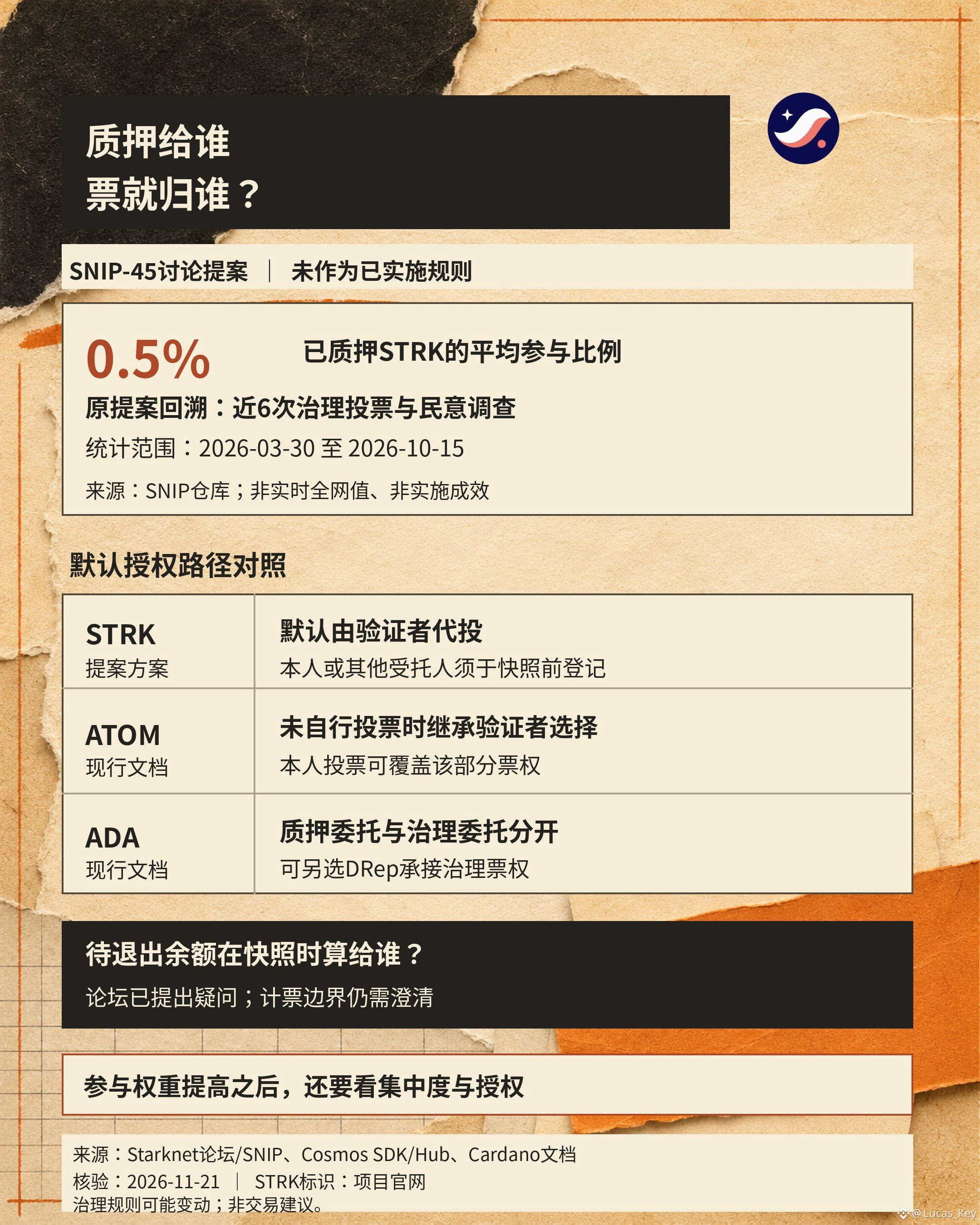
You delegate $STRK to validators to earn staking rewards. Would you also let them vote on governance proposals for you by default? SNIP-45 aims to link these two forms of trust. The latest question raised on the Starknet forum is: will balances that have requested unstaking but are still in the waiting period still count toward a validator at snapshot time? This isn’t a minor interface detail; it determines who can represent whom.
There are solid reasons to support default proxy voting. The proposal looks back at the six most recent governance votes and polls (March 30 to October 15, 2026), and says that, on average, only 0.5% of staked STRK participated. Letting validators who have voted cast default votes could reduce the representation gap caused by silence; delegators can also register a preference to vote themselves or use another address. This changes how voting power is assigned; it does not change the staking contract, rewards, or unstaking window.
But concerns can’t be brushed aside with “it only takes one transaction to change it.” Large validators could end up with more concentrated voting power, and registered preferences are effective only if set before the snapshot for the current proposal. Miss the snapshot, and a later change won’t affect that round. The proposal repository also explicitly acknowledges the concentration risk; the forum has asked for clarification on how balances pending unstaking are counted.
For comparison, $ATOM : Cosmos Hub documentation says that if you don’t vote yourself, your validator’s choice is inherited, but your own vote overrides it. $ADA separates staking delegation for block production from governance delegation, allowing holders to choose a DRep separately. These three models differ in their default authorization—not in whose token is a better buy: node operations, governance judgment, and holder consent don’t necessarily align.
What I care about most is whether a publicly auditable voting-power ledger, snapshot rules, and the treatment of unstaking balances will be made available before launch. If participation increases but becomes more concentrated among a few operators, it will still need to be explained why this trade-off is worthwhile. SNIP-45 is currently a discussion proposal; the historical statistics should not be treated as evidence of implementation results.
Sources: Starknet forum and SNIP repository, Cosmos SDK/Hub, and official Cardano documentation; verified on 2026-11-21. Governance rules may change; this is not trading advice. This post may receive platform creator rewards.