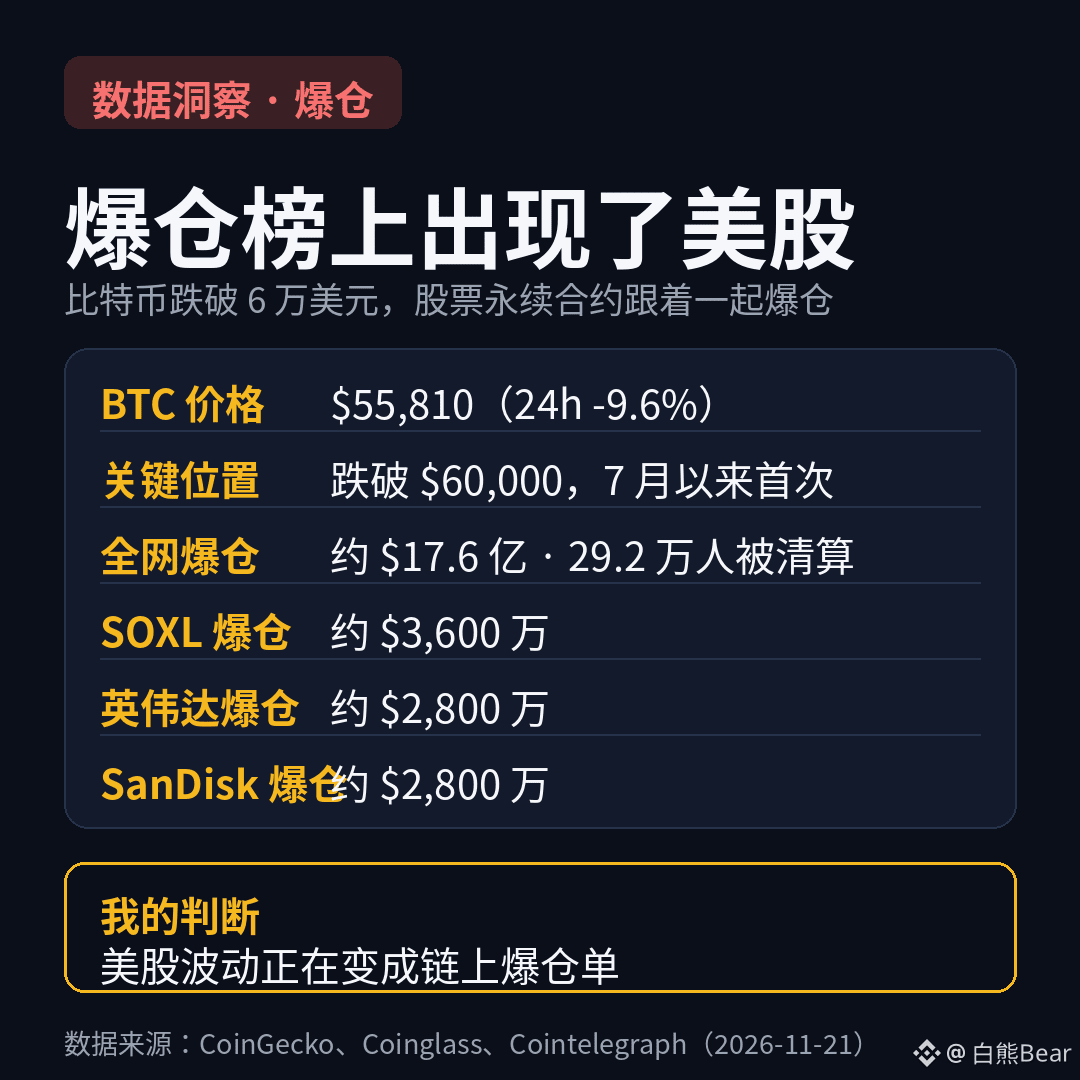
Someone who had never bought a single share of Nvidia got their Nvidia position liquidated in the crypto market.
Bitcoin fell to $55,810, down 9.6% in 24 hours. The $60,000 level was lost for the first time since July. Ethereum fell 10.9% to $1,544, and BNB dropped 10.4% to $511. Almost nothing in the market was left standing. About $1.76 billion in positions were liquidated across the market in 24 hours, wiping out more than 290,000 traders.
What’s truly unusual isn’t the figure—it’s the names on the liquidation leaderboard. Coinglass’s rankings show about $36 million in SOXL liquidations, around $28 million in Nvidia, and around $28 million in SanDisk. SOXL alone saw nearly twice the liquidations of XRP. These traders hadn’t touched U.S. stocks; they were betting on chip stocks with perpetual futures on platforms like Hyperliquid, where leverage can reach as high as 200x.
This is what I think we need to keep an eye on: leverage in the crypto market has long since expanded beyond coins. When U.S. stocks fall, Nasdaq volatility directly turns into on-chain liquidations, which in turn drive down crypto prices. The two markets feed into each other. When people used to talk about crypto and U.S. stocks moving together, they meant sentiment. Now the same positions and the same leverage are being liquidated on both sides at once.
Bitcoin ETFs are bleeding too: on November 20, they saw $45.7 million in net outflows in a single day, bringing the seven-day total to $1.64 billion. Wintermute previously said it would change its bearish stance only if Bitcoin climbed back above $68,000 and ETFs returned to net inflows. At current prices, Bitcoin is still more than $10,000 short of that level.
There are two things I’ll be watching next: whether chip stocks can stabilize after the U.S. market opens, and whether Bitcoin can reclaim $60,000. If it can’t, the cascade of selling triggered by liquidations isn’t over yet.
What do you think—is this kind of stock perpetual futures trading bringing fresh liquidity into crypto, or planting an even bigger landmine?
$BTC $ETH #爆仓 #PerpetualFutures