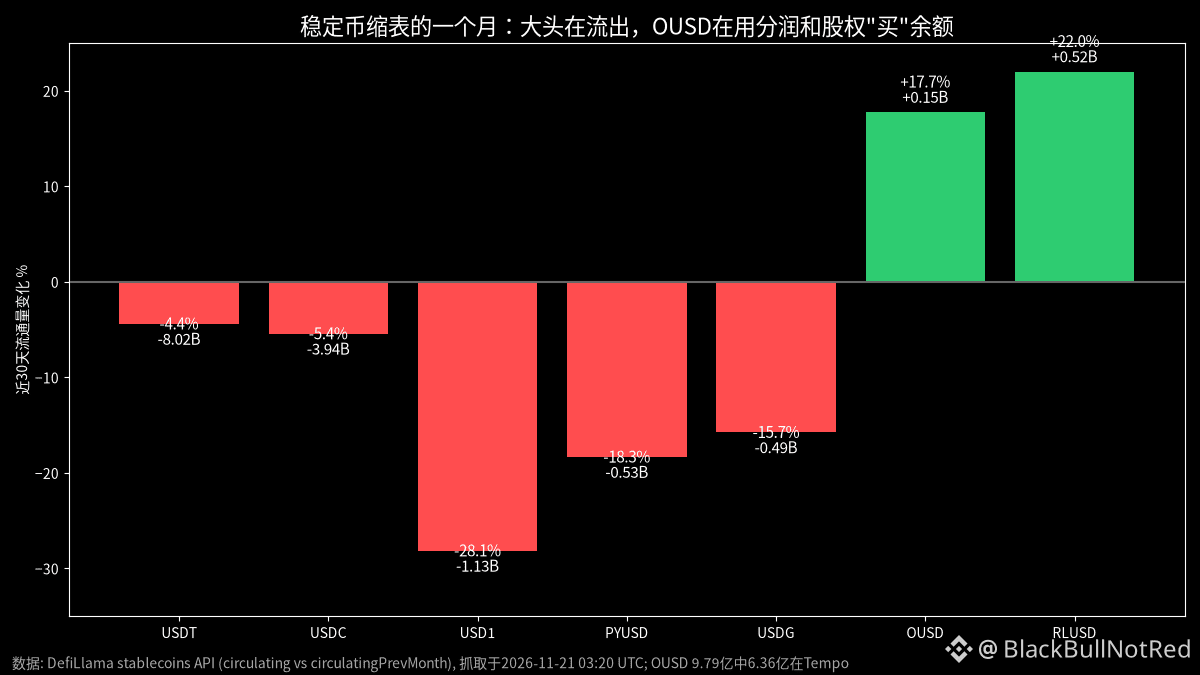
AMINA Bank’s integration of OUSD was framed as “traditional finance embracing a new stablecoin.” What I’d rather talk about is where OUSD’s growth is coming from.
First, the broader picture. DefiLlama’s circulating supply figures for the past 30 days: USDT is down $8.02 billion, USDC down $3.94 billion, USD1 down 28%, PYUSD down 18%, and USDG down 16%. The stablecoin market as a whole is contracting, with redemptions far outpacing minting.
Only two are growing against the trend: RLUSD, up $520 million; and OUSD, up $147 million to $979 million, a monthly increase of 17.7%.
OUSD’s model is the exact opposite of USDT’s and USDC’s. Tether and Circle keep the interest earned on their reserves for themselves. OUSD distributes that interest to partners that “generate balances and activity,” while Open Standard takes only a small management fee (according to documents reviewed by CoinDesk: 0.1 basis points per payment, capped at one cent per transaction). There’s also an equity earn-in pool: equity is allocated each month based on how much OUSD a partner holds and moves. The threshold is $50 million, with a maximum of 5% for any single partner.
In other words, it uses reserve interest and company equity to buy balances. The idea is exactly like DeFi’s token incentives to buy TVL back in the day, except the incentives are now Treasury yields and equity in a company partly owned by Visa, Mastercard, Stripe, Coinbase, and Shopify.
So it’s worth looking at where those balances are. Of OUSD’s $979 million, $636 million—about 65%—is sitting on Tempo, a chain incubated by Stripe. OUSD issuer Bridge is also part of Stripe. Most of the balances are within the founding company’s own ecosystem, so it’s hard to say how much “independent demand” there really is.
The most intriguing case is Coinbase. It’s already the biggest distribution channel for USDC and receives a share of Circle’s reserve income. Now it’s also a founding shareholder of OUSD. For Coinbase, this isn’t about picking sides; it’s leverage in negotiations. Whichever side offers a bigger cut gets the balances. Circle’s $3.9 billion decline this month is partly the price of that bargaining power.
Whether OUSD can grow isn’t about which banks announce support. It’s about whether balances stick around after the earn-in pool has been distributed. Balances brought in by incentives can leave just as quickly when the incentives stop.
#稳定币 #OUSD