
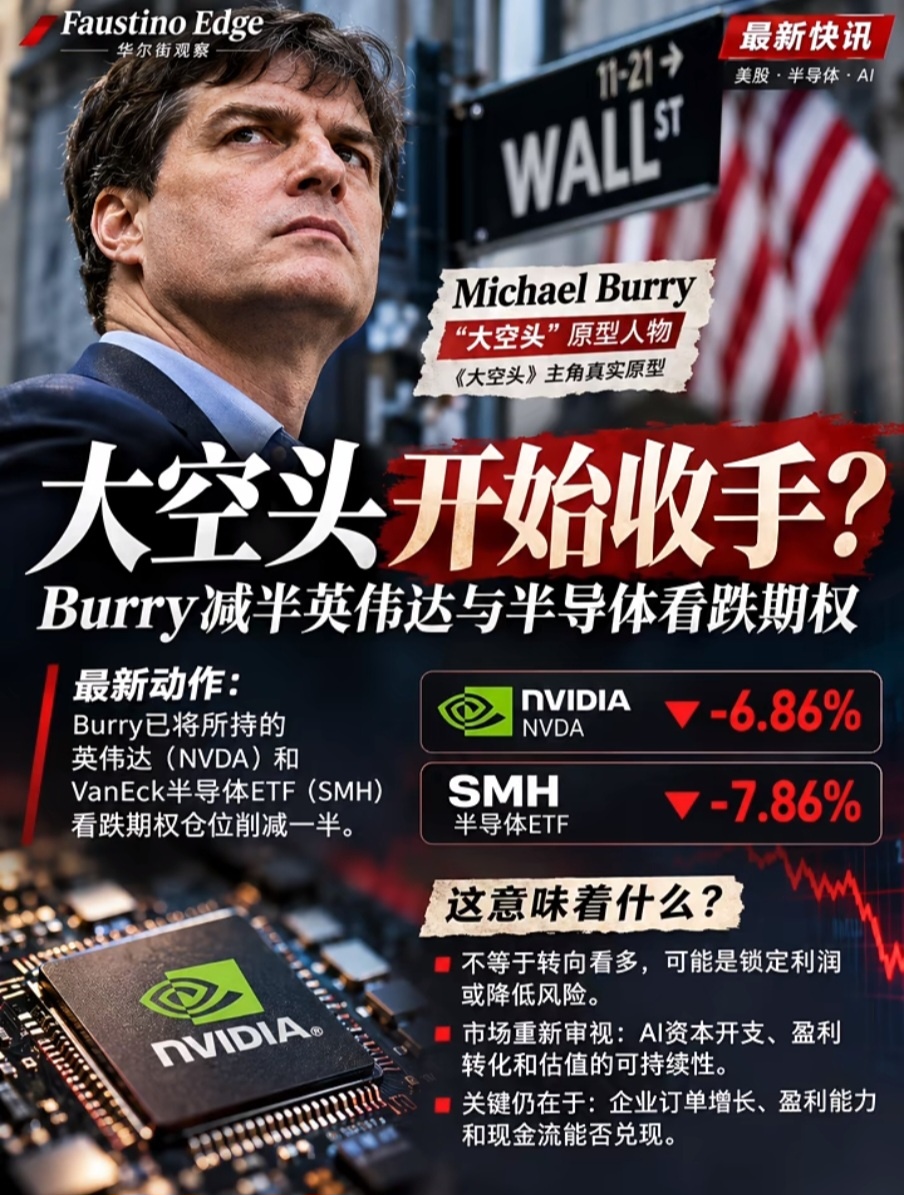
According to the latest news from Futu, Burry said he had cut his put options position in the VanEck Semiconductor ETF (SMH) by half, while also selling
half of his Nvidia (NVDA) put options.
The news comes as the semiconductor sector is experiencing a significant sell-off. Nvidia is down 6.86%, and SMH is down 7.86%.
What does this position reduction mean?
Reducing put options doesn't necessarily mean turning bullish. Burry may have chosen to trim his positions to lock in profits or reduce his risk exposure.
Based on this news alone, it's impossible to determine his true motives or remaining positions.
Over the past few years, the investment thesis for AI has revolved around demand for computing power, chip supply, and data center expansion.
Today, the market is starting to reconsider three questions:
①Can AI capital expenditure continue to translate into actual profits?
②Can chip companies’ high growth rates support their current valuations?
③If tech giants slow their investments, how much pressure will the semiconductor supply chain face?
Burry’s moves are worth watching, but they shouldn’t be taken as the answer to where the market is headed.
What will really determine the medium- to long-term trajectory of Nvidia and the semiconductor sector is still order growth, profitability, cash flow, and valuation. A short-term decline doesn’t mean the AI investment thesis has failed; likewise, a falling share price doesn’t mean a stock has become cheap.
What the market needs now isn’t more optimistic forecasts, but results that can be delivered.
#全球股市创三年来最长连跌,投资者避险情绪升温 #比特币跌破6万美元,短期能否企稳反弹? $NVDAB