


🌙 Uncle’s Weekly Report|11.16–11.20
The key takeaway: Nvidia’s earnings beat expectations, yet its stock plunged about 23% in a single week; Anthropic made a record-breaking market debut, only to briefly fall back near its offering price on the second trading day. AI orders and revenues are still growing, but the market is beginning to ask: How much capital do these gains require, how complex is the financing structure, and how much cash flow will ultimately remain?
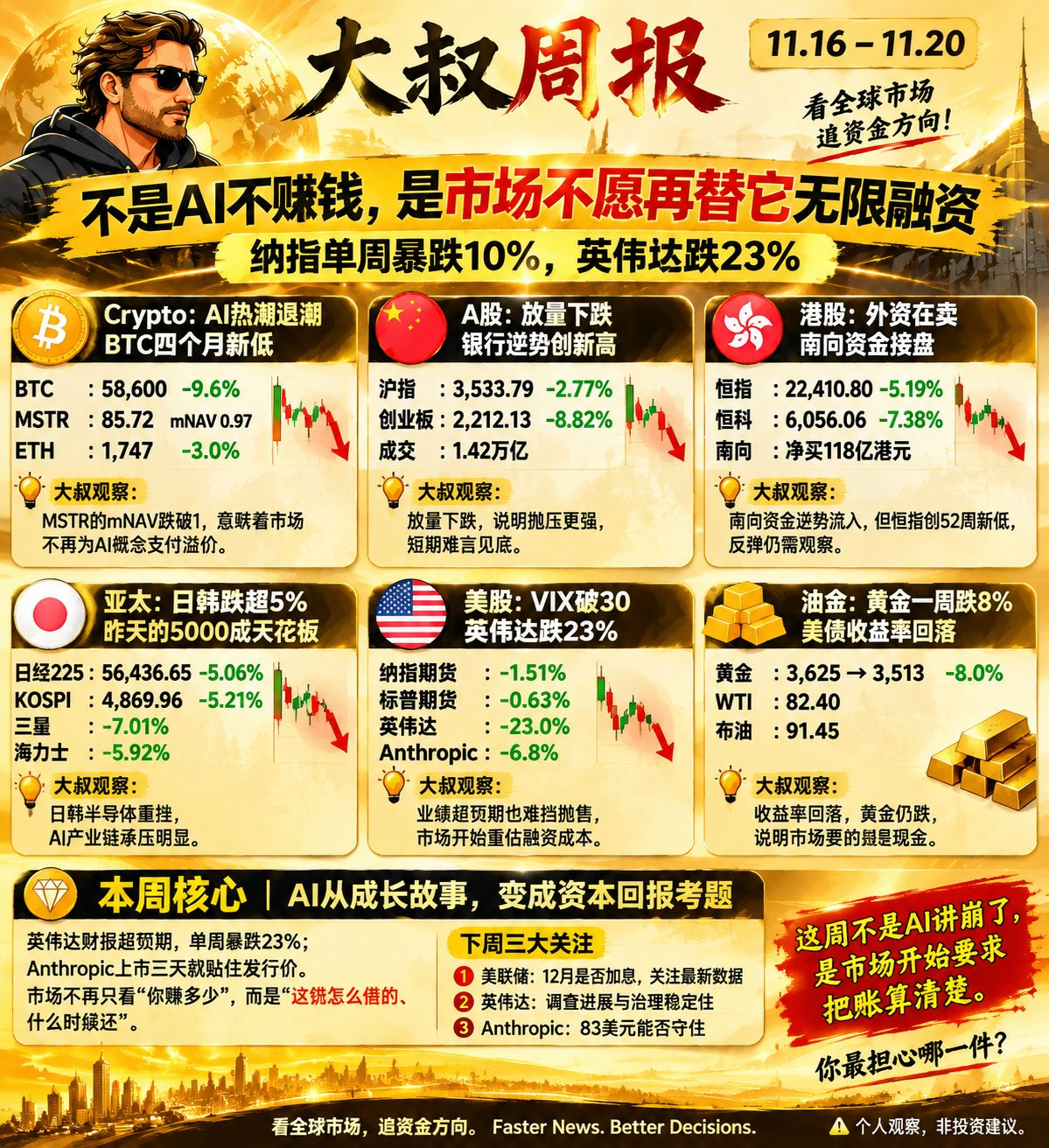
▍Weekly Report Card|AI assets face a broad revaluation
Nasdaq: Fell about 10% for the week, marking one of its worst weekly performances since 2020.
Philadelphia Semiconductor Index: Fell 17.1% for the week, its worst weekly performance since 2001.
Nvidia: Fell about 23% in a single week, its biggest weekly drop since 2008.
A-shares: The Shanghai Composite fell 2.77% for the week; the STAR 50 Index fell 11.03%, with technology and growth stocks under particular pressure.
Hong Kong stocks: The Hang Seng Index fell 5.19% for the week, touching the area of its 52-week lows intraday on November 20.
Bitcoin: Closed at around $58,799 on November 20. Based on the November 16 closing price, it fell about 9.3% over four trading days, reaching an intraday low of around $57,709.
Gold: Fell about 8.5% this week.
This isn’t a problem with any single stock. AI supply chains, technology stocks, and high-volatility assets are all facing valuation pressure at the same time.
▍What happened this week | Three pillars weakened at once
① Financing structures are coming under closer scrutiny
The minutes of the Federal Reserve’s October meeting, for the first time, raised debt risks tied to AI infrastructure buildout in discussions of financial stability.
The minutes noted that AI companies’ off-balance-sheet lease commitments and circular financing arrangements between related companies could magnify losses if investment returns fall short of expectations.
At the same time, two officials argued for a 25-basis-point rate hike at the October meeting.
What really matters here isn’t that the market has decided there will be a rate hike in December. It’s that the Fed is starting to ask how the massive capital spending on AI infrastructure is being financed, and whose balance sheets will ultimately bear the risk.
Uncle’s take: In the past, the market focused on AI orders, revenue, and growth rates. Now it’s looking at debt, leases, financing terms, and cash flow. Growth still matters, but how that growth is financed is starting to shape valuations too.
② Investors are no longer chasing every new AI story without question
Anthropic closed at $97.17 on its first day of trading, up 17.1% from its $83 offering price. But during the second trading day, it briefly fell close to its offering price.
The company ultimately raised about $119.5 billion through its IPO and concurrent private placement, making it a financing deal of historic proportions.
But it would be wrong to say this financing directly pulled $119.5 billion out of the secondary market. What’s really worth watching is that when market risk appetite drops sharply, even a newly listed, highly sought-after AI company can’t escape the fallout.
Uncle’s take: The first-day IPO gain shows that investors are still willing to pay a premium for the AI story. The sharp pullback the next day shows that enthusiasm isn’t firmly rooted. Investors are starting to distinguish between “AI companies worth investing in” and “any AI asset worth chasing.”
③ Nvidia’s results weren’t bad, but the market is starting to worry about corporate governance and trust
Nvidia reported third-quarter revenue of $115.8 billion, up 103% year over year. Data center revenue was $107.6 billion, up 110%. Both its results and revenue guidance for the next quarter exceeded market expectations.
But its share price fell about 23% in a single week.
Meanwhile, Jensen Huang has stepped down as CEO, with CFO Colette Kress taking over as interim CEO. The U.S. SEC is investigating potential accounting issues at Nvidia, but the investigation has not yet established that the company violated any rules.
Uncle’s take: This was the week’s most striking contrast: the income statement remains strong, yet the stock has been repriced. The market is worried not only about how much the company can earn next quarter, but also about whether management can remain stable, whether revenue quality can withstand scrutiny, and whether massive AI investments can ultimately generate sustainable cash flow.
▍Key anomaly | Money is providing a floor, but risk appetite hasn’t returned
A-shares: The Shanghai Composite fell 2.77% for the week, while the STAR 50 Index fell 11.03%. Large-cap blue chips and technology growth stocks diverged sharply. Support for the index hasn’t eliminated risks in individual stocks.
Hong Kong stocks: Southbound funds made net purchases of about RMB 11.8 billion on November 20, but the Hang Seng Index still fell 5.19% for the week, touching the area of its 52-week lows intraday. Buying support and the index trend are not the same thing.
Crypto: BTC fell to around $58,000, while MSTR’s mNAV dropped to about 0.97x, leaving its common stock trading at a discount to its net BTC value. The premium-driven flywheel of the past is losing its appeal.
Gold: Fell about 8.5% this week. Meanwhile, U.S. Treasury yields fell around 21 basis points over the week. Lower interest rates didn’t stop gold from falling, suggesting this bout of pressure on gold prices can’t be explained by rates alone. A stronger dollar, position adjustments, and demand for liquidity are all playing a part.
💎 Uncle’s view | AI is shifting from a growth story to a test of returns on capital
This week, the market did one thing:
It repriced AI from a growth story where “only growth matters” into a capital-intensive project where “returns on capital must be calculated.”
For growth stocks, investors look at revenue and earnings growth. For capital-intensive projects, they also have to consider investment scale, financing structure, depreciation, cash flow, and payback periods.
Nvidia’s revenue grew 103%, yet its stock fell 23% in a single week. It’s not that the market suddenly stopped believing in demand for AI; it’s that investors are starting to ask: With so much money being invested across the supply chain, how much will ultimately turn into real profits and free cash flow?
Support from A-share blue chips and southbound buying in Hong Kong stocks both show that some investors are still willing to step in. But buying support can soften the pace of a decline without necessarily changing the market’s direction.
A true bottom isn’t about how much money buys in on a given day. It’s when the market becomes willing to take on risk again after selling pressure eases.
Three things to watch closely next week
Federal Reserve: Inflation and employment data ahead of the December meeting will shape how expectations for further rate hikes evolve.
Nvidia: Watch developments in the SEC investigation, the interim CEO transition, and governance stability. Focus on the facts of the investigation; don’t assume wrongdoing in advance.
Anthropic: Can it stabilize near its $83 offering price? Watch how well the market absorbs the valuation of a newly listed AI company.
This week wasn’t about the AI story falling apart; it was about the market starting to demand that AI show its workings.
Which worries you most next week: financing costs continuing to rise, or AI capital expenditures ultimately failing to deliver returns?
Follow global markets. Track the flow of money. Faster News. Better Decisions.
Personal observations, not investment advice.
#UnclesWeekly #AI #Nvidia #AShares #HongKongStocks #BTC