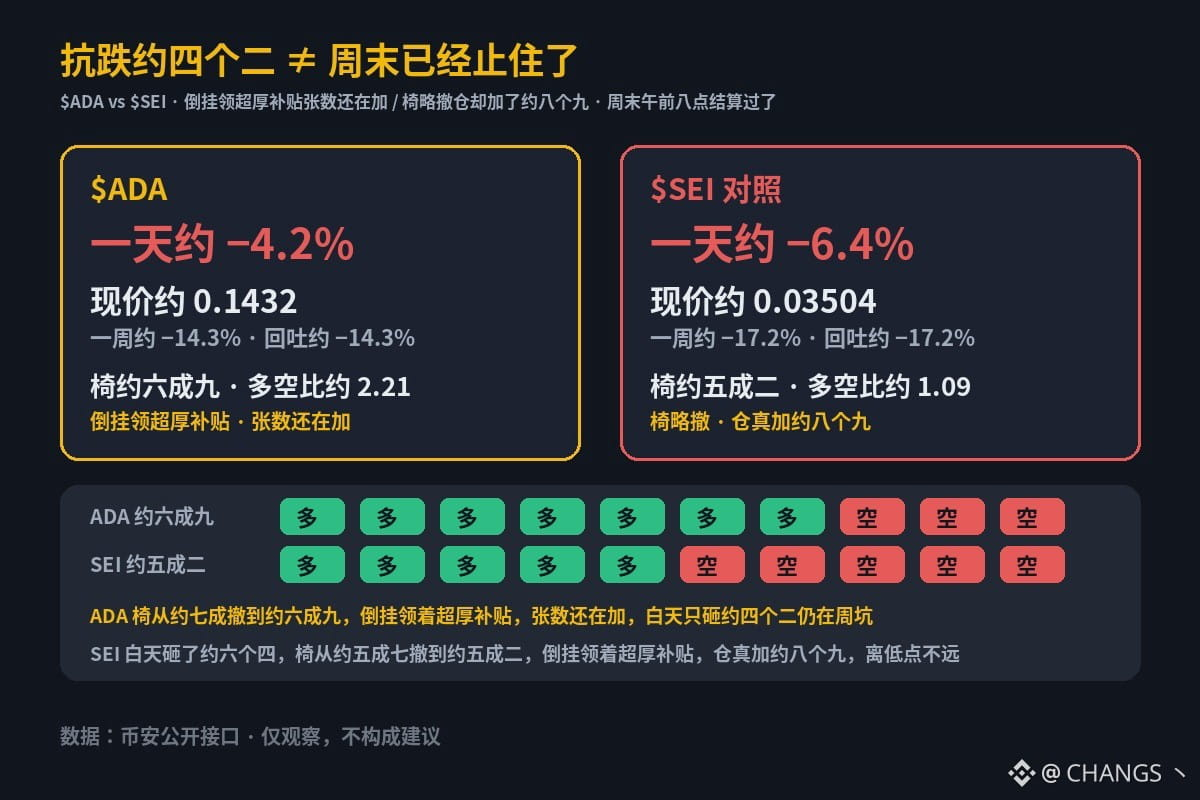
By late Saturday morning, the 8 a.m. funding payment had already passed. Some people are taking Cardano being down only about 4.2% during the day and holding up better than many assets as proof that the weekend selloff has stopped—and that its resilience means the risk in this move has been fully priced in. The numbers say otherwise: on one side, longs have eased from about 70% to about 69%, while the deeply inverted funding rate is paying an unusually hefty subsidy, and the number of contracts is still rising; it’s still in the weekly trough. On the other side, longs have eased from about 57% to about 52%, and funding is also deeply inverted and paying an unusually hefty subsidy, yet open interest has genuinely risen by about 8.9%; price is still near the intraday low and in the weekly trough.
$ADA: down about 4.2% over one day / about 14.3% over one week, currently around 0.1432. Weekly high: about 0.1671; pullback: about 14.3%. Account long/short ratio: about 2.21 (about 69% long; around a day ago it was about 2.37 / 70%, so longs are trimming). Funding is inverted at about −0.0335%/8h, paying a subsidy far beyond the usual upper limit. OI contract count over the past day: about +4.8% (about +0.4% in USD-margined terms, meaning positions are genuinely being added). Price has slid from the intraday high of about 0.1506 and is not far from the intraday low of about 0.1378; it’s still in the weekly trough. Longs have eased from about 70% to about 69%, funding is inverted and paying an unusually hefty subsidy, and the contract count is still rising—so don’t take ADA at 0.1432 being down only about 4.2% on the day and holding up better than many assets as proof that the weekend selloff has stopped. And definitely don’t take longs easing slightly and the 8 a.m. settlement passing as proof that the risk in this move has been fully priced in.
Meanwhile, $SEI is down about 6.4% over one day and about 17.2% over one week, currently around 0.03504. Weekly high: about 0.0423; pullback: about 17.2%. Longs are about 52% (long/short ratio about 1.09; around a day ago it was about 1.34 / 57%, so longs are trimming). Funding is inverted at about −0.0194%/8h, paying a subsidy far beyond the usual upper limit. OI contract count over the past day: about +8.9% (about +2.0% in USD-margined terms, meaning positions are genuinely being added). Price has slid from the intraday high of about 0.0378 and is not far from the intraday low of about 0.03416; it’s still in the weekly trough. Longs have eased from about 57% to about 52%, funding is inverted and paying an unusually hefty subsidy, yet open interest has genuinely risen by about 8.9%.
On one side, longs have eased from about 70% to about 69%, funding is inverted and paying an unusually hefty subsidy, the contract count is still rising, and price is still in the weekly trough; on the other, longs have eased from about 57% to about 52%, funding is also inverted and paying an unusually hefty subsidy, open interest has genuinely risen by about 8.9%, and price is still near the intraday low and in the weekly trough. Does this mean that because the daytime drop was only about 4.2% and the 8 a.m. settlement has passed, the weekend selloff has stopped and the risk in this move has been fully priced in? Or are longs simply still pinned at about 69% on one side and collecting an unusually hefty subsidy as contract counts rise, while on the other side longs have eased a little but open interest is rising even faster—and price hasn’t climbed out of the trough yet? Post counterexamples in the comments.
$ADA: down about 4.2% over one day / about 14.3% over one week, currently around 0.1432. Weekly high: about 0.1671; pullback: about 14.3%. Account long/short ratio: about 2.21 (about 69% long; around a day ago it was about 2.37 / 70%, so longs are trimming). Funding is inverted at about −0.0335%/8h, paying a subsidy far beyond the usual upper limit. OI contract count over the past day: about +4.8% (about +0.4% in USD-margined terms, meaning positions are genuinely being added). Price has slid from the intraday high of about 0.1506 and is not far from the intraday low of about 0.1378; it’s still in the weekly trough. Longs have eased from about 70% to about 69%, funding is inverted and paying an unusually hefty subsidy, and the contract count is still rising—so don’t take ADA at 0.1432 being down only about 4.2% on the day and holding up better than many assets as proof that the weekend selloff has stopped. And definitely don’t take longs easing slightly and the 8 a.m. settlement passing as proof that the risk in this move has been fully priced in.
Meanwhile, $SEI is down about 6.4% over one day and about 17.2% over one week, currently around 0.03504. Weekly high: about 0.0423; pullback: about 17.2%. Longs are about 52% (long/short ratio about 1.09; around a day ago it was about 1.34 / 57%, so longs are trimming). Funding is inverted at about −0.0194%/8h, paying a subsidy far beyond the usual upper limit. OI contract count over the past day: about +8.9% (about +2.0% in USD-margined terms, meaning positions are genuinely being added). Price has slid from the intraday high of about 0.0378 and is not far from the intraday low of about 0.03416; it’s still in the weekly trough. Longs have eased from about 57% to about 52%, funding is inverted and paying an unusually hefty subsidy, yet open interest has genuinely risen by about 8.9%.
On one side, longs have eased from about 70% to about 69%, funding is inverted and paying an unusually hefty subsidy, the contract count is still rising, and price is still in the weekly trough; on the other, longs have eased from about 57% to about 52%, funding is also inverted and paying an unusually hefty subsidy, open interest has genuinely risen by about 8.9%, and price is still near the intraday low and in the weekly trough. Does this mean that because the daytime drop was only about 4.2% and the 8 a.m. settlement has passed, the weekend selloff has stopped and the risk in this move has been fully priced in? Or are longs simply still pinned at about 69% on one side and collecting an unusually hefty subsidy as contract counts rise, while on the other side longs have eased a little but open interest is rising even faster—and price hasn’t climbed out of the trough yet? Post counterexamples in the comments.