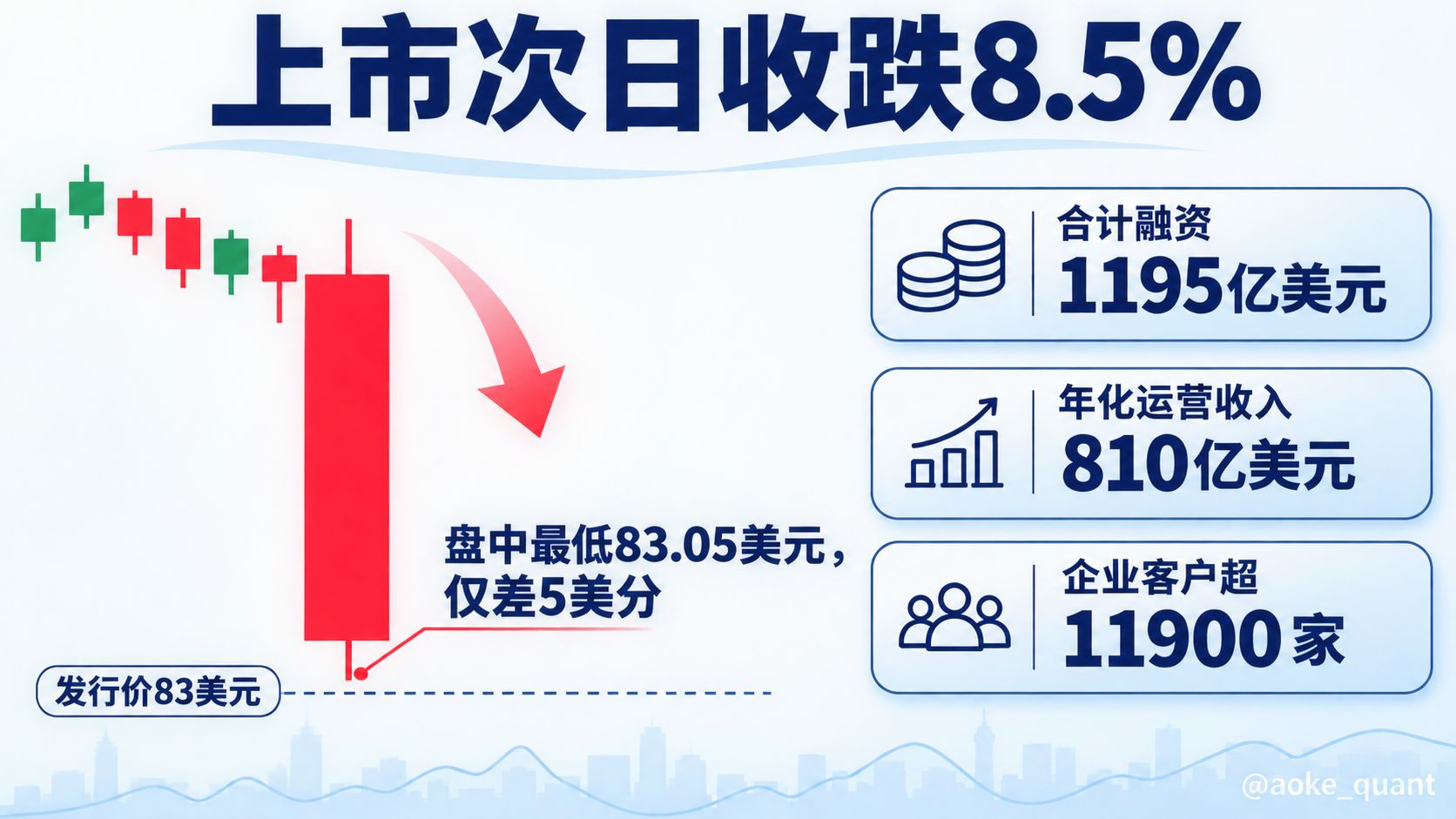
Anthropic shares fell 8.5% on the second day after its IPO, trading as little as 5 cents above the offering price
As the first developer of a frontier AI model to go public in the U.S., Anthropic’s listing was a historic event. The stock’s performance on the second trading day provided its first real test. The key facts: shares fell as much as 15% to $83.05, just 5 cents above the $83 offering price, before rebounding slightly to close down 8.5%—erasing nearly all of the first day’s gains. On that first day, the stock briefly pushed the company’s market capitalization above Amazon’s. On the same day, the underwriting banks exercised their over-allotment option (the greenshoe), further increasing the supply of shares and bringing total proceeds from the IPO and concurrent private placement to $119.5 billion, surpassing the $86.6 billion record set by SpaceX in June this year. At the macro level, a wave of selling spread from Asia to the U.S. The Nasdaq 100 fell 1.5%, the S&P 500 dropped 0.5%, and the VIX surged above 29—well beyond the level at which companies typically consider the market receptive to IPOs.
In parsing the dynamics, Emmanuel Valavanis of Forte Securities characterized the situation as a “buyers’ strike” against Anthropic and the broader AI and technology trade. Many clients failed to receive IPO allocations and, with neither positions to protect nor index-tracking pressures, preferred to wait on the sidelines for longer-term price discovery. This highlights the vulnerability of first-day IPO premiums: when core buyers have already secured shares at the offering price and the secondary market lacks fresh inflows, the stock is almost inevitably under pressure. Fundamentals offer some support, however. As of October 31, the company had an annualized operating revenue run rate of $81 billion, up $10 billion from the end of September. The number of business customers generating more than $100,000 in annual revenue grew from about 1,500 at the start of 2025 to over 11,900; users of its coding agent, Claude Code, even include NASA engineers. Olivier David, a fund manager at Vega IS, said his team would consider buying shares on the open market if the price approached or even fell below the offering price. Raphael Thuin, head of investment strategies at Tikehau Capital, said he would prefer to wait for post-IPO volatility to subside before considering an investment.
The following analysis of potential effects on crypto markets is a logical projection, not a description of events that have already occurred. First, the listing is effectively a direct test of whether investors can put a value on the underlying technology of AI itself. If weakness persists, it could reduce investors’ tolerance for highly valued growth assets. Crypto risk appetite has long been linked to technology stocks, and sell-offs in tech typically show up first as heightened volatility in crypto markets. Second, sentiment around AI-related tokens often follows the performance of leading AI stocks, so enthusiasm for the sector’s narrative could cool. Third, a VIX above 29 signals a high-volatility environment. When more capital stays on the sidelines, tighter liquidity in crypto markets is a common knock-on effect.
Editorial view: A near-break below the offering price in a single day does not mean the IPO was mispriced. The greenshoe-driven increase in supply, macro-driven selling, and the composition of the buyer base were the main drags, while revenue and business-customer figures continue to grow rapidly. Key things to watch are whether institutions step in around the offering price and whether volatility subsides. This pricing process could also affect the timing of a future OpenAI listing. Crypto market participants should distinguish sentiment spillovers from substantive effects and avoid mapping a single stock-price event directly onto a price call for crypto assets.
#AnthropicSharesFallSharplyOnSecondDay,StockNearIPOPrice #BTC #ETH #BNB