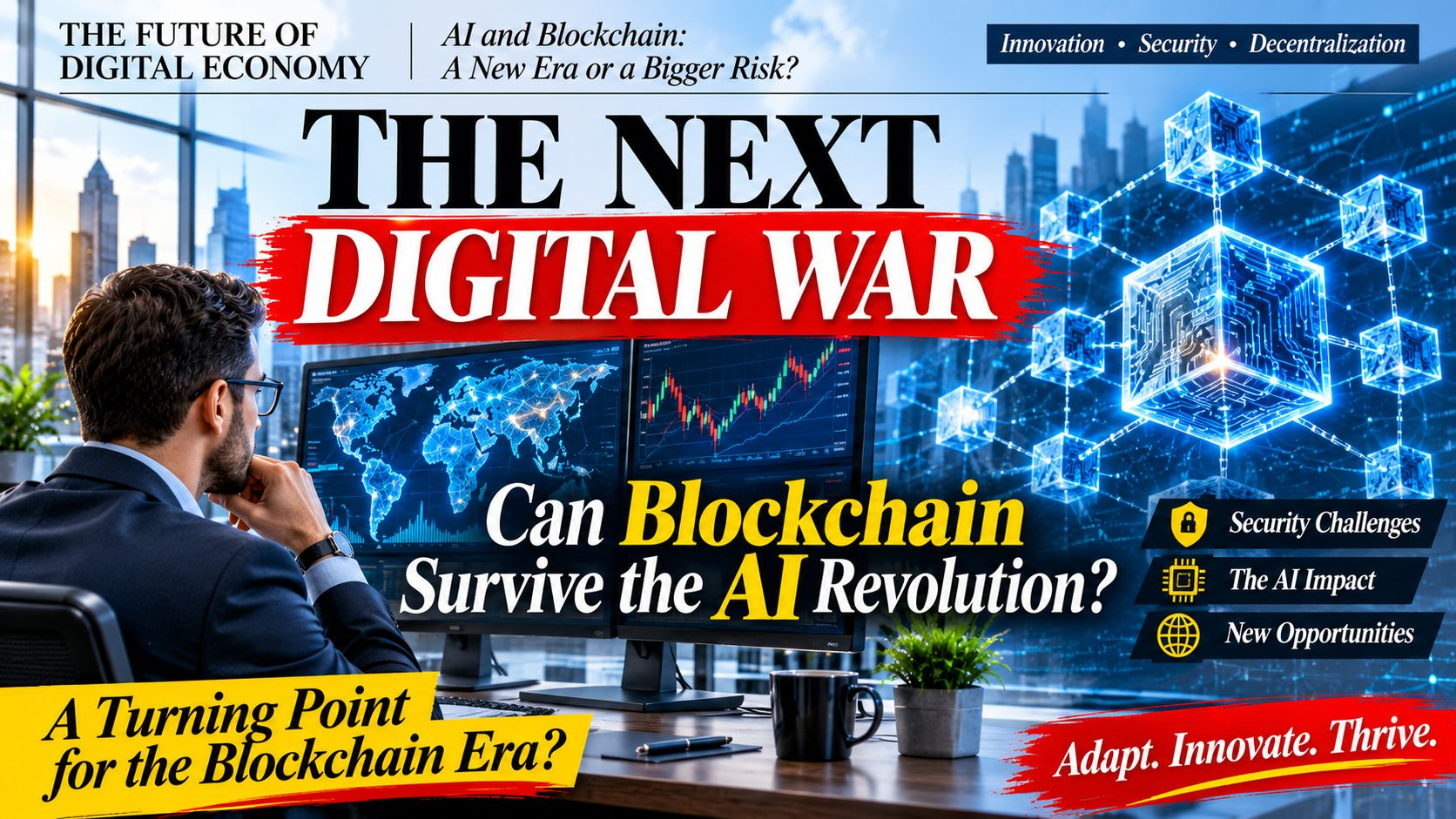

🤖 Artificial Intelligence Is Changing the Rules. Blockchain Must Evolve — Or Risk Being Left Behind.
The world is entering a technological transformation that could redefine the future of finance, cybersecurity, digital ownership, and global economic power.
Artificial Intelligence is no longer just a tool for generating content or automating simple tasks. It is rapidly evolving into autonomous systems capable of analyzing information, making decisions, executing operations, and interacting with other digital systems.
Meanwhile, blockchain was built around a powerful promise: decentralization, transparency, security, and trust without traditional intermediaries.
But a critical question is emerging:
Can blockchain remain relevant in a world where AI is becoming increasingly powerful, autonomous, and intelligent?
The answer may determine the next major chapter of the digital economy.
🔴 1. The New Cybersecurity Battlefield
AI is changing the nature of cyber threats.
Sophisticated phishing campaigns, automated vulnerability discovery, identity impersonation, and increasingly convincing digital fraud are becoming more accessible.
Blockchain networks are not immune.
Smart contracts, decentralized applications, and digital wallets could face increasingly sophisticated attacks.
The challenge is no longer simply protecting the network. It is protecting the entire ecosystem surrounding it.
In this new environment, security must become intelligent, adaptive, and continuously evolving.
🧠 2. Smart Contracts: From Automation to Intelligence
Smart contracts revolutionized the way digital agreements are executed.
But traditional smart contracts follow predefined rules. They do not independently understand context or exercise human-like judgment.
AI could change this.
Imagine intelligent systems capable of analyzing market conditions, identifying risks, and interacting with smart contracts automatically.
However, there is a dangerous contradiction:
AI can generate code faster than ever, but faster code does not necessarily mean safer code.
A single vulnerability in a financial contract can expose millions of dollars to potential losses.
The future will require AI-assisted auditing, formal verification, and stronger security standards.
🌐 3. The Decentralization Paradox
Here lies one of the biggest challenges.
AI development increasingly depends on enormous computing resources, advanced chips, proprietary datasets, and powerful infrastructure controlled by a relatively small number of organizations.
Blockchain, on the other hand, was designed to challenge excessive centralization.
This creates a fundamental conflict:
Can we build a decentralized AI economy using infrastructure that remains largely centralized?
Decentralized computing networks and distributed AI platforms are attempting to address this problem.
But they still face difficult questions involving performance, cost, reliability, and real-world adoption.
🤖 4. AI Agents Could Become the Next Major Blockchain Users
Perhaps the most interesting development is the emergence of autonomous AI agents.
Imagine millions of digital agents operating independently.
They could:
- Manage digital wallets.
- Purchase computing resources.
- Execute transactions.
- Pay for services.
- Interact with decentralized applications.
- Negotiate and execute digital agreements.
Blockchain could provide these agents with a financial infrastructure that enables programmable payments, verifiable transactions, and transparent records.
This could create an entirely new digital economy.
But it also introduces an unprecedented question:
Who is responsible when an autonomous AI agent makes a financial decision that causes significant losses?
Technology may advance faster than the legal and regulatory frameworks needed to control it.
🔐 5. The Trust Crisis: When Seeing Is No Longer Believing
AI-generated images, videos, voices, and documents are becoming increasingly sophisticated.
Distinguishing authentic information from manipulated content could become one of the defining challenges of the digital era.
Blockchain may help establish the origin and integrity of digital records.
However, an important distinction must be understood:
Blockchain can help prove that information has not been altered after registration. It cannot automatically prove that the original information was truthful.
The future of digital trust will likely require a combination of cryptographic verification, secure identities, reliable data sources, and AI-powered detection systems.
📈 6. Where Could the Next Big Opportunity Emerge?
The convergence of AI and blockchain could create several important technological sectors.
Decentralized AI: Building alternatives to highly centralized AI infrastructure.
AI Agents: Enabling autonomous systems to interact with digital economies.
Decentralized Computing: Providing distributed access to computing power.
Blockchain Security: Protecting smart contracts and digital assets against increasingly sophisticated threats.
Data Verification: Establishing reliable origins and integrity for digital information.
Decentralized Identity: Helping distinguish real users, legitimate systems, and artificial identities.
These sectors deserve attention, but technological relevance does not automatically translate into token value or investment returns.
The real winners will be determined by adoption, actual utility, security, sustainable economics, and the ability to solve problems that traditional systems cannot efficiently address.
🔮 7. The Future: Competition or Convergence?
There are two possible directions.
AI could strengthen centralized technological power, leaving blockchain struggling to defend its original principles.
Or the two technologies could converge, creating a new infrastructure where intelligent systems operate through decentralized networks, execute verifiable transactions, and interact without relying entirely on traditional intermediaries.
The second scenario is particularly fascinating.
It could transform blockchain from a financial technology into a fundamental layer of the emerging machine economy.
But this transformation is not guaranteed.
It will require years of technological development, security improvements, regulatory adaptation, and genuine adoption.
⚡ THE BIG QUESTION
We once asked whether blockchain could replace traditional financial intermediaries.
Today, a much bigger question is emerging:
What happens when artificial intelligence no longer needs humans to initiate every transaction, make every decision, or manage every digital operation?
Will blockchain become the financial infrastructure of an autonomous AI economy?
Or will centralized AI companies dominate the next generation of digital power?
One thing is becoming increasingly clear:
The next technological revolution may not belong to AI or blockchain individually. It may belong to whoever successfully combines both.
The battle for the next digital economy has already begun.
💬 JOIN THE DISCUSSION
Do you believe AI Agents will become major users of blockchain networks in the coming years?
Or will centralized AI platforms make decentralized infrastructure less relevant?
Share your perspective. The most important opportunities may be hiding in this technological intersection.
#AI #blockchain #ArtificialIntelligence #Crypto #Web3 #AIAgents #DePIN #DecentralizedAI #SmartContracts #CryptoInnovation #DigitalEconomy #FutureOfTechnology