$BTC $ETH $ZEC
Nvidia plunged 14% overnight, while Bitcoin fell only 4.3%—this time, AI wasn’t the one bleeding.
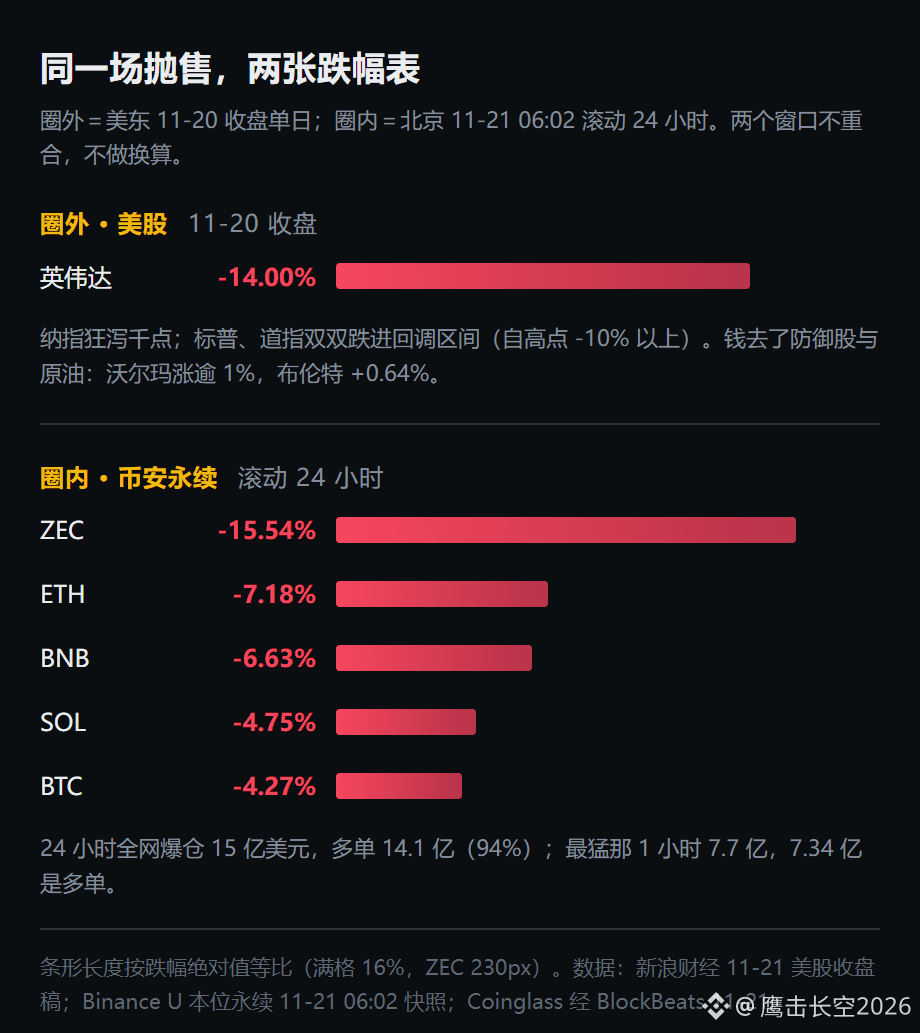
【Outside crypto | U.S. Eastern Time, Nov. 20 close】The Nasdaq plunged more than 1,000 points, Nvidia dropped 14% in a single day, and both the S&P 500 and Dow Jones fell into correction territory. The 10-year Treasury yield slipped back to around 4.95%—driven by buying, not easing inflation. Oil, meanwhile, rose: Brent December futures settled at $92.57 (+0.64%), and WTI at $83.98 (+0.93%), with the Middle East keeping pressure on. Defensive stocks gained: Walmart rose more than 1%, while Procter & Gamble, Johnson & Johnson, and Costco each rose about 1%. The money didn’t leave the market that day; it changed seats. (Sina Finance, closing report, 2026-11-21)
【Inside crypto | Beijing, 06:02, rolling 24 hours】BTC 59,057.87 (-4.271%), ETH 1,619.34 (-7.18%), ZEC 744.52 (-15.536%), BNB 539.54 (-6.625%), SOL 69.03 (-4.747%). Over the same period, Coinglass recorded $1.5 billion in liquidations across the crypto market in 24 hours. Long positions accounted for $1.41 billion, or 94%; in the worst single hour, liquidations totaled $770 million, of which $734 million were longs.
【What’s the difference?】First, the magnitude: the heavyweight stock outside crypto fell 14%, while the hardest-hit coin inside crypto, ZEC, fell 15.54%. BTC, by contrast, fell just 4.27%. Based on these figures, the claim that “AI is draining money from crypto” doesn’t hold up over these 24 hours. Crypto fell less than AI stocks.
Next, the measurement periods: the two windows don’t overlap at all. The U.S. market’s one-day figure is based on the closing price, while crypto’s covers a rolling 24 hours. I’m not converting between them; that would require minute-by-minute alignment, which I don’t have. I’d rather lay out both sets of official figures as they are and let you judge for yourself.
Finally, the nature of the moves: outside crypto, this was a valuation-driven sell-off. Money went into defensive stocks and oil, but stayed in the market. Inside crypto, it was a leverage-driven wipeout: 94% of liquidations were longs. That money was forcibly liquidated, not voluntarily withdrawn. Both are declines, but one is money changing hands, while the other is money going up in smoke.
【A counterintuitive detail】BTC fell the least, but its funding rate eased: -0.003898%, narrowing by a fifth from -0.004743% at 04:56. ETH (-0.019006%) and SOL (-0.01995%), which fell more, saw their rates deepen instead. Three negative figures, moving in two directions. Funding rates reflect positioning, not price—falling less doesn’t mean it held firm.
【My notes】The 62,372.01 short order I placed hasn’t filled once since I put it up. It missed by 99 points, and I’m not going to chase it by changing the price. At 59,057, the current price isn’t a place to short; if I do place an order, I’ll wait to see whether a rebound fails at 59,546.51 (the highest 1H closing price from last night). I’ll add to the position only if it closes below 57,778.35. 57,737.35 is the July 1 low—two floors stacked together, just 41 points apart. ZEC at 744 isn’t a bottom; its funding rate is still the only positive one among the five coins, at +0.003539%, so I’m not going long. Watching ETH.
The asset that falls the least isn’t necessarily the strongest; maybe it just hasn’t had to pay up yet.
No ancients came before me; no successors will follow. —Chen Ziang, “Song on Climbing Youzhou Terrace”
Outside crypto, down 14%; inside crypto, down 4%. Do you believe “AI is draining money” or “leverage is blowing itself up”? Pick a side, and while you’re at it, spell out your position size, leverage, and stop-loss. I want to know how much money is behind that claim.
If you want to lay out both sets of figures and work through them together, tap the group chat link on my profile—Eagle Strikes the Sky · Crypto Study Group. Someone’s around to reply, even in the early hours.