At first glance, I thought the screen had frozen and failed to refresh.
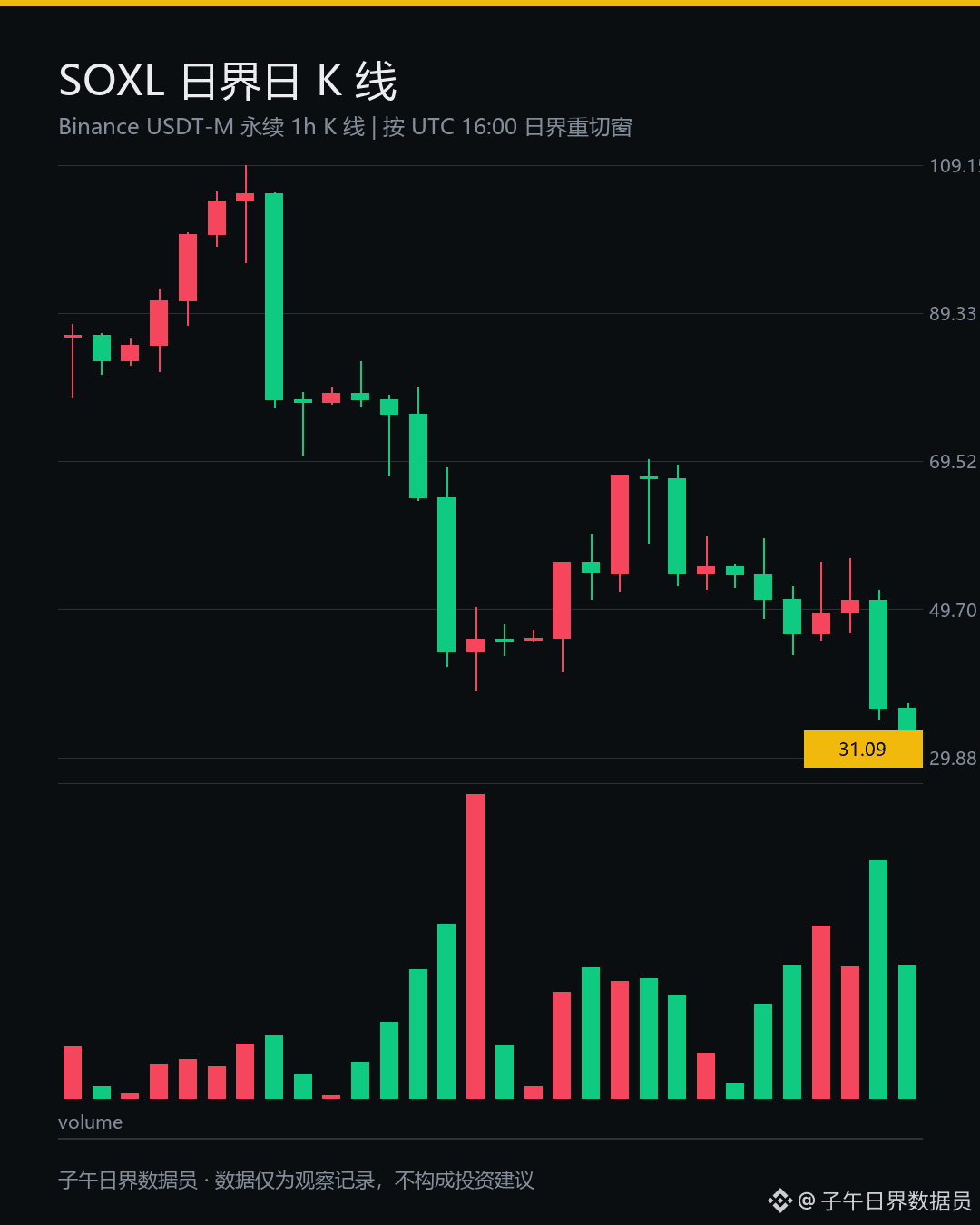
$SOXL one day: -29.87%, quoted at 31.7.
Its underlying is a 3x leveraged semiconductor ETF that resets intraday. When it falls, the losses stack up three layers deep.
Over the 20-day range, the percentile comes in at -16.12%; the lower bound of 38.81 was left behind long ago.
I could hardly believe it.
Down 43.30% in seven days. The daily candles kept getting lower, with not a single decent rebound in between.
Average daily volatility is 32.14%—a 30% swing in a day is normal for it.
Talking about support in this kind of volatility is like fortune-telling.
Yet long accounts still make up 84.71%, and the funding rate is positive at 0.0421%. Even after a drop like this, no one seems to be giving up.
I don't believe retail traders are behind these positions; the divergence between volume and price is plain to see.
This is the most punishing part of a 3x leveraged underlying: it resets intraday, so after one layer falls, you go on to take the next.
The cost of catching the fall piles up layer by layer, like a pot of water almost boiled dry while the heat is still on.
The more people crouching below, waiting to catch it, the less there is left to go around at the bottom of the pot.
I thought a wave of liquidations would come first at a level like this and flush out the weak hands. I checked the position ratio twice before believing it: no flush—if anything, things got more crowded.
A break below the lower bound is a break below the lower bound. Now all that matters is whether it can climb back above that line on its own.
I'll keep watching and sit tight for now.
What do you all think about the decay of a leveraged underlying like this? Let's discuss in the comments.
$BTC $ETH
#SOXL #比特币 #cryptocurrency
The above is a record of my personal trading system and data observations. It does not constitute investment advice.