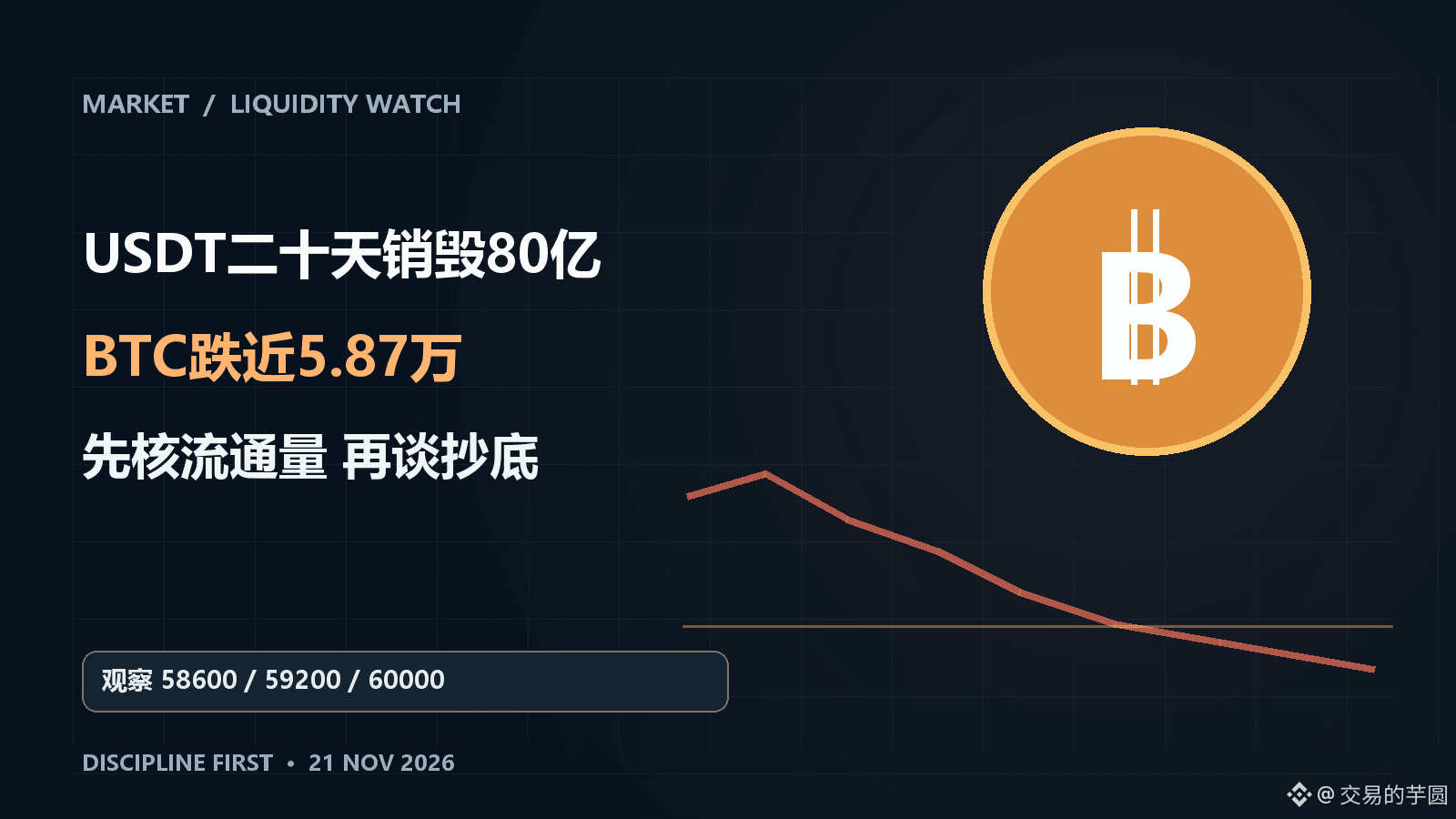
USDT burns 8 billion in twenty days | BTC falls to nearly 58,700 | Check circulating supply before buying the dip
My stance is cautiously bearish. For now, I won't interpret stablecoin burns as a direct sign that Bitcoin must fall, nor will I go all-in against the trend just because the fear index is low. The current hot topic on Binance Square is #TetherBurns8BillionUSDTInPast20Days. Lookonchain says Tether burned about 8 billion USDT in total over the past twenty days, and also recorded a burn of about 4 billion USDT on the Ethereum mainnet on November 20. This figure is worth taking seriously, but first and foremost it represents an on-chain token supply operation. If the burn came from the issuer's inventory, it doesn't directly mean an equivalent amount of funds has just been withdrawn from exchanges, nor does it mean an equivalent amount of BTC spot has been sold. Redemptions, inventory consolidation, cross-chain transfers, and new issuance on other chains need to be checked separately. So far, I haven't seen an official statement from Tether sufficient to attribute the entire 8 billion to new redemptions.
Why does this affect the crypto market? USDT is an important part of trading settlement and collateral. If net redemptions continue and the amount of stablecoins available on exchanges also declines, market-making depth and leverage capacity may weaken, making volatility more likely to intensify. If the burn is merely of unissued inventory, the price impact may be far smaller than the headlines suggest. So my order of observation is cross-chain net circulating supply, stablecoin balances on exchanges, BTC spot trading volume, and then whether the price can reclaim key levels. Treating the amount burned on-chain as same-day selling pressure confuses an accounting action with trading activity.
The market has already reacted: when I checked Binance spot prices, BTC was around 58,684 USDT, down about 6.90% over the past 24 hours, with an intraday low of about 58,680 and a high of about 63,084. The price weakness is real, but the fact that these events happened at the same time alone doesn't prove that this burn caused it. The Square Fear and Greed Index is at 8, indicating extreme sentiment, but that doesn't mean a bottom has been confirmed. I consider around 58,600 a short-term line of defense, with 59,200 and 60,000 as levels the price needs to reclaim and hold for a rebound. These are prices to watch for trading, not value anchors issued in a project announcement. If the price falls below 58,600 and the rebound is weak, my cautious view still holds. If the price returns above 60,000 on rising volume, stablecoin net circulating supply stabilizes, and spot buying follows through, then my current bearish view is invalidated.
If I were trading myself, I wouldn't chase shorts or rush to buy the rebound now. The only direction I'd consider is a small spot long, using no more than 5% of my total capital, with no leverage. The trigger would be BTC first reclaiming 59,200, then holding on a retest, confirmed by a one-hour candle close. The initial target is 60,000, where I'd sell half. If the remaining position continues to hold, I'd look to 60,800 and move the stop-loss up to breakeven. The initial stop-loss would be below 58,500. If a one-hour candle closes back below 58,600 or stablecoin net circulating supply continues to contract significantly, I'd exit early. If the price breaks through the line of defense before the trigger, the entire plan is canceled. This is a conditional plan, not a claim that I have already entered a trade or made a profit.
#TetherBurns8BillionUSDTInPast20Days #BTC
The above is solely my personal market observation and does not constitute investment advice.