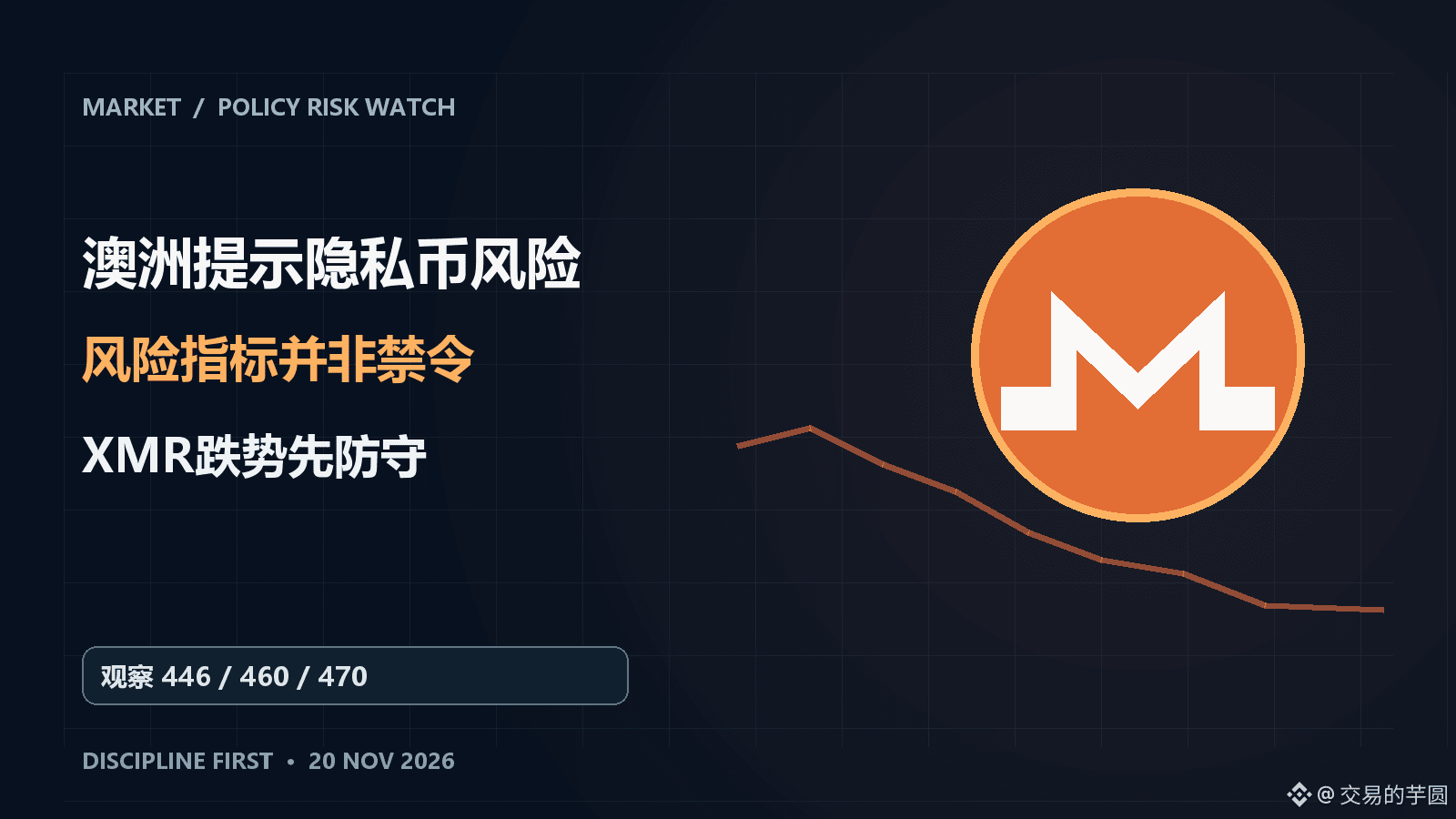
XMR | Australian sanctions risk advisory names privacy coins | Compliance pressure is not a ban
My position is to manage risk first, rather than interpret policy headlines as a one-way trading signal amid XMR’s decline. The Australian Department of Foreign Affairs and Trade website shows that the sanctions-evasion advisory for cryptocurrency, jointly issued by the Australian Sanctions Office and AUSTRAC, was first published on November 6 and updated on November 17. The document lists mixers, privacy coins and cross-chain transfers as “indicators” that may signal illicit activity, and names coins such as Monero when discussing terrorist financing risks. This is a risk advisory for regulated entities conducting due diligence and reporting; the document does not announce a blanket ban on XMR in Australia, nor does it say every privacy transaction is suspected of being illegal. Reading the official wording carefully helps avoid misrepresenting “monitoring indicators” as a “new ban.”
The market impact is through trading channels. XMR’s defining feature is privacy by default. If exchanges face heightened sanctions screening and compliance requirements, they may adjust their listing, custody, or deposit and withdrawal policies. Even if the Monero network continues to operate as usual, fiat on-ramps and liquidity on centralized markets may still change, increasing the cost of executing trades. But this is only a risk transmission mechanism: this advisory alone is not enough to claim that any new platform has delisted XMR today, or to attribute the entire decline today to Australian regulation. What needs to be checked is official exchange announcements, available trading pairs, withdrawal status, and spreads on major order books—not rumors from anonymous social media accounts.
The market reaction has already been quite sharp. Kraken’s publicly available XMR/USD quote is around $450.7, significantly below the 24-hour opening reference price of $497.5, with a low of around $446.8 and a high of around $506.5. The 470 recovery level mentioned in an earlier post has still not been reclaimed; the conditions for the long trade discussed then were not triggered, so I cannot claim to have made any trades or profits. For now, I’m treating 446–447 as the risk boundary, 460 as a short-term recovery level, and 470 as a stronger confirmation level. If XMR breaks below 446 and fails to recover by the four-hour close, I’ll first watch for volatility to expand further amid thin liquidity. If it holds 460, then moves back above 470, and no new official restrictions emerge on major trading channels, I’ll reduce my defensive stance. Policy risks need to be monitored, but price signals and trading-channel signals should be verified separately.
If I were trading this myself: I would stay out for now and avoid high-leverage countertrend positions. The only direction I would consider is a small spot long, triggered when XMR’s four-hour close is above 460, it holds above 455 on a retest, and then breaks above 465 again. I would use no more than 3% of total capital, with per-trade account risk capped at 0.4%. The first target is 470, where I would sell half; the target for the remainder is 485, though I would close early if order-book spreads widened. The stop-loss would be below 445. If the price rapidly breaks below 446 intraday or an actual trading channel such as Kraken shows irregularities, I would exit immediately. Any new, explicit restrictions announced by regulators would require reassessing all existing plans. If these conditions do not materialize, I would remain in cash and wait for verifiable developments.
#XMR
This is solely my personal market observation and does not constitute investment advice.