
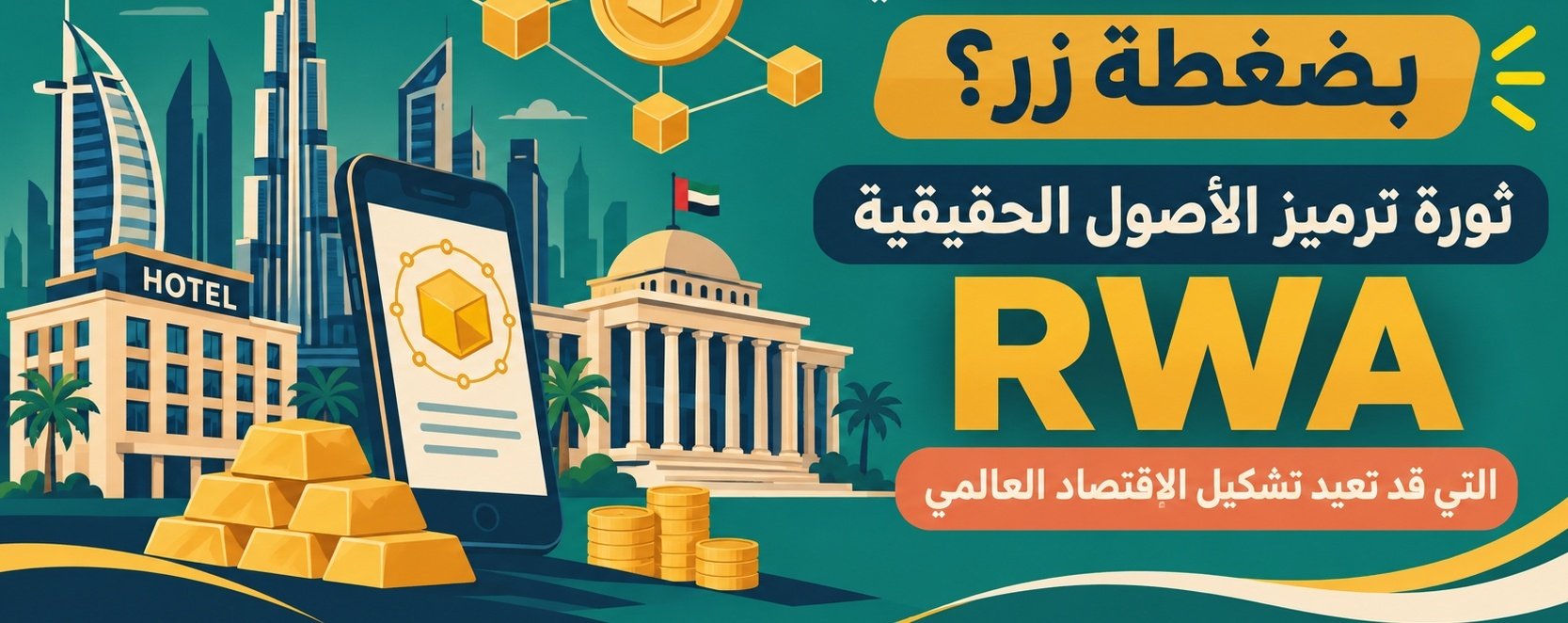
Can you own a share of a tower, hotel, or government bond with the click of a button?
The RWA tokenization revolution that could reshape the global economy
Imagine standing in front of a luxury residential tower in Dubai. The tower is worth tens of millions of dirhams, and owning it outright would require enormous capital you can’t afford. But what if the investment value of this property could be divided into thousands of digital units, allowing you to buy a small share, track your investment through an online platform, and perhaps sell your share to another investor?
This is no longer just a vision of the future.
It is one of the use cases blockchain technology is trying to deliver through a concept known as Real World Asset Tokenization (RWA).
The idea goes far beyond real estate. We are talking about the possibility of representing traditional assets such as gold, government bonds, stocks, investment funds, loans, and commodities as digital tokens that can be traded or transferred under specified conditions.
But the more important question is not: Can assets be converted into digital tokens?
The real question is: Will this change how wealth is owned, traded, and managed? Who will benefit from this shift? And what risks could make this revolution less straightforward than it seems?
Let's start with the basics.
---
First: What is meant by real-world asset tokenization?
Asset tokenization is the process of representing a right or interest associated with a particular asset as a digital token recorded on a blockchain network.
Put more simply, instead of investment or ownership data remaining confined to traditional records and separate databases, a digital token can be created to represent a specific right in an asset, fund, or security.
Suppose there is a property worth one million dollars.
One million digital units can be created, each representing a portion of the value or economic right associated with the property, if the legal structure allows it.
If you buy a thousand units, you are not necessarily buying a specific physical part of the building. Instead, you receive the rights specified in the product's legal structure: these might be a stake in a company that owns the property, an interest in an investment fund, or a contractual right to certain returns.
And here is a fundamental point:
A digital token is not necessarily the asset itself; rather, it is a digital representation of a legal or economic right associated with the asset.
This distinction determines whether an investor owns a genuine, enforceable right or merely a token that depends on the promises of the entity that issued it.
---
Second: Why is the world interested in asset tokenization now?
The traditional economy holds assets of enormous value, but accessing them is not always easy.
Buying property requires substantial capital, investing in some bonds or funds may require intermediaries and legal procedures, and transferring ownership and settling transactions can take time and involve multiple parties.
This is where the promises of tokenization come into view.
1. Fractional ownership
Instead of buying an entire asset, the investment can be divided into smaller units.
Depending on the issuance terms and regulatory limits, it may become possible to invest in a property, fund, or bond with less than the amount required to buy the asset directly.
However, a lower minimum investment does not mean that risks disappear or profits are guaranteed.
2. Facilitating ownership transfers and settlement
In traditional markets, a transaction may pass through several institutions, such as a broker, custodian, clearing house, and settlement agent.
In blockchain-based systems, however, the transfer of a token can be recorded and some settlement conditions executed automatically, potentially reducing manual reconciliation and delays.
Nevertheless, settling a token on the network does not necessarily mean that legal ownership of the off-chain asset has been fully transferred; this depends on the legal system and the mechanism linking the digital ledger to official records.
3. Programmability
Tokens can be designed so that smart contracts automatically execute certain conditions.
For example:
- Distributing returns to investors according to their ownership percentages.
- Restricting who can buy the token.
- Executing transfers when specific conditions are met.
- Scheduling redemption dates or dividend distributions.
This turns the token from a mere digital record into an instrument that can be programmed to execute certain rights and obligations.
4. Expanding access
Digital platforms may give investors in different markets access to products that were not previously easily available to them.
However, international access does not mean that a product is legally available to everyone in every country; regulatory rules, know-your-customer requirements, residency, and taxes vary from one market to another.
5. Improving the efficiency of certain illiquid assets
Some assets, such as real estate and private loans, are difficult to sell quickly without incurring a cost or discount.
Tokenization may help create smaller, more transferable investment units, but it does not create liquidity out of thin air.
If there are no buyers, an asset will not become liquid simply because its ownership has become digital.
---
Third: Which assets can be tokenized?
The potential scope is broad and can be divided into several main categories.
1. Real estate
Real estate is one of the areas attracting the most interest.
Tokenization can include:
- Residential units.
- Commercial towers.
- Hotels.
- Shopping centers.
- Land.
- Income-generating real estate projects.
An investor may receive an economic interest in a company or fund that owns the property, or another type of right specified by the issuance.
However, it is important to distinguish between owning a token representing a stake in a real estate company and having the investor's name registered as the direct owner of part of the property in the land registry.
The two are not legally equivalent.
2. Gold and precious metals
Digital tokens can be issued to represent specific quantities of gold held by a custodian.
Examples of well-known products in this area include:
- PAX Gold (PAXG).
- Tether Gold (XAUT).
These models offer exposure to the price of gold through digital units, but investors should verify the custodian, audits, redemption mechanisms, and the actual rights granted by the token.
3. Government bonds
Government bonds can be represented as digital tokens.
This makes it possible to issue, trade, or settle them using a technological infrastructure different from traditional systems.
U.S. Treasury bills and bonds are of particular interest in this area, as investors are looking for fixed-income financial instruments that can be used in some digital finance applications.
4. Stocks and investment funds
Rights associated with company shares or investment fund units can be represented as tokens.
However, one should not assume that every token bearing the name of a well-known stock gives its holder the rights of a traditional shareholder, such as voting or directly receiving distributions.
The product may simply provide economic exposure to the stock price, or a contractual claim against the issuer, rather than being a share registered in the company's shareholder register.
5. Loans and credit
Loan portfolios or rights to the cash flows associated with them can be tokenized.
This opens the door to representing commercial loans, real estate financing, and private credit as digital units.
However, this category involves real credit risks: borrowers may default, collateral values may fall, and payments may be delayed.
6. Commodities and other assets
It is also possible to tokenize rights associated with oil, agricultural products, industrial metals, commercial inventory, and certain works of art and valuables.
But this model can only succeed if the asset's existence is proven, its location identified, its safekeeping guaranteed, and a clear mechanism established for redeeming or disposing of it.
---
Fourth: How does a real-world asset become a digital token?
Tokenization is not simply a matter of creating a smart contract and issuing a set of tokens.
It is a process made up of interconnected stages.
Stage One: Identifying the asset and the rights
The asset to be tokenized must be identified, along with its owner, legal status, and the rights that can be transferred or represented.
Are we talking about direct ownership? A stake in a company? A right to returns? Or a financial claim?
This step determines the nature of the product in its entirety.
Stage Two: Valuation and verification
The asset must be valued, and its existence, value, and associated liabilities must be verified.
For real estate, for example, this requires examining ownership, valuation, mortgages, debts, and other rights.
For gold, the quantity, purity, and safekeeping must be verified.
For loans, the quality of borrowers, collateral, and default risks must be assessed.
Stage Three: Building the legal structure
The entity that will issue the tokens, the nature of the rights investors receive, how those rights will be protected, and what happens in the event of bankruptcy, a dispute, or the platform ceasing operations must all be determined.
This stage is just as important as the technical side.
Stage Four: Issuing the tokens
Once the requirements have been met, digital tokens are created on a suitable blockchain network.
Their number, transfer rules, restrictions, and associated rights are defined.
Stage Five: Distribution and trading
Tokens are offered to investors in accordance with regulatory rules and issuance terms.
They may be traded on an approved primary market or secondary platform, if permitted.
Stage Six: Managing the asset and returns
The responsible entity continues to manage the real-world asset, collect revenues or payments, settle liabilities, and report to investors.
This is where the connection between the digital and real worlds becomes important.
A smart contract may distribute revenues, but it cannot by itself collect rent from a tenant, repair a property, or force a debtor to pay.
---
Fifth: Has asset tokenization become a real market, or is it still an experiment?
Asset tokenization is no longer just a theoretical idea, but it is still small compared with the traditional financial markets.
According to the European Central Bank, the estimated market value of tokenized assets on public blockchain networks was around €38 billion in February 2026, compared with around €7.4 billion at the beginning of 2024.
Despite this growth, the figure remains extremely small compared with the scale of traditional global assets, which were estimated at around €241 trillion at the end of 2025.
A Binance Research report published in September 2026 stated that the total real-world assets tracked by the report had reached around $34.18 billion as of September 15, 2026, with bonds and money market funds continuing to dominate a large portion of the market.
These figures point to two things:
First: Financial institutions have begun treating tokenization as an economic field worth investing in and developing.
Second: The market is still at an early stage, and its current size does not justify believing that the traditional financial system is on the verge of disappearing.
Figures differ across reports depending on how tokenized assets are defined, which networks are included in the measurements, and whether certain categories are included or excluded from the data.
Therefore, not every published figure should be treated as representing exactly the same global market.
---
Sixth: Why have major financial institutions entered this field?
The reason is not simply a desire to use a new technology.
Financial institutions see tokenization as an opportunity to redesign parts of the market infrastructure.
Some prominent examples include:
BlackRock
BlackRock launched its BUIDL institutional digital fund, which allows units in a fund investing in traditional short-term financial instruments and cash assets to be represented digitally.
The significance of this experiment is that it shows how traditional asset management can be combined with blockchain-based technological infrastructure.
JPMorgan
JPMorgan is developing blockchain-based solutions through its infrastructure, now known as Kinexys, which evolved from earlier initiatives such as Onyx.
These solutions aim to improve payments, settlement, and value transfers between financial institutions.
The significance of these initiatives is that major institutions do not view blockchain as a technology limited to cryptocurrencies, but as a potential infrastructure for modernizing some traditional financial operations.
However, the entry of major institutions does not mean that every tokenized product is safe or suitable for investment.
---
Seventh: How could RWA intersect with decentralized finance (DeFi)?
This is where one of the most interesting ideas begins.
Decentralized finance (DeFi) relies on protocols and smart contracts that enable lending, borrowing, and trading without necessarily depending on a traditional financial intermediary at every step.
However, many assets in this digital world are tied to the value of cryptocurrencies themselves.
This is where volatility becomes a problem.
If tokenized traditional assets can be brought into some DeFi applications, the range of collateral available to users may expand.
Suppose an investor owns tokenized units linked to government bonds.
A particular platform may allow these units to be used as collateral for a digital loan, subject to the platform's terms and the product's rules.
This creates a bridge between traditional markets and decentralized finance.
But this bridge is not without complications.
A tokenized asset may be subject to legal rules outside the blockchain and may not be available to all users. Using it as collateral also does not eliminate the risks of liquidation, price fluctuations, or protocol failure.
It is also important to note that some tokenized assets cannot be freely traded within DeFi protocols due to legal restrictions or issuance terms.
---
Eighth: Why doesn't tokenization mean that investing has become safe?
One of the biggest mistakes is believing that recording an asset on a blockchain automatically makes it safe.
Blockchain may help document transactions and record token transfers, but it does not, by itself, guarantee the accuracy of the information entered into it.
There are several risks to understand.
1. Legal ownership risk
An investor may own a digital token without having a direct legal right to the asset.
If the issuing entity goes bankrupt or a dispute arises, the question is: Can the investor prove and assert their right in court?
The answer depends on the legal structure, the contracts, and the courts with jurisdiction.
2. Custodian risk
If a token represents gold, bonds, or assets held by an institution, the investor partly depends on that institution's soundness.
What happens if the custodian fails? Are there actual assets backing the tokens? Can they be redeemed?
These are fundamental questions, not minor details.
3. Liquidity risk
You may theoretically be able to sell the token, but that does not mean there will be a buyer willing to purchase it at your desired price.
Liquidity requires an active market, buyers and sellers, and reliable trading mechanisms.
4. Smart contract risk
Smart contracts may contain software vulnerabilities or execution errors.
Exploiting a single vulnerability could result in lost funds or disrupt operations related to the tokens.
5. External data risk
Real estate, gold, and loans are assets that exist outside the blockchain.
Systems therefore need data from external sources to verify prices, ownership, and legal status.
If the data is incorrect, delayed, or manipulated, digital tokens may reflect inaccurate information.
6. Regulatory risk
Laws vary between countries, and some tokens may be classified as securities or investment products subject to specific licensing and disclosure requirements.
Changes in regulatory rules may restrict trading or prevent certain investors from accessing the product.
7. Concentration risk and reliance on intermediaries
Although blockchain is often presented as a technology that reduces reliance on intermediaries, many RWA products still depend on centralized entities to issue tokens, hold and manage assets, and determine redemption mechanisms.
In other words, the intermediary may change its form, but it does not necessarily disappear.
---
Ninth: The Dubai and UAE experience—when tokenization approaches the real estate market
It is important to look at what is happening in the UAE, as Dubai has become one of the markets testing practical models for real estate tokenization.
In March 2025, the Dubai Land Department launched the pilot phase of a real estate tokenization project in collaboration with entities including the Virtual Assets Regulatory Authority (VARA) and the Dubai Future Foundation.
In May 2025, a tokenized real estate investment pilot was launched through the Prypco Mint platform as part of the project.
The Dubai Land Department later announced that the first tokenized project attracted 224 investors from 44 nationalities, with an announced average individual investment of around AED 10,714.
In February 2026, the department announced that the project was moving to its second phase, which includes testing the resale of around 7.8 million real estate tokens on a secondary market within a regulated pilot framework.
This step is important because it goes beyond simply issuing tokens to test whether they can be traded after issuance.
However, it is important to note that the project operates within a regulated pilot framework. This does not mean that all properties in Dubai can now be tokenized or that every real estate token available to the public carries the same rights.
The significance of the UAE experiment lies in its testing of the relationship between technology, the land registry, legal rights, and investor protection, rather than simply creating digital tokens detached from the official system.
---
Tenth: Who really benefits from the RWA revolution?
It may seem that small investors are the primary beneficiaries, but they are not the only ones.
Individual investors
They may gain access to investments that previously required more capital, with the ability to diversify their portfolios across different asset classes.
However, they need to understand the rights, fees, liquidity, and risks before buying any token.
Asset-owning companies
They may be able to reach broader groups of investors, organize fundraising, and perhaps improve the management of certain assets.
Financial institutions
They may benefit from developing new services for custody, issuance, trading, settlement, and digital asset management.
Blockchain platforms and financial technology companies
They may become part of the infrastructure connecting traditional assets with digital markets.
Regulators and governments
They may benefit from improved transaction traceability and the development of more efficient markets, provided there are clear rules to protect investors and monitor risks.
However, one should not assume that all parties will benefit equally; this shift may redistribute revenue and influence between traditional institutions and new technology companies.
---
Eleventh: What needs to happen for RWA to become a fundamental part of the economy?
According to an International Monetary Fund analysis published in October 2026, tokenization may bring gains in efficiency, transparency, and automation, but it remains a small, fragmented market compared with the traditional financial system.
The analysis indicates that meaningful expansion requires addressing a set of interconnected challenges, most importantly legal certainty, clear regulatory rules, interoperability between different systems, and the availability of suitable settlement assets.
This means that the future of RWA will not be determined by the number of tokens companies issue, but by how well those tokens can integrate into the real economy.
There are four essential conditions:
1. Legal recognition: The rights of token holders must be clear and enforceable.
2. Trust and transparency: The existence, safekeeping, and valuation of the asset must be verified, and associated liabilities disclosed.
3. Technical interoperability: Different networks, platforms, and institutions should be able to exchange data and value reliably.
4. A real market: Issuing tokens is not enough; effective trading, redemption, and settlement mechanisms must exist.
If these conditions are met, tokenization may become part of the core infrastructure of financial markets, rather than just a niche sector of the cryptocurrency industry.
---
Twelfth: What might the future of tokenized real-world assets look like?
Three main scenarios can be envisioned.
Scenario One: Gradual, regulated growth
Financial institutions and governments adopt tokenization for specific asset classes, such as bonds, money market funds, and real estate.
Traditional systems remain in place, but some issuance, trading, and settlement processes gradually move to a more efficient digital infrastructure.
This seems the most realistic scenario in the near term.
Scenario Two: Broad integration between traditional and digital markets
Tokenized assets begin to spread across multiple platforms, and some of their units become usable as collateral in digital finance, supported by compatible legal and regulatory systems.
In this scenario, the technical boundaries between traditional financial markets and digital asset markets may shrink.
Scenario Three: Expansion stalls
The industry may slow down if legal problems persist, major platforms face crises, or some products fail to prove that the assets they represent exist.
This could lead to a loss of confidence and declining demand, even if blockchain technology itself continues to develop.
The future, then, is not guaranteed; it depends on the industry's ability to solve problems of trust, rights, and liquidity, not just its technical ability to issue tokens.
---
Conclusion: Will every asset in the world become ownable with the click of a button?
Perhaps not every asset will be tokenizable, and tokenization may not be the right model for every type of investment.
But the trend we are seeing points to a significant shift in how financial rights are represented, transferred, and managed.
In the past, digital technology meant converting documents and data into electronic files.
Now, we are seeing an attempt to convert economic rights themselves into digital units that can be programmed and traded within specific legal and technical frameworks.
That is a major difference.
Small investors may be able to access a portion of a fund, property, or bond; institutions may be able to settle some transactions more quickly; and traditional financial markets may intersect with decentralized finance applications in new ways.
But always remember:
Blockchain can record a token, but it cannot by itself guarantee the existence of the asset, the validity of its ownership, or protect investors from bankruptcy or fraud.
That is why the future of RWA will not be made by developers alone, nor will it be determined by the platforms that issue the most tokens.
It will be shaped by cooperation between technology, law, financial institutions, and regulators—and, most importantly, by investor confidence.
Perhaps the question worth considering is not: Will we own real estate and bonds through blockchain?
Rather: When real-world assets become divisible and globally tradable, who will control ownership? Who will determine investors' rights? And who will ensure that a token truly represents a real asset?
I'll leave you with this question for discussion:
Do you think real-world asset tokenization will give small investors a fair opportunity to access wealth, or will it create a new kind of market in which control remains in the hands of major institutions?