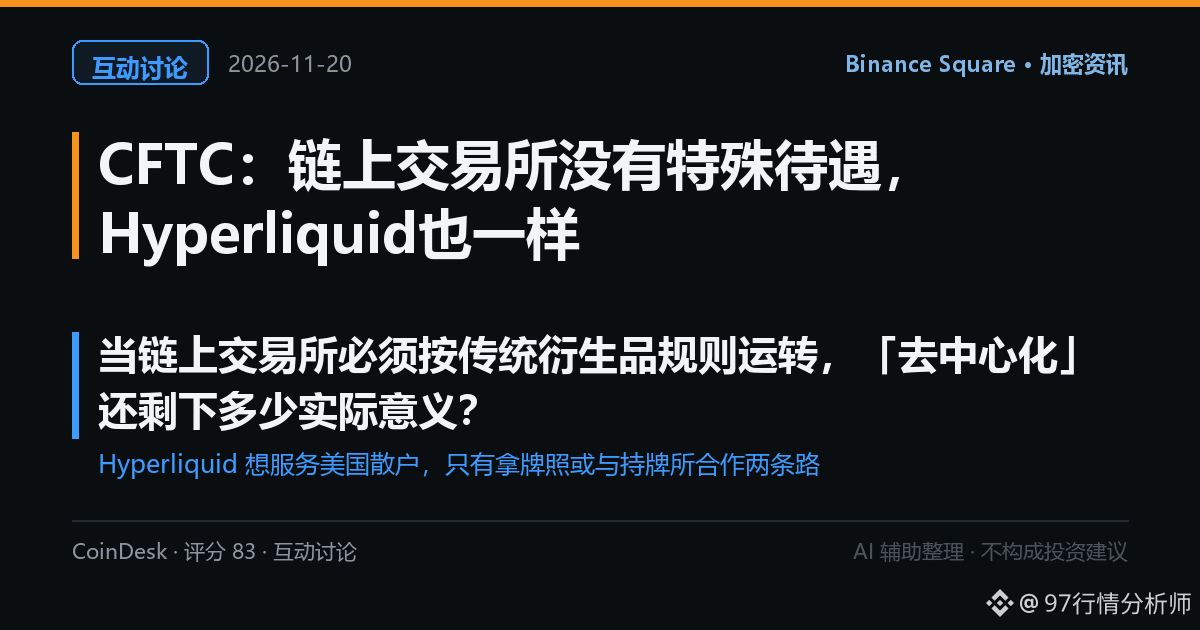
CFTC: On-chain exchanges get no special treatment—and neither does Hyperliquid
CFTC Chair Michael Selig said Thursday in Washington that on-chain platforms like Hyperliquid have only two options if they want to offer perpetual futures to U.S. retail traders: obtain a license themselves or partner with a licensed exchange. Being “on-chain” does not mean they face a different set of requirements.
Demand is already lining up. Backpack was approved this week to operate a U.S. derivatives exchange and clearinghouse; Kraken parent Payward plans to offer perpetual futures on the Hyperliquid blockchain through CFTC-regulated Bitnomial; and HypeStrat Markets has applied for an FCM license. Meanwhile, Hong Kong’s SFC added Hyperliquid to its suspicious entities list on Wednesday, and CME and ICE called for an investigation into it this May.
Selig’s reasoning is straightforward: if these trades aren’t allowed here, they’ll simply move overseas. This is both an effort to bring on-chain trading into the fold and a way to protect licensed institutions. Once the regulatory standards are aligned, the dividing line will be “who gets a license,” not “whose technology is more decentralized.”
When on-chain exchanges have to operate under traditional derivatives rules, how much practical meaning does “decentralized” still have?
CFTC Chair Michael Selig said Thursday in Washington that on-chain platforms like Hyperliquid have only two options if they want to offer perpetual futures to U.S. retail traders: obtain a license themselves or partner with a licensed exchange. Being “on-chain” does not mean they face a different set of requirements.
Demand is already lining up. Backpack was approved this week to operate a U.S. derivatives exchange and clearinghouse; Kraken parent Payward plans to offer perpetual futures on the Hyperliquid blockchain through CFTC-regulated Bitnomial; and HypeStrat Markets has applied for an FCM license. Meanwhile, Hong Kong’s SFC added Hyperliquid to its suspicious entities list on Wednesday, and CME and ICE called for an investigation into it this May.
Selig’s reasoning is straightforward: if these trades aren’t allowed here, they’ll simply move overseas. This is both an effort to bring on-chain trading into the fold and a way to protect licensed institutions. Once the regulatory standards are aligned, the dividing line will be “who gets a license,” not “whose technology is more decentralized.”
When on-chain exchanges have to operate under traditional derivatives rules, how much practical meaning does “decentralized” still have?