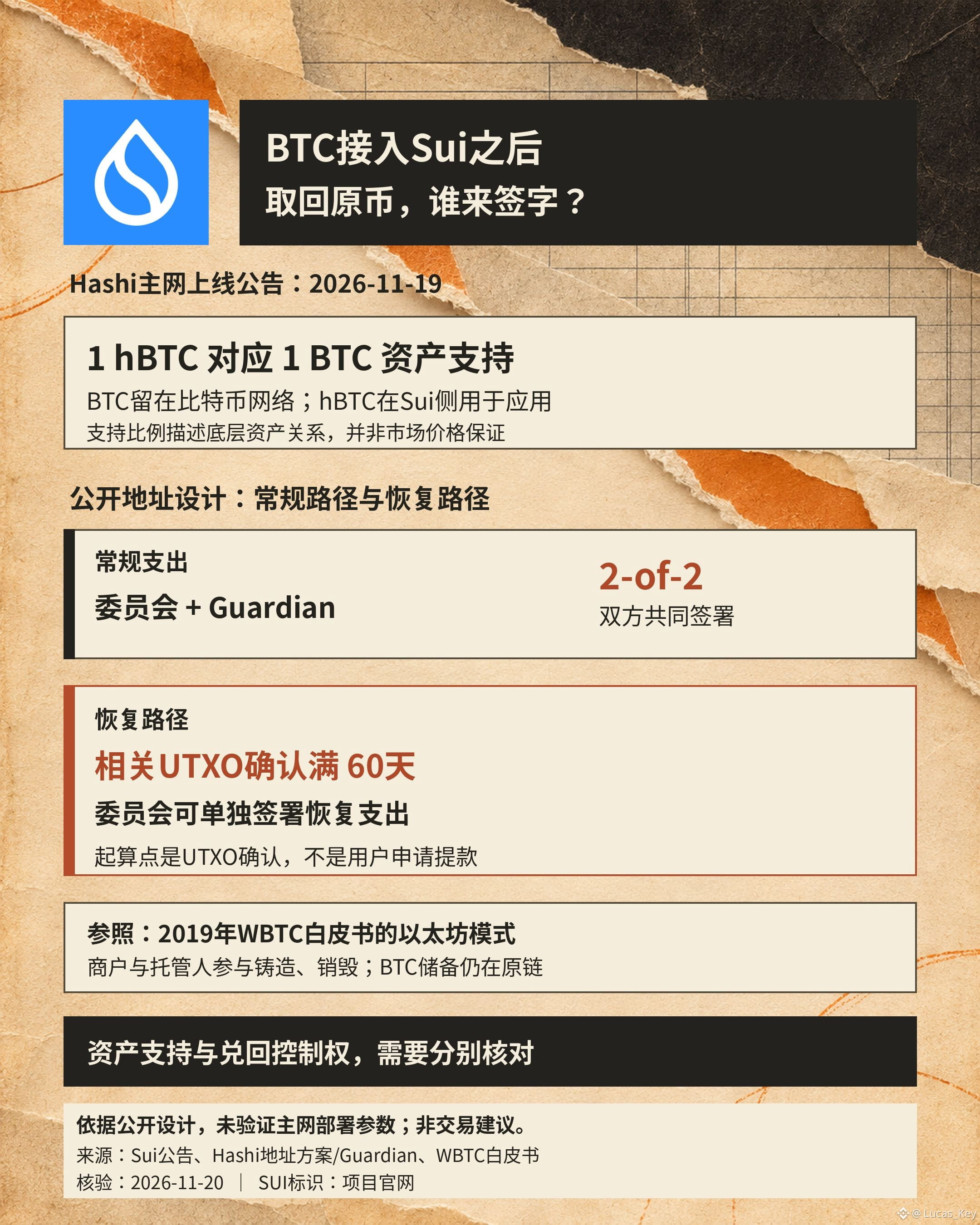
Bringing BTC into DeFi? First, look at who has to sign when the original coins are withdrawn. On November 19, the official $SUI account announced the launch of Hashi mainnet: $BTC stays on the Bitcoin network, while hBTC, backed 1:1, is minted on Sui and then used by applications for purposes such as lending.
Trace the exit path backward, and the design trade-offs become clear. Hashi’s design documents state that BTC is jointly controlled through threshold multiparty computation by a committee drawn from the Sui validator set; routine spending requires joint 2-of-2 signatures from the committee and an independent Guardian. No single committee member can transfer funds alone, so separate authorization provides a clear security benefit.
But there is an exception that’s easy to miss: the address script allows the committee to use a recovery path on its own once the relevant UTXO has been confirmed for 60 days. This is an escape hatch in case the Guardian key is lost. The 60 days start from UTXO confirmation, not from when a user requests a withdrawal. This improves recoverability, while also defining the limits of the “dual-signature protection.”
Keeping the original coins on the Bitcoin network does not mean users can still spend the BTC in the pool at any time using their own private keys. WBTC on Ethereum is a useful comparison: its 2019 white paper describes a mint-and-burn model involving merchants and custodians; the network where $ETH resides hosts the tokens and applications, while BTC reserves remain on Bitcoin. Both ecosystems are expanding BTC’s utility. The difference lies in control and redemption paths, so “1:1” alone is not enough to rank their security.
I’m more focused on whether reserves, hBTC supply, and redemption records can be continuously verified, and on how the recovery path works in the event of a failure. If exits are blocked under stress, availability should be reassessed; the number of applications launched does not prove these things. The above is a discussion of the public design; I have not verified the mainnet deployment parameters and am not making any inferences about token prices.
Sources: Sui announcement dated 2026-11-19, Hashi address scheme and Guardian documentation, and the 2019 WBTC white paper; verified on November 20. Cross-chain activity and lending carry risks. This is not trading advice. This post may receive platform creator rewards.