

Venezuela received US$12.107 billion from an account held in custody by the U.S. Here’s what we know about where that money went
CNN en Español
—
The U.S. government published a report this month showing how it has safeguarded the billions of dollars in resources Venezuela has obtained this year from the sale of oil and other goods.
The amount totals about US$12.263 billion, which the United States placed under its oversight on the grounds of “supporting macroeconomic stability and the restoration of government functions and key sectors” following the capture of President Nicolás Maduro in the U.S. military operation carried out on January 3.
Venezuela’s acting president, Delcy Rodríguez, visits PDVSA facilities alongside U.S. Energy Secretary Chris Wright in Maturín on February 12.
Related article
China bet on Venezuelan oil. After the Caracas-Washington deal, it is now facing the cost of that gamble
According to the report, most of that money has already been delivered to Venezuela, with prior authorization from the State and Treasury departments, and has already entered the Venezuelan economy through currency auctions, foreign exchange interventions and payments to suppliers. The document says the ultimate recipients of those funds are not being disclosed for confidentiality reasons.
For several analysts, this arrangement—in which the United States holds and authorizes the use of money derived from Venezuelan assets—is another example of the influence Donald Trump’s government wields in Venezuela in the post-Maduro era, in which Delcy Rodríguez serves as acting president and has had numerous meetings with U.S. officials since January.
CNN contacted the Venezuelan government for comment and is awaiting a response.
How the Venezuela Custody Account was established
Days after Maduro’s capture—he is accused by the United States of narco-terrorism, drug trafficking and other crimes, which he denies—the Trump administration established a special account to receive proceeds from the sale of Venezuelan oil and other assets, the report says. The report was released by the State Department and prepared by the auditing firm KPMG.
The fund is based on an executive order Trump issued on January 9, under which money deposited in the account belongs to Venezuela but will be held by the United States to verify the legality of its origin and use.
“The Venezuela Custody Account serves as the central mechanism for the custody and oversight of revenues generated by activities related to Venezuela’s natural resources. The oversight structure provides transparency into how funds are collected, managed, authorized, protected and distributed to advance approved economic and humanitarian objectives,” the report says.
Millions in revenue, mainly from oil
Between January and September 30, the special account received a total of US$ 12.263 billion.
Of that amount, 98.74% came from sales of oil—a mainstay of the Venezuelan economy—as well as other petroleum products and natural gas. This amounts to US$ 12.109 billion.
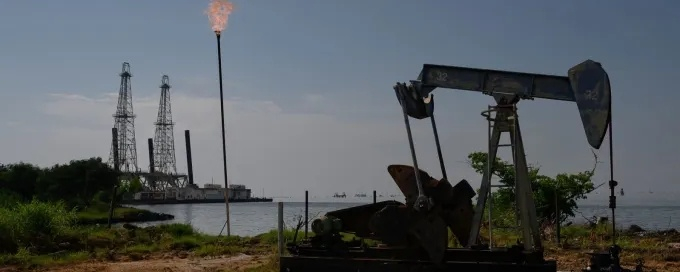
An oil pumpjack belonging to Petróleos de Venezuela SA (PDVSA) on Lake Maracaibo, in Cabimas, Zulia state, Venezuela, on Friday, November 17, 2023.
The remaining amounts came from gold sales totaling US$ 108 million, sales of other minerals totaling US$ 22 million, and fertilizer sales totaling US$ 24 million.
The report says there were 20 depositors in these transactions but does not disclose their identities, citing confidentiality agreements.
Where did the money go?
Of the total amount received in the account, by September 30 the United States had delivered US$ 12.107 billion to Venezuela through transactions with the Central Bank of Venezuela (BCV) approved by the State and Treasury departments. The BCV then carried out transactions with other banks.
The report says US$ 2.087 billion was channeled into the Venezuelan economy through currency auctions, US$ 9.322 billion through electronic interventions in the foreign exchange market, US$ 549 million through interventions involving banknotes, and US$ 133 million went toward supplier payments.
Drilling mud flows into a container as an oil worker works on a drilling rig at an oil well operated by Venezuela’s state oil company PDVSA in the Orinoco oil belt, near Cabrutica in Anzoátegui state, on April 16, 2015.
Related article
Venezuela announces restructuring of its external debt and PDVSA’s debt. How much does it amount to?
The document does not specify who the ultimate recipients were, identifying only broad categories. For example, it says US$ 2,873 went to individuals and US$ 9.366 billion to legal entities, meaning public and private companies.
For this latter amount, the report lists the economic sectors that received the money. The largest share went to food and consumer goods, with US$ 3.348 billion, followed by business and administrative services with US$ 2.218 billion, and agriculture with US$ 1.178 billion.
“Together, these three categories accounted for 72% of total disbursements by sector, indicating a strong emphasis on activities related to consumer goods, food availability and broader commercial supply chains,” the report says.
Other sectors on the list include health care and pharmaceuticals, with US$ 531 million; technology and professional services, with US$ 522 million; industry and manufacturing, with US$ 381 million; household goods and electronics, with US$ 378 million; fashion and clothing, with US$ 241 million; and construction and real estate, with US$ 219 million.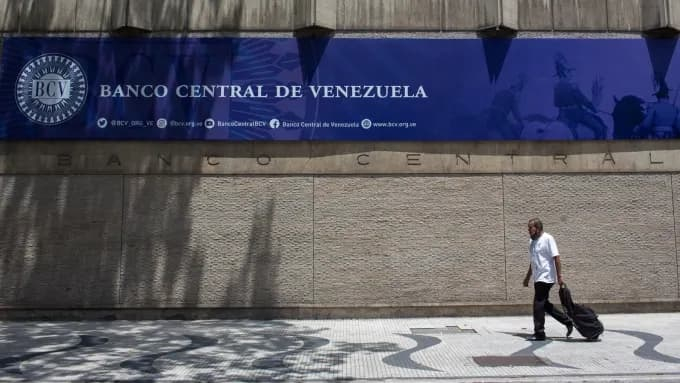
A man walks past the headquarters of the Central Bank of Venezuela in Caracas.
In the case of the US$ 133 million allocated to supplier payments, the report only includes descriptions of the transactions—from legal and professional advice to the purchase of polycarbonate sheets for making passports or equipment for coal mining—but not who was paid for each service or product.
Another example of U.S. power
The release of this information has prompted numerous reactions from analysts inside and outside Venezuela.
Imdat Oner, an academic at Florida International University, told CNN on Wednesday that the flow of money detailed in the report “says a lot about Washington’s priorities.”
Related article
Pete Hegseth and Delcy Rodríguez announce in Caracas that they are resuming military cooperation
“Most of the money has gone toward foreign currency auctions designed to support the bolívar, suggesting that the United States is focused above all on preventing an economic collapse in the country. That is understandable. If Venezuela’s economy were to collapse after Maduro’s removal, people inside and outside Venezuela would blame Washington, regardless of who was formally in charge,” he explained.
“However, economic support also creates influence. Every disbursement requires U.S. approval, which means the fund is more than a financial lifeline for the interim government. It also gives Washington room to maneuver. As long as the interim regime depends on Washington’s approval to access its own funds, Venezuela is not exercising full sovereignty,” he added.
Analyst Ricardo Ríos, president of the consulting firm Poder & Estrategia, pointed out that questions remain about who the funds’ ultimate recipients were.
“More than 90% was used to settle foreign currency transactions in the domestic market. This highlights two unavoidable questions: 1. Who were the main beneficiaries of this allocation of foreign currency at preferential rates? 2. How much longer will we have a monetary system that allows a single transaction to create a new millionaire at the expense of the economic distortion of an entire country?” Ríos said on X
Academic Benigno Alarcón, meanwhile, agreed that the report is another example of the influence the United States can exert over Venezuela.
“The leverage exists, it is exercised daily, and it has not been used to set a timeline,” Alarcón said on X, apparently alluding to the lack of a date for future elections, a point demanded by the opposition and many citizens, and on which the interim government has so far made no commitments.