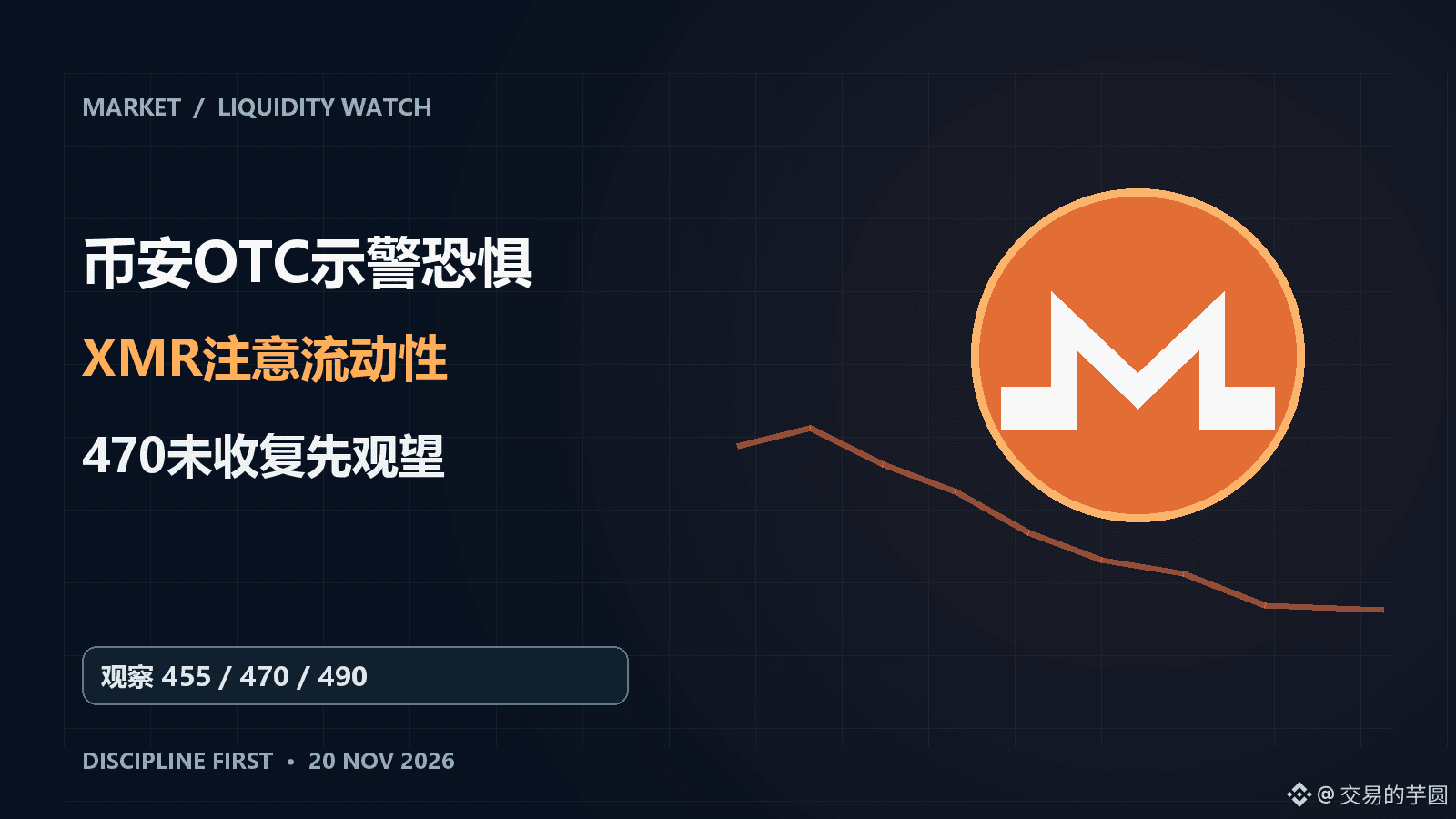
Binance OTC Weekly Report Signals Extreme Fear|XMR Rebound: Beware of Liquidity Discounts|Wait Until 470 Is Reclaimed
My stance is to remain defensive and not mechanically interpret extreme fear as meaning a bottom is imminent. The weekly report published by Binance OTC and Execution Services on November 19 looked back at the market from November 13 to 19. It cited the Fear & Greed Index falling from around 50 midweek to 11, and described BTC’s price pullback, the liquidation of leveraged longs, and ETF outflows. The current Binance Square page also shows the Fear Index in the extreme zone. The two sources use different methodologies and observation times, so the report’s figure of 11 should not be presented as the precise reading right now—nor should futures liquidations in the BTC market be taken to mean that XMR experienced liquidations on the same scale.
For XMR, I’m more concerned with how trades are executed when risk appetite declines. Monero has its own use case in privacy payments, but its price is still determined by marginal buying and selling. Some platforms have adjusted their XMR trading services. Traders who look only at the last traded price on one exchange may underestimate cross-platform spreads, withdrawal status, and slippage. This is not evidence that the protocol has failed, nor does it mean that all exchanges have halted service at the same time. The latest official software announcement currently shown on Monero’s website is still the October maintenance release; there is no new mainnet upgrade announcement that directly explains today’s price movements. Trending topics on Binance Square are focused more on BTC, ETFs, and hardware wallet security. There is no corresponding accurate trending tag for XMR, and I won’t tack unrelated popular keywords onto the end of this post just to get exposure.
Market reaction has already been weak. When I checked Kraken XMR/USD, the latest trade was around $463, and the page’s interface showed a rolling range of approximately $455 to $507. This is a quote from Kraken’s USD market, not the Binance spot price. The price remains below the $470 recovery level in my previous plan, and the entry conditions in that plan have not been met—so there has been no buy and no profit. Extreme fear can sometimes mean selling pressure is close to exhaustion, but it can also persist for several days. To judge which is the case, we need to see at minimum whether XMR can reclaim $470 and whether BTC risk sentiment and available spot-market depth stabilize at the same time. Around $455 is a reference for this round’s low, while $490 is the first more significant supply zone above. If $455 continues to give way, my short-term recovery thesis is invalidated.
If I were trading this myself, I would stay out for now and consider only a small spot long. The conditions are that XMR first holds above $470, then retests it without breaking below, and that the order book and withdrawal status on the platform where I would actually place the order confirm that execution is feasible. If those conditions are met, I would use no more than 3% of my total trading capital, entering in two tranches. The first target is $490, where I would reduce the position by half; I would look to around $505 for the remainder, but close early if the spread suddenly widens. I would set a stop below $458 and close the entire position if it is hit. If the price breaks below $455 first, I would cancel the long-entry plan. If a major service restriction is confirmed by an exchange or the project’s official channels, I would cancel any orders rather than gamble on a reversal with high leverage. The only things I can control are position size and exit rules.
#XMR
The above is solely my personal market observation and does not constitute investment advice.