
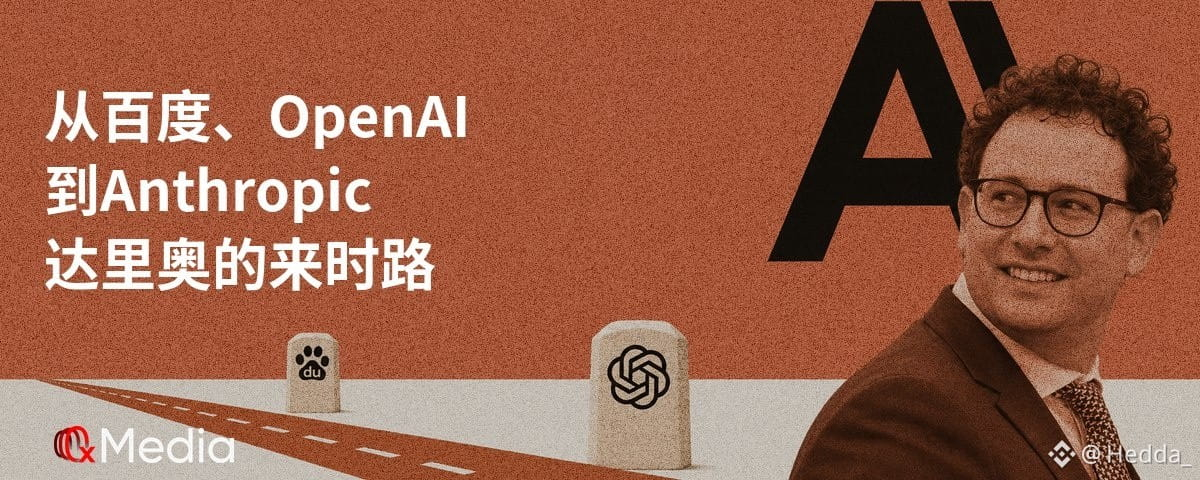


Anthropic officially debuted on the Nasdaq. On its first day of trading, its share price briefly climbed to $111.50, bringing the company’s market capitalization to around $1.3 trillion. From co-founding Anthropic in 2021 to joining the ranks of trillion-dollar companies today, co-founder and CEO Dario took just over five years. Yet Dario’s career has not been smooth sailing. From initially studying physics and biology, to joining Baidu’s Silicon Valley AI Lab, then moving on to Google Brain and OpenAI, what has this influential and controversial figure in the field of artificial intelligence been through?
Perhaps Dario had already planted the seeds of everything we see today while he was at OpenAI
On December 29, 2020, OpenAI announced on its website that Dario, its vice president of research who had worked on GPT-2, GPT-3, and the series of projects on scaling laws, was leaving. He told the company that the project could do more and conduct more research. This was, in fact, the project that would later become Claude
Dario was born on January 13, 1983, and his birth was registered in San Francisco County, California. His father, Ricardo Dario, was an Italian immigrant and leatherworker. His mother, Elena Engel, was a Jewish American who grew up in Chicago and later managed projects such as library renovations and furniture planning for the San Francisco Public Library system. The two married on March 2, 1979, and separated on April 19, 1991, when Dario was about seven or eight years old
The siblings grew up in San Francisco. In public accounts, they rarely go into much detail about where they grew up. Dario later said on a podcast that by the time the tech boom around his high-school years arrived, San Francisco had not yet really become gentrified to that extent. He had no interest in that boom at all; he found it boring
He attended Lowell High School, a highly competitive public school. In 2000, his name appeared on the U.S. Physics Team roster published by the American Association of Physics Teachers. That year's training team had 24 members. His high-school physics teacher, Shapiro, remembered him as a student with exceptional mathematical ability who often worried excessively that his solutions were not elegant enough
Dario first studied physics at the California Institute of Technology, then transferred to Stanford University, where he earned a bachelor's degree in physics in 2006. During this period, something deeply unfortunate happened. Dario's father, Ricardo, had hepatitis C and died in 2006, the same year Dario graduated from Stanford
He later turned to biophysics and became interested in intelligent systems. Big Technology even said directly in a 2025 in-depth interview that this AI leader, one of the field's most outspoken figures, found his direction in the midst of a personal tragedy
He went on to focus his training on neural circuits, proteomics, and cancer biomarkers at Princeton and Stanford Medical School. In 2007, he became a Hertz Foundation Fellow and went to Princeton University to study biophysics and physics. His 2011 doctoral dissertation was titled “Network-Scale Electrophysiology: Measuring and Understanding the Collective Behavior of Neural Circuits.” At Princeton, he worked on statistical-mechanical models of neural circuits and developed new devices for intracellular and extracellular recording. He then went to Stanford Medical School for postdoctoral research, focusing on mass spectrometry, network models of cellular proteomes, and cancer biomarkers
From November 2014 to October 2015, Dario worked at Baidu. He was based at Baidu's Silicon Valley AI Lab, which was led by Andrew Ng at the time. But his time at Baidu may not have been as pleasant as outsiders imagine
At the time, Dario was not yet a well-known figure in AI. His academic background was primarily in physics and biology, rather than traditional computer science. According to former colleague and AI researcher Gregory Diamos, when the team first saw Dario's application materials, they were not even sure he was suited to machine-learning research. Some colleagues with formal engineering training looked down on him for this reason
However, after reading the code Dario had contributed to the ProteoWizard project, Diamos realized that his programming skills were excellent and supported hiring him. Once at Baidu, Dario devoted almost all his energy to research and quickly made up for the gap in his formal background. He made important advances in deep-learning speech recognition and encountered the scaling laws that would later profoundly shape his research philosophy
However, the rift between Dario and Baidu's management may have been more serious than the initial disdain he faced from some engineers. In an October 2026 interview with Agence France-Presse, Diamos recalled that Dario was one of the most strong-willed members of the roughly 300-person research team. He had very strong personal views on research directions and would voice his disagreement without hesitation, even when speaking to researchers with far more experience than he had. The same trait shaped his relationship with management. Diamos said that if Dario disagreed with the company's direction, he would say so directly rather than keep quiet just because the other person was a manager. Over time, these disagreements grew
Details revealed by tech journalist Alex Kantrowitz in his in-depth investigation, The Making of Dario Amodei, appear to corroborate this account. As Baidu's AI research team continued to achieve technical breakthroughs, the strategic value of AI technology, research results, and computing resources rose rapidly, and disputes broke out within the company over who controlled these assets. His report says that intervention from Baidu's senior leadership further intensified internal tensions, triggering a steady exodus of research talent. The once high-profile Silicon Valley lab then gradually declined. The journalist sought comment from Andrew Ng about this history, but Ng declined to comment. Dario eventually left Baidu and joined Google Brain
Unlike his earlier work at Baidu, where he was primarily involved in developing the Deep Speech 2 speech-recognition system, at Google he gradually shifted his research interests toward AI safety. There, he began to seriously consider a question: as neural networks become more capable, can humans really understand and control these systems?
In June 2016, Dario and fellow researchers including Chris Olah published “Concrete Problems in AI Safety,” which systematically outlined five categories of AI safety problems: reward hacking, safe exploration, negative side effects, scalable oversight, and distributional shift. The paper later became one of the key early works in AI safety research
However, Dario's time at Google was also very brief. He gradually grew dissatisfied with the organizational culture of large tech companies and began to reconsider OpenAI's invitation. Meanwhile, OpenAI had evolved from an initial startup idea into a formally established nonprofit AI research organization, attracting many researchers. These changes eventually prompted Dario to change his initial assessment. Around July 2016, he officially left Google, joined the recently founded OpenAI, and began leading research on AI safety
At OpenAI, Dario led work on GPT-2 and GPT-3 and headed a safety team focused on interpretability and on how to embed human preferences and values into future powerful systems. On January 23, 2020, the paper “Scaling Laws for Neural Language Models” was published. In 2020, OpenAI had already released GPT-3 and launched the company's first commercial product
The good times did not last. Dario left again at the end of that year
OpenAI's official statement was carefully worded, emphasizing that both sides still shared the goal of responsible AI. Later, at a Council on Foreign Relations discussion, Dario put it very plainly: he felt that OpenAI's leadership was not taking seriously enough the task of getting AI right
In early 2021, Dario and his sister Daniela, along with five other former OpenAI colleagues, founded Anthropic. It is unusual in the industry for siblings to hold the top positions at a frontier lab together
On May 28, 2021, Anthropic announced that it had raised $124 million in a Series A round led by Skype co-founder and tech investor Jaan Tallinn. Participants included Dustin Moskovitz, the Center for Emerging Risk Research, and Eric Schmidt
On April 29, 2022, Anthropic raised $580 million in a Series B round led by Sam Bankman-Fried, then CEO of FTX. On May 23, 2023, the company raised $450 million in a Series C round led by Spark Capital, with participation from Google, Salesforce Ventures, and others
On September 25, 2023, the company announced that Amazon would invest up to $4 billion. AWS became the primary cloud provider for its key workloads, and Amazon acquired a minority stake. The governance structure remained unchanged, with the Long Term Benefit Trust continuing to guide the company under its responsible scaling policy. On May 28, 2026, the company announced that it had completed a $65 billion Series H funding round at a post-money valuation of $965 billion
On the eve of its November 2026 IPO, Anthropic released Claude Fable 5.2 and Claude Mythos 5.2. The two products use the same underlying model but have different access policies. Fable 5.2 has stricter cybersecurity and biology safeguards and is available to all users. Access to Mythos 5.2 requires an application through a life sciences or cybersecurity verification program
In evaluations, Fable 5.2 scored 69.9% on the FrontierSWE v2 agentic coding benchmark, outperforming Opus 5.5 at 62.3%, GPT-6 Astra at 65.5%, and Gemini 4 Carbon at 61.2%. However, on the AutomationBench business workflow benchmark, Fable 5.2 scored 51.4%, slightly below Gemini 4 Carbon's 53.9%
Perhaps buoyed by this technological strength, Anthropic further expanded the size of its offering on the eve of IPO pricing. On November 18, the company increased the number of shares on offer by about 19% to 980 million and ultimately priced them at $83 per share, above the previous range of $70 to $78. The public offering alone raised $81.34 billion. Together with $26 billion in private funding raised around the same time, the total financing exceeded $107.3 billion. This record-breaking IPO gave Anthropic the vast capital it needed to keep expanding and lifted Wall Street's expectations for its future growth to new heights
Anthropic's share lockup arrangements are also worth watching. According to the final prospectus, up to 315 million previously restricted shares will be eligible for sale on the first day of trading, with more shares to be released in stages afterward. Following the release of the company's full-year 2026 results, approximately 1.7 billion additional shares could become eligible for sale. After the first-quarter 2027 results are released, or around 180 days after the IPO, up to another 3 billion shares will enter the corresponding lockup-expiration window
But in fact, the market remains deeply divided over Anthropic's long-term prospects
A November 13 Reuters report noted that investors' main concerns include whether Anthropic can maintain its lead and whether Claude can expand beyond coding into the broader enterprise market. Some investment banks forecast that the company's 2028 revenue could reach $270 billion to $280 billion, while some investors have put forward estimates about 30% lower
IPOX analyst Lukas Muehlbauer believes some of the demand may come from investors' fear of missing out on a leading AI company, even though its long-term profitability remains uncertain. Talley Leger, chief market strategist at Wealth Consulting Group, also cautioned investors against ignoring valuation risks in pursuit of a hot IPO
The road ahead for Dario may be even tougher than it was before the IPO
Anthropic must prove that it can stay ahead in the fierce competition to build models, while also explaining to shareholders when its massive investments in computing power will translate into stable profits. The more intractable challenges, however, still come from AI itself. Founded as a public benefit corporation with a commitment to safety, Anthropic must grapple with a host of ethical issues, including models going out of control, cyberattacks, biological safety, and disruption to human employment. When technological progress, safety commitments, and shareholder returns come into conflict, Dario must make a choice
Liu Cixin once depicted a scene like this in The Three-Body Problem. In the desert late at night, Luo Ji explains the brutal laws of survival among civilizations in the universe to Shi Qiang. In his telling, the universe is a dark forest, and every civilization is a hunter lurking within it, gun in hand. They cautiously conceal their whereabouts, because no one can know what intentions the other hunters may have, let alone predict when they might pull the trigger
Today, this science-fiction story seems to find a kind of real-world reflection in the field of artificial intelligence. Tech companies, led by Anthropic, are all vying for a path to more powerful AI. Even knowing the dangers of technology getting out of control, no one dares to stop in their tracks. Dario may well be one of the hunters in this forest
Original: https://x.com/0xmediaco/status/2123762070856311127