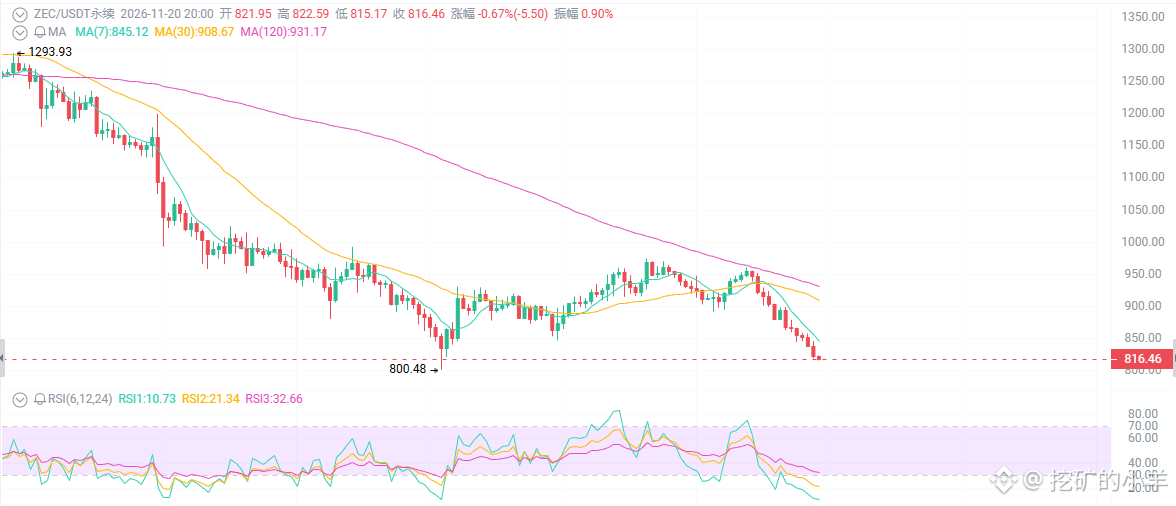
ZEC at $815—would you dare to buy the dip?
Thirty days ago, you thought $950 was too expensive. Now it’s $815 and you’re afraid it’ll go to zero. The ETF application was just filed, NU7 just launched, and the Extreme Fear Index has plunged to 10—is the privacy narrative really falling apart, or are you letting your emotions get the better of you again?
First, the surface picture: a sharp drop, but definitely oversold in the short term
The daily and 4-hour charts show a clear downtrend. Price is below the SMA 20 and 50, with the 200-day moving average offering a potential support reference. The RSI (14) is around 32–35, entering oversold territory. There’s room for an hourly bounce, but the daily chart hasn’t shown bottom confirmation like a double bottom or a strong engulfing candle.
The trend is still bearish, but a sharp rebound could happen at any moment in the short term. Don’t chase the drop and end up shorting right at the tip of the wick.
First up: the ETF application is here, but all you see is the price chart
Bitwise has filed an application for a spot ZEC ETF, proposing a listing on the Texas Stock Exchange, with Coinbase Custody involved. Grayscale’s ZCSH fund previously saw net inflows and also pledged $1 million to support the ecosystem. Winklevoss-linked Cypherpunk bought ZEC on the dip after mining became profitable.
Institutions are getting to work while prices fall; you’re cursing the market while prices fall.
Second: NU7 is live, and ZEC has a new engine
NU7 is live. Block times have dropped from around 75 seconds to around 25 seconds, making confirmations faster, and it also introduces fee-related mechanisms. NU7.1 is also being discussed, with even shorter block times.
ZEC has taken another step from “legacy privacy coin” toward “usable privacy infrastructure.” Speed is up, and the barrier to adoption is down.
But the market isn’t paying attention to that right now—it’s watching BTC.
Good news in a bear market is like serving a great meal to someone with no appetite. It’s not that the food is bad; the timing is wrong.
Third: governance voting is underway—noise in the short term, a signal in the long term
The community is voting (around November 16–30) on proposals related to the Dev Fund, including a possible transfer of around 50,000 ZEC from the Grants treasury and changes to reward allocation. In the short term, this could shift supply expectations; it’s internal governance noise. But it also shows that this old project is still evolving, still arguing, still alive.
A project where nobody argues is truly dead. ZEC is still arguing, which means people still care.