
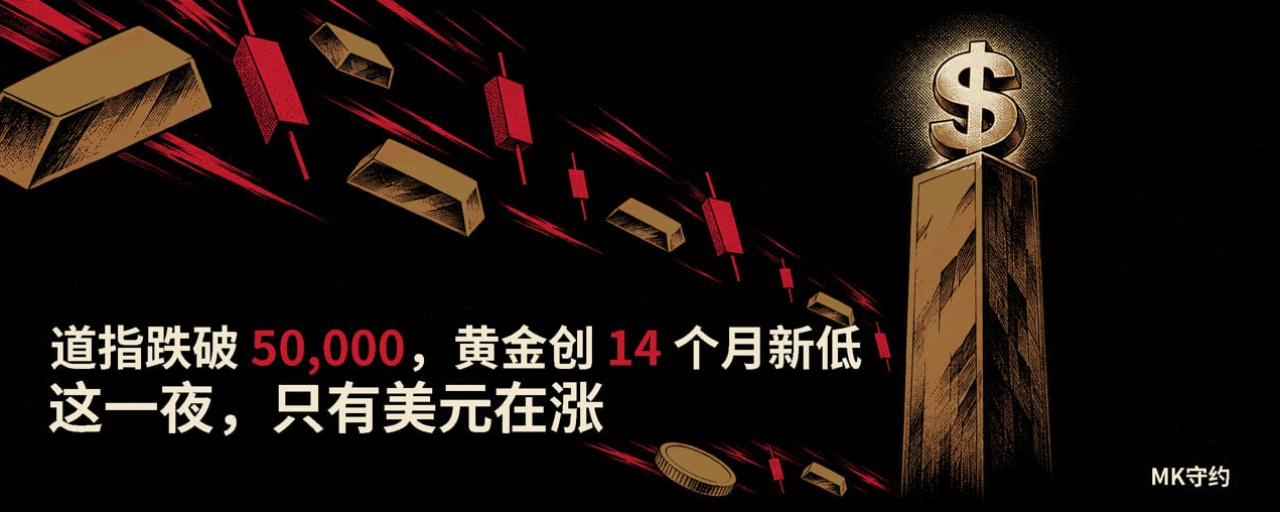


The Dow falls below 50,000, gold hits a 14-month low: Overnight, only the dollar rose
If you held U.S. stocks, gold, and Bitcoin last night,
all three fell together.
The two things that rose were the dollar and U.S. Treasuries.
And both of them happen to pay interest.
It wasn’t a coincidence.
That’s what last night’s 1,101-point drop in the Dow was all about.
1. The most counterintuitive thing: Long-term bond yields fell, yet gold hit a new low
According to the old playbook, with the 10-year yield down three basis points to 5.04%, gold should have rebounded.
Instead, spot gold fell to 3,667 intraday, its lowest level in a year and two months.
The COMEX December contract settled at 3,713, its lowest close in more than a year.
That’s down 34% from the January 29 record of 5,595.
Why did gold fall even as interest rates fell?
Because nominal rates fell, not real rates.
The 10-year TIPS reopened last night, with a real yield of 2.903% at auction.
That number says one thing.
To lock up money for ten years, investors need 2.9% compensation in real purchasing power.
Gold’s opportunity cost is measured against that number, not 5.04%.
That same day, 20-year Treasuries traded at 5.459%, with a bid-to-cover ratio of 2.63 and no tail.
Investors aren’t unwilling to take on duration; they’re unwilling to accept zero yield.
Remember that line—it explains every price move last night.
II. The Fed Has No Reason to Cut Rates—That’s the Key
Before U.S. markets opened last night, the Philadelphia Fed’s November manufacturing index came in at 6.3.
That was below expectations of 20.0 and the prior reading of 20.9, and the lowest in six months.
New orders fell to -0.4, turning negative after four straight declines.
In the same report, prices paid came in at 58.2, jumping fifteen points in a month.
Prices received came in at 47.0, the highest in more than four years.
Demand is falling; costs are rising.
This doesn’t look like a recession. It looks like stagflation.
You can cut rates in a recession; you can’t in stagflation.
So Wall Street isn’t trading on “when will they cut rates?” now, but “how much will they hike in December?”
Last week, Waller said a half-point hike in December might be needed to break the market’s psychological fixation on 3% inflation.
Growth is weakening, costs are rising, and policy can only get tighter.
The numerator—earnings—is being revised downward; the denominator—the discount rate—is not coming down.
This isn’t stocks and bonds both getting crushed; it’s the numerator and denominator both getting crushed.
Take another look at oil prices.
Brent at 92.72, WTI at 83.21. Both were up on the day.
Costs haven’t eased; they’re pushing higher.
So this report isn’t an isolated case.
Factory orders are falling, while factory input prices are rising.
With both happening at once, the Fed can only choose one side.
It will choose inflation, without question.
III. The Dollar Hits a 19-Month High: Money Is Flowing Back, Not Disappearing
The dollar index closed at 103.92 last night, up for the seventh time in eight trading days.
When the dollar rises, everything priced in dollars has to give ground.
Gold, crude oil, Bitcoin—none can escape.
And gold and Bitcoin have something else in common: neither pays interest.
Gold is down 34% from its January record; Bitcoin has fallen from 86,500 in early October to 61,900 last night.
With nominal yields at 5.04% and real yields at 2.9%, the carrying cost of zero-coupon assets has been repriced to its most expensive level in over a decade.
That 2.9% is the anchor for all valuations in this cycle.
As long as that anchor doesn’t move lower, growth stocks and zero-coupon assets have no reason to reprice higher.
So last night wasn’t about seeking safety. It was about prioritizing yield.
A flight to safety means indiscriminately buying safe-haven assets.
Last night, investors bought only the two kinds that pay interest.
That distinction determines where the bottom is.
If it were a flight to safety, prices should rebound after the sell-off.
If it’s yield-driven pricing, money won’t come back until the relative appeal of yields declines or growth expectations turn higher again.
And right now, neither has happened.
IV. Last Night Delivered the Test I Set Up Yesterday
In yesterday’s piece, I set out a test that could be verified that same day: ANT’s first day versus the Nasdaq.
The answer: the Nasdaq lost, and lost decisively.
ANT priced at 83, opened at 111.50, surged to 114 intraday, and closed at 97.17, up 17%.
From its opening price, it gave back 12.9% in a single day.
Now look at the broader market.
The Nasdaq was up 2% in early trading, then closed down 2.25%.
More than 90% of S&P 500 constituents fell; all eleven sectors finished in the red.
The Dow fell 1,101 points to close at 49,097, its first close below 50,000 since June.
Over the four trading days this week, the Dow fell 6.2% and the S&P 500 fell 5.1%.
One stock rose 17%; one market fell 2.25%.
I wrote the test. I didn’t provide the answer—the closing prices did.
The biggest IPO in history is no longer a sentiment engine. It has become an exit for liquidity.
The primary market captured a 17% premium, while the secondary market paid a 2.25% price on the very same day.
V. Crypto: Money Is Leaving, and So Is Market Depth
Bitcoin hit a low of 61,300 last night and is now at 61,900.
A seventh straight daily loss is in sight; Bitcoin has shed about $20,000 since mid-October.
ETF flows are the first piece of evidence.
There were $2.89 billion in net outflows in November, with outflows on eleven of the thirteen trading days.
Total net assets stand at $77.7 billion, their lowest level in three months.
There’s another figure that rarely gets mentioned.
Order-book depth within 1% of the midpoint is down 38% from late October.
What does a 38% drop in depth mean?
The same sell order can drive a drop twice as large.
That’s why 62,000 can look like it’s “holding”—until it suddenly breaks.
Now look at who’s getting liquidated.
Over the past 24 hours, $178 million in Bitcoin positions were liquidated, 78% of them longs.
Long positions are being forcibly closed. This isn’t panic; it’s a lack of margin.
VI. Four Numbers to Watch Today
1. The dollar at 104. A close above 104 means global capital is still flowing back into dollars, and gold and crypto haven’t bottomed yet.
A move back below 103 would mean this round of margin replenishment is finally over.
2. Gold at 3,700. If the daily close can’t reclaim this level, the next range is 3,500 to 3,600, where most institutions put it.
3. Bitcoin at 61,300. A daily close below this level puts 57,800—the July low—in view; the next level down is 53,700, the realized price.
4. ANT at 83. A break below the IPO price would erase the entire first-day premium and cut off the last tail of sentiment in the AI trade.
One more thing this morning: Japan’s Nikkei is indicated to open down 2.8%, and Hong Kong’s Hang Seng is down 1.1%.
Asia is settling the bill for U.S. stocks.
Three things to watch tonight. China’s LPR fixing is at 9:15 a.m.
At 7:30 tomorrow morning, Japan releases October CPI; Philadelphia Fed President Paulson is also scheduled to speak around the same time.
VII. Three Things Not to Do Today
1. Don’t use “it’s fallen a lot” as a reason to add leverage.
The harshest part of last night wasn’t the size of the drop; it was how broad it was.
With 90% of constituents down, there are no structural opportunities in this kind of market—only more structural declines.
2. Don’t read “interest rates fell” as “easing is here.”
The 10-year yield fell three basis points, while gold fell 1.3% on the same day.
The market has already told you through prices: it sees recession, not rate cuts.
3. Don’t use “gold is down 34%” as a reason to buy.
The size of the decline isn’t the evidence; real rates are.
A genuine turning point for gold would come when 10-year TIPS yields move down from 2.9%.
The most valuable thing you have today isn’t your position—it’s cash.
5.04% nominal, 2.9% real: that’s the price you’re waiting for.
Cash isn’t conservative.
In a year when every asset is being repriced, those who can hold cash are the ones who can name their price when others are forced to sell.
Only those who can afford to wait deserve to buy at the bottom.
(Data cutoff: 8:00 a.m. Beijing time today. U.S. stocks: last night’s close; gold: COMEX December settlement and intraday spot prices; crypto: Kraken and Coinbase spot prices.)
(This article is market analysis and does not constitute investment advice. Data are from public sources.)
— MK守约