


When blockchain is mentioned, most people immediately think of cryptocurrency. This is actually the biggest misconception.
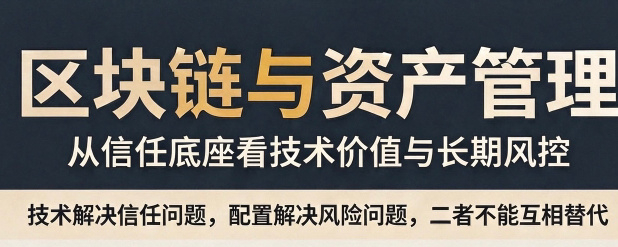
Cryptocurrency was merely one of the early experimental applications of blockchain technology. Blockchain itself is an underlying technology that is distributed, tamper-proof, and traceable. Its true value lies not in speculation, but in solving the most fundamental challenge in traditional commerce: trust.
I. The Core of Asset Allocation Has Never Been Chasing Short-Term Returns
When it comes to asset management, many people fall into a common misconception: they keep looking for a high-return asset, hoping to reap outsized gains all at once. But truly prudent asset allocation is fundamentally about building a sustainable, risk-managed system that can be passed down.
There are three underlying principles of asset allocation:
1. Diversify risk: Don’t concentrate all your funds in a single asset class; avoid being wiped out by a single point of failure.
2. Take a long-term view: Wealth is built through compounding over time, not short-term market timing.
3. Ensure foundational security: For any asset, first ensure that ownership is clear, records are verifiable, and information cannot be tampered with.
Traditional asset systems often face problems such as information asymmetry, easily altered documents, high costs of reconciling records across multiple parties, and difficulty proving ownership in disputes. This is where blockchain technology can make a difference.
II. Blockchain Technology: Building Trust Infrastructure for Assets
Blockchain’s core features include distributed ledgers, on-chain data records, permanent timestamps, and validation through multi-party consensus. These features ensure records are authentic and cannot be changed unilaterally, without relying on a single third-party institution to vouch for them.
Applied to asset-related scenarios, blockchain can be used in several key areas:
• Digital proof of ownership: Record intellectual property, digital assets, contracts, and transaction history on-chain, preserving verifiable proof of when they were recorded to facilitate future rights protection and ownership verification;
• Asset tracking and tracing: Record the entire movement of physical and supply chain assets on-chain, making every step traceable and reducing counterfeiting and information concealment;
• Multi-party collaboration and reconciliation: Synchronize records of asset transactions between companies and institutions on-chain, reducing the cost of manual reconciliation and the risk of accounting disputes;
• Compliant digital management: Within a lawful and compliant framework, use technology to make asset registration, verification, and transfer more transparent.
One distinction is important: blockchain is a technological tool, not an investment asset. The technology itself is neutral and can serve many real-world industries, including finance, traceability, recordkeeping, supply chains, and public administration.
III. A Rational Perspective: Technology Has Limits, and Risks Must Be Addressed Upfront
Blockchain is not a cure-all.
It cannot eliminate market volatility, guarantee asset appreciation, or replace laws and regulations. Before implementing a project, you must first ensure that it meets actual needs, undergoes security audits, has a sound permissions design, and receives a compliance assessment. Otherwise, even the most advanced technology will be nothing more than a castle in the air.
When building technology for assets, security must always come first. Contract vulnerabilities, backdoors in access controls, and data risks must all be addressed in advance. A reliable on-chain system must be developed from the ground up, with source code under your control, audited for security, and designed for long-term updates and maintenance.
IV. Conclusion
Market enthusiasm will ebb and flow, and speculative narratives will fade, but the value of technology will endure.
In the future, asset management will be less about who catches the next short-lived trend and more about who builds a more robust, transparent, and secure asset framework. Blockchain technology is the foundation of trust within that framework.
Don’t chase bubbles; return to the fundamentals of technology. Don’t believe in overnight riches; prioritize long-term risk management. This is the most rational way to think about blockchain and asset allocation.#区块链 #资产配置 #资产管理 #资产上链 $BTC $USDT
