



At the new table where cross-market assets flow around the clock, Binance has revealed its AI trump card.
Written by ChandlerZ, Foresight News
Over the past decade, whether crypto-native trading platforms or traditional online brokerages, the underlying logic of expansion has been much the same: put more assets on the shelf and deepen liquidity at the moment trades are matched. But today, as stocks, ETFs, commodities, and crypto derivatives gradually converge in a single account, the competitive moat built purely on expanding asset offerings is approaching its limits. The strategic battleground for global financial platforms has shifted much further upstream, to the long journey users take before they press the buy button.
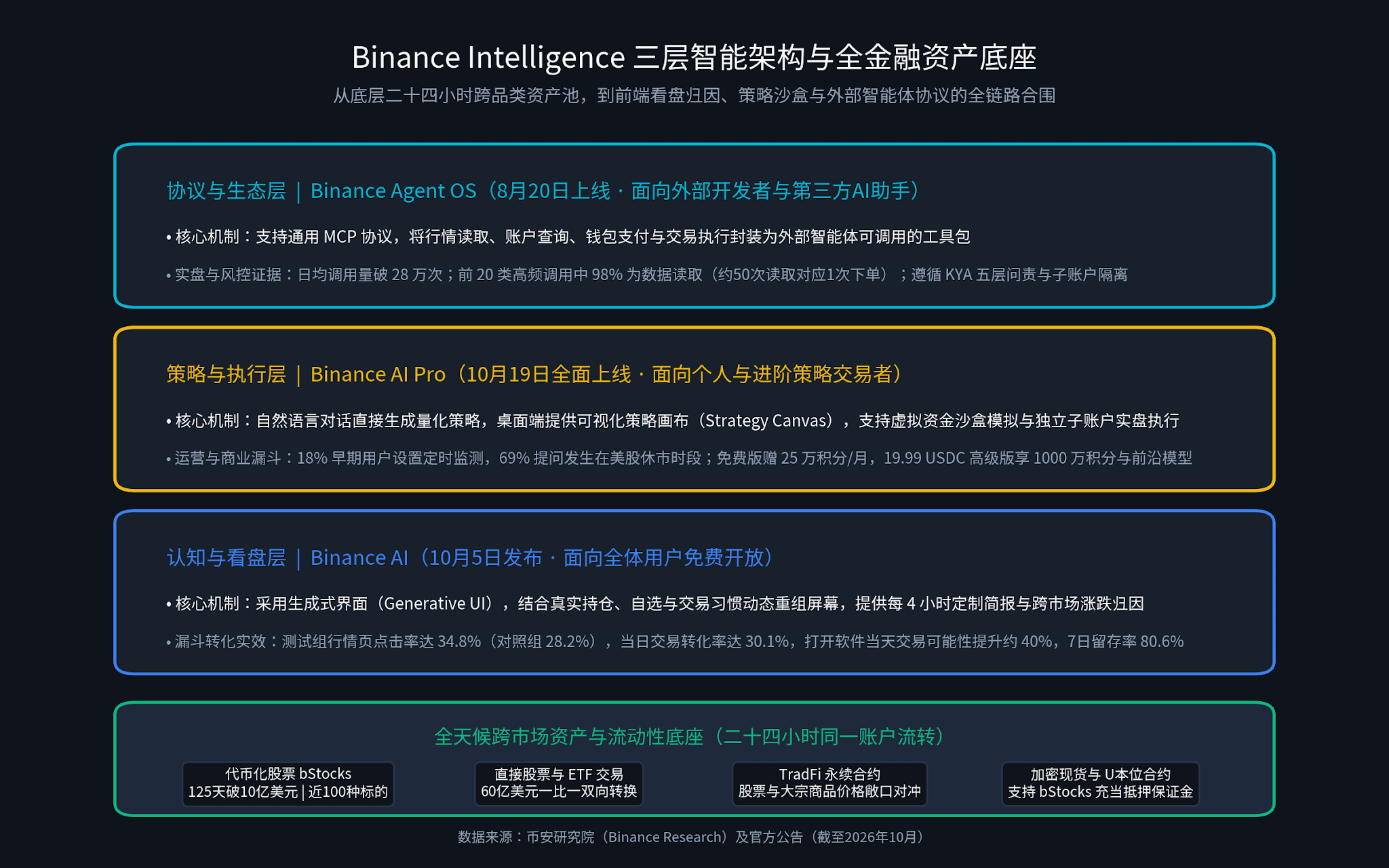
In October 2026, Binance unveiled major progress in its AI business, bringing this strategic shift to the forefront. On October 5, Binance announced the launch of Binance Intelligence, an AI product stack comprising three products: the free Binance AI for all users, Binance AI Pro, which turns natural language into executable strategies, and Binance Agent OS, which developers can use to build AI applications.
On October 19, Binance AI Pro became available to all users worldwide on both the web and the Binance App. This AI agent is focused on finance: users can describe trading ideas in a conversation, and it turns them into visual automated strategy workflows without requiring any programming. Strategies can first be tested through simulated trading and then deployed for live trading after user approval. Each live strategy runs in an isolated sub-account, and funds can only be transferred there manually by the user.
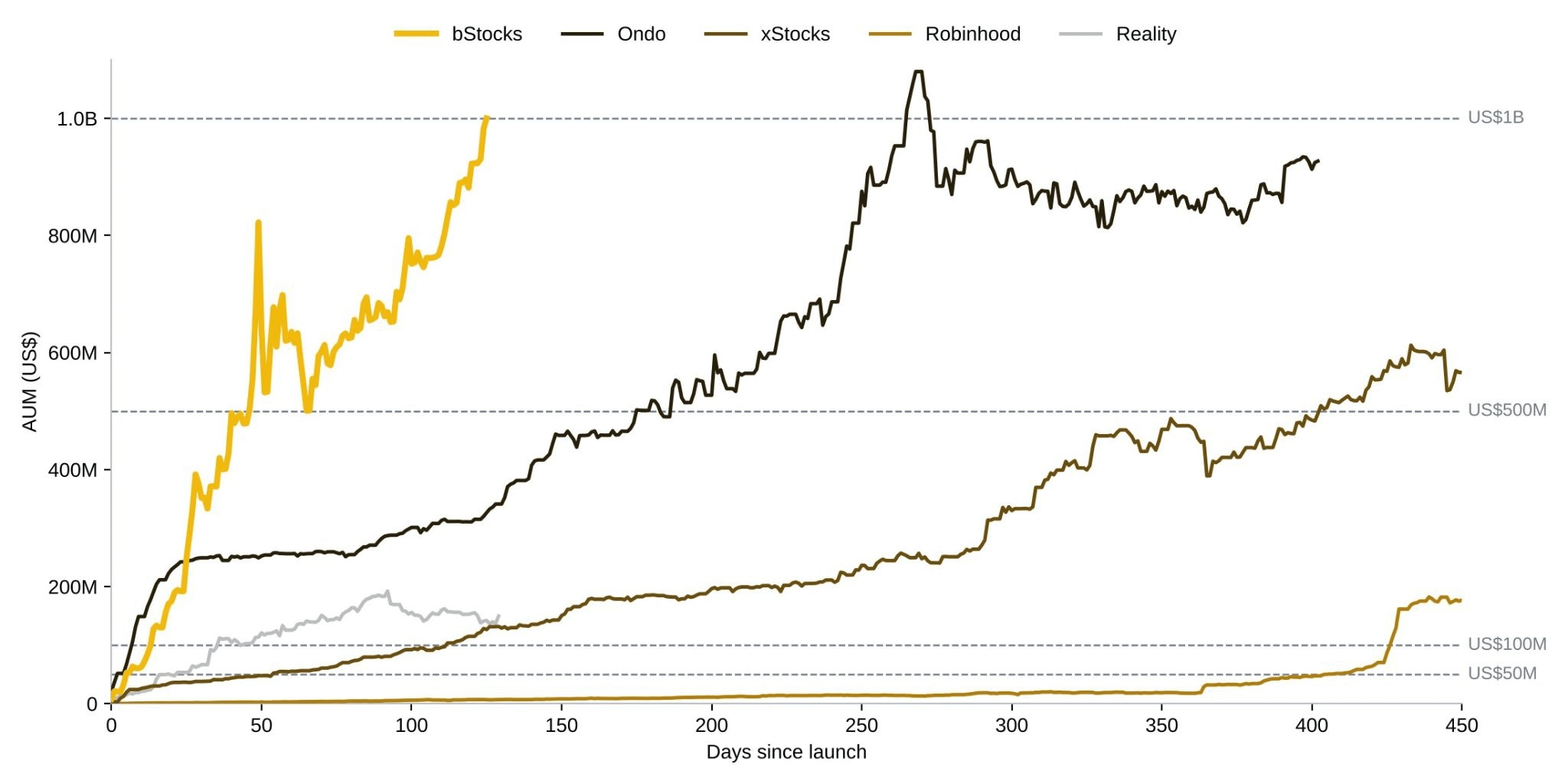
Just days before AI Pro became fully available, Binance’s connection to traditional financial assets also crossed a major scale milestone. bStocks, its tokenized stock product launched on June 11 this year, surpassed $1 billion in assets under management in 125 days, with cumulative trading volume exceeding $40 billion.
These two business lines converged in the same autumn, outlining Binance’s strategic play for the new cycle and ushering in a new round of competition among trading platforms. Robinhood and Coinbase are rapidly bringing agents, U.S. stocks, and perpetual futures into a single app. Binance, meanwhile, is expanding its around-the-clock asset pool with tokenized stocks and using a three-tier AI toolkit to rewrite the processes for monitoring markets, testing strategies, and placing orders. As large language models reshape how people interact with financial markets, the battle for position at the gateway to the next generation of global asset trading is now in full swing.
Global Assets Converge: The AI Revolution in the Trading Room
Traditional financial assets are being brought into crypto accounts faster than the market expected.
Since the start of this year, the global tokenized stock market has surged from approximately $700 million at the beginning of the year to more than $3 billion by the end of September, making it the fastest-growing real-world asset category of 2026. In this wave, Binance’s bStocks reached $500 million in 46 days and crossed the $1 billion mark on day 125—less than half the time taken by another major issuer in the same sector, Ondo (265 days). Another platform, xStocks, took 403 days to reach $500 million.
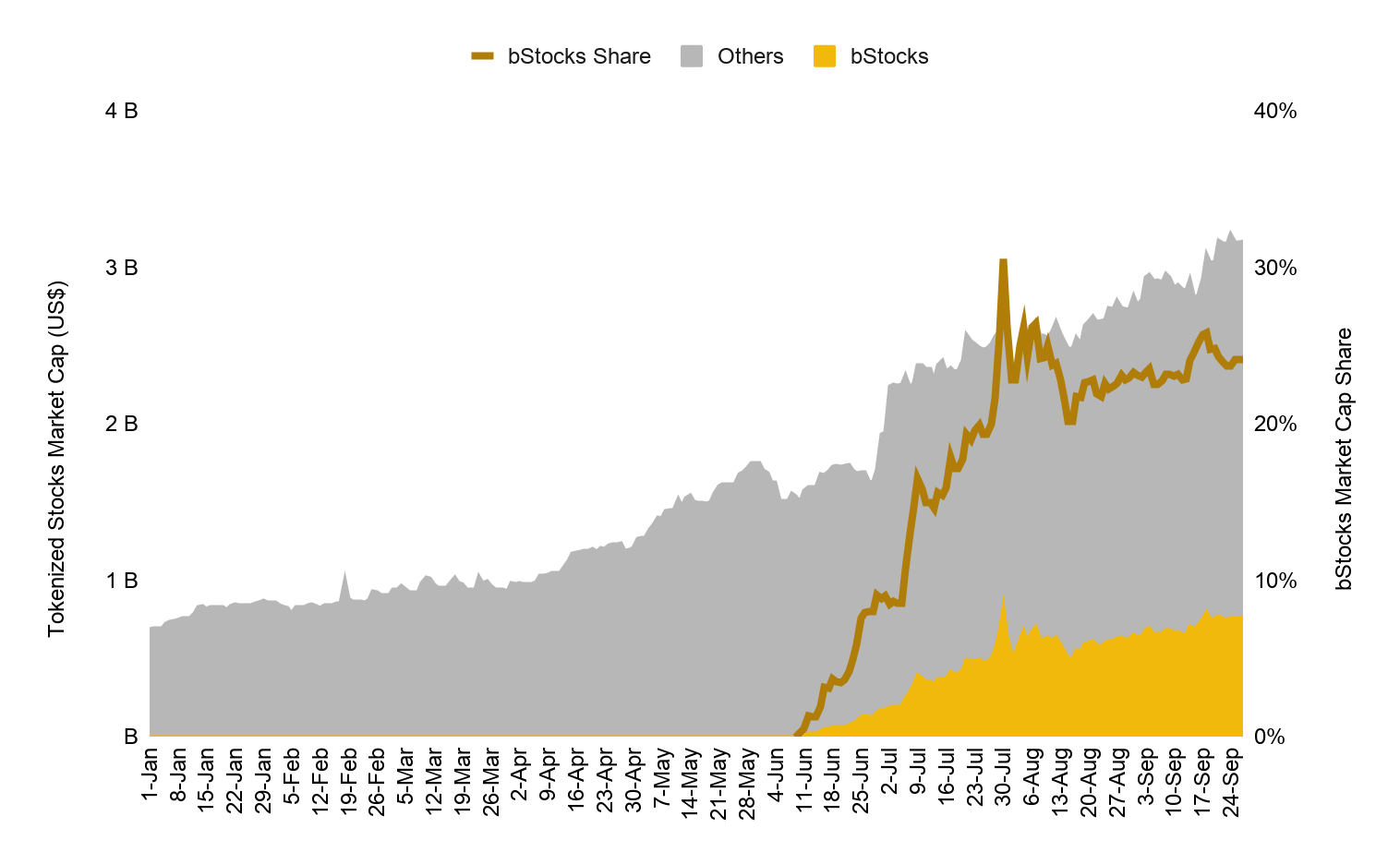
In just four months, the range of bStocks assets expanded from 5 to nearly 100 U.S. stocks and ETFs. The product accounted for more than 60% of the growth in the entire tokenized stock market during the same period, with its market share leaping from less than 1% to 34.2%.
These assets, which provide exposure to the U.S. stock market, have even become widely integrated into around-the-clock trading. Data shows that the volume of one-to-one conversions between direct stock holdings and bStocks has reached $6 billion, with about 56% of trading taking place outside regular U.S. market hours. By October 19, bStocks equivalent to about 17% of assets under active management had been deployed in decentralized finance protocols for lending or providing liquidity. In terms of user demographics, young Gen Z users accounted for 46% of all bStocks users. They traded on weekends at a rate of 11.5%, well above the 6.9% rate among other age groups.
With nearly 100 forms of U.S. stock exposure, commodity contracts, and crypto assets all moving in a 24-hour market, traditional market data software—largely unchanged for more than a decade—has quickly revealed its shortcomings. Faced with public information feeds sorted by popularity, ordinary investors struggle to figure out in a few minutes how an after-hours tech earnings report or a weekend macroeconomic announcement relates to their holdings across U.S. stocks and Bitcoin.
To help users navigate this cross-market complexity, Binance turned the experience it had accumulated over the past few years with more than 100 AI models in its internal risk control and compliance systems into Binance Intelligence, a suite directly aimed at users.
The first tier is Binance AI, which has been rolling out free to users worldwide since October 5. It does away with a fixed software layout and uses generative interface technology to dynamically reorganize screen content based on each account’s actual holdings, watchlists, and level of knowledge. It brings charts, news, social sentiment, and on-chain data together in one place, generating a personalized text and audio briefing every four hours.
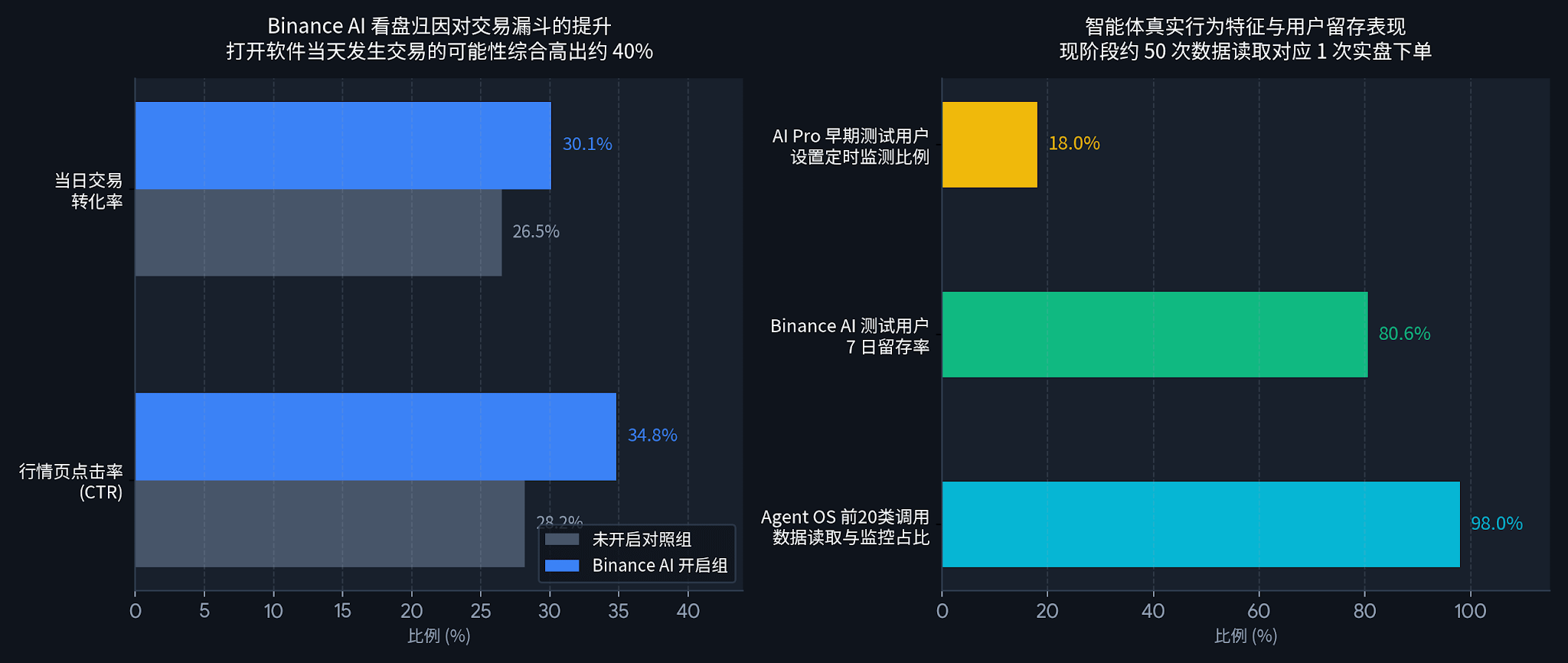
Comparison tests conducted by Binance Research through October 4 showed that the tool directly improved conversion through the trading funnel. Users in the test group had a market-page click-through rate of 34.8%, compared with 28.2% in the control group. Their same-day trading conversion rate rose from 26.5% to 30.1%, making them about 40% more likely overall to trade on the day they opened the app. The seven-day retention rate also remained high at 80.6%.
After understanding the market, the next step is turning trading ideas into strategies that run automatically. Binance AI Pro targets the pain point faced by individual investors who do not know how to code. Users describe their target assets, buy and sell conditions, and risk limits in everyday language in a chat window. The system then draws on Binance’s in-house market research and external data sources to automatically fill in any missing parameters.
On desktop, AI Pro generates a visual flowchart called the Strategy Canvas beside the chat window. Users can click any module to inspect details, adjust parameters, or add and remove steps. On mobile, the entire strategy-building and code-generation process takes place through conversation. Each user can run up to 10 strategies at a time, covering simulated trading, live execution, or signal alerts. Internal testing found that 18% of early test users had used it to run scheduled monitoring or daily report tasks, and 69% of questions were asked outside U.S. stock market hours.
External Agents Force Open the Ledger
If Binance AI and AI Pro are transforming the experience inside Binance’s software, Agent OS, the developer infrastructure launched on August 20 this year, is designed to address a more radical trend: more and more traders are leaving traditional software interfaces and initiating tasks directly through external AI assistants.
This shift is also related to how AI tools connect to external services. The Model Context Protocol (MCP) provides a standardized way for AI applications to access external data and tools. For example, users can ask an AI assistant to query market data, read account information, or submit trading instructions within the scope of its authorization. As tools such as Claude, ChatGPT, and coding assistants are used for investment tasks, the ways users access information and operate their accounts are also multiplying.
Through Agent OS, Binance opens market data access, account queries, order submission, and wallet-related capabilities to external agents. To use the exchange’s MCP service, users must scan a QR code to log in and complete identity verification. According to the data provided, the peak daily call volume reached 1.2 million for MCP services covering only Binance’s centralized exchange business.
Agent services on Binance Wallet likewise require users to scan a QR code to log in and complete identity verification. Users can authorize agents to use an on-chain wallet within specified limits. Driven by the Agent ID campaign, the combined daily peak for Wallet-related calls and exchange MCP calls can reach 50 million. The number of related users has surpassed 300,000. Each Wallet user can create one Agentic Wallet, and identity verification enables the system to identify the user.
At the trading layer, agent-related transactions have exceeded one million, with contributions from both Web3 and centralized exchange businesses. In a live-trading example disclosed by Binance, trader Crypto Eagle connected Agent OS to the external coding agent Codex and used natural language to instruct it to buy BNB with USDT. The order was submitted after user confirmation, and the system then returned the average fill price, fees, and updated balance.
As soon as external software starts handling real funds, the boundaries of authority and responsibility become a sword of Damocles hanging over every financial institution. On this issue, Binance and U.S. online brokerages have taken distinctly different approaches to risk control.
At the end of May this year, Robinhood launched an agent trading feature based on the MCP protocol, allowing users to connect third-party agents to a dedicated brokerage account. Robinhood later introduced an in-app agent feature that lets users set up manual approval for each order. This option is enabled by default during setup, but users can change it themselves.
Binance, by contrast, has chosen a more cautious principle of limited autonomy. In October this year, Binance’s global policy team published a compliance framework report titled Know Your Agent (KYA), in response to the Monetary Authority of Singapore’s Runtime Security Framework (SAFR), introduced in July this year, and the UK’s financial AI adoption plan. The report proposes that, beyond traditional KYC, the financial industry must establish a five-layer accountability mechanism that strictly distinguishes agents’ authority to provide analytical recommendations from their authority to execute trades.
This principle is written directly into the underlying code of AI Pro and Agent OS. Within Binance’s system, agents used only for market research cannot access trading permissions, and any strategy approved for live trading must run in a dedicated sub-account isolated from the main account. Users must manually transfer funds to the sub-account. AI cannot transfer capital from the main account on its own, and is strictly prohibited from making withdrawals to external addresses. Every change to a strategy’s parameters must be approved by a human again, and users can cut off all external agent connections at any time by pressing the emergency kill switch.
The Battle to Become the All-in-One Financial Platform in the AI Era
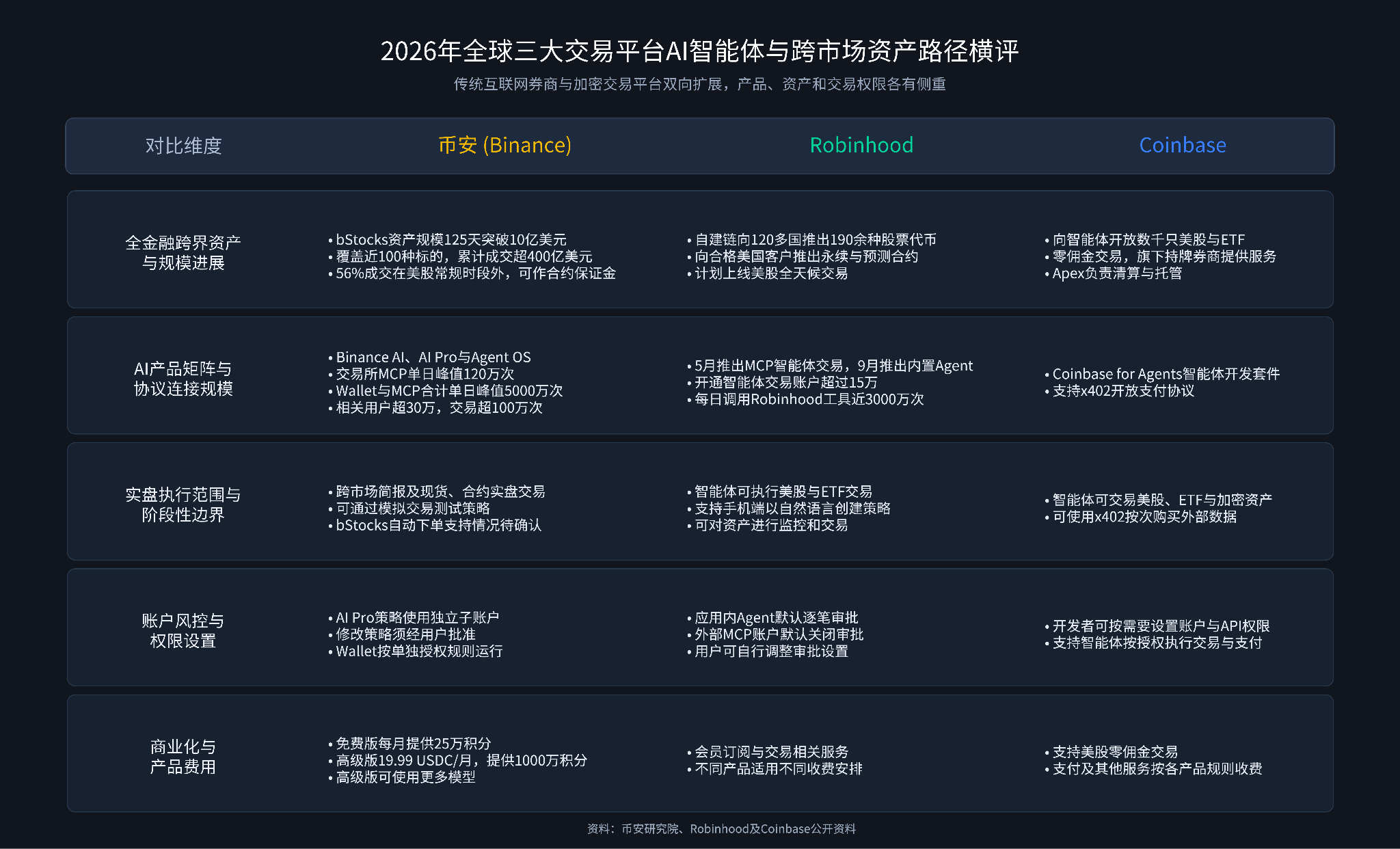
Take a broader view, and it becomes clear that Binance’s flurry of moves in the fall of 2026 is part of a two-pronged encirclement by the world’s leading trading platforms. Traditional online brokerages are aggressively moving into crypto derivatives, around-the-clock trading, and on-chain tokenization, while crypto trading platforms are moving in the opposite direction into equities and agent access points.
Robinhood has been the most aggressive. After launching stock tokens based on derivative contracts in Europe last year, Robinhood launched the mainnet of its own blockchain on July 1, offering wallet users in more than 120 countries over 190 on-chain stock tokens backed one-to-one by real shares. On September 29, Robinhood CEO Vlad Tenev announced that since opening agent trading to third parties in May, 150,000 customers had opened agent trading accounts, with Robinhood tools being called nearly 30 million times a day.
Another crypto giant, Coinbase, has taken a different tack, starting with compliant U.S. equities and machine-to-machine micropayments. After launching agent tools in June this year, Coinbase officially opened commission-free trading in thousands of U.S. stocks and ETFs to its agent services in late September, with its licensed brokerage subsidiary and Apex handling clearing and custody. More distinctively, Coinbase has tied stock trading to the x402 payment protocol it helped develop. The protocol uses payment status codes at the internet’s foundational layer to let AI agents purchase external paid data directly, on a per-use basis with USDC stablecoins in their accounts, without interrupting tasks or requiring manual credit card input or key management. As of September, the x402 protocol had processed more than 230 million transactions totaling over $54 million. Market data provider Massive has integrated the protocol, allowing agents to spend a few cents to purchase a piece of U.S. stock data in real time and immediately place an order within the same closed loop.
In this multi-sided battle, Binance holds two advantages that competitors will find difficult to replicate in the short term. The first is its enormous real-world liquidity and the ability to reuse assets across scenarios. bStocks not only reached $40 billion in trading volume in four months, but also allows users to use the tokens as contract margin. As a result, the share of outstanding loans backed by bStocks assets deposited as collateral surged from 5.5% at the end of June to 46.2% in mid-September. The efficiency of reusing funds across spot, futures, and on-chain protocols within the same account is beyond the reach of traditional brokerages.
The second advantage is a monetization funnel built on a user base of 300 million. Binance has designed a clear points system: all users receive 250,000 points per month for free to build and test strategies, while the premium plan, priced at 19.99 USDC per month, raises the allowance to 10 million points and unlocks access to leading large language models such as ChatGPT Sol, ChatGPT Astra, and Claude Opus, as well as the ability to top up points. Payments can be made through Binance Pay. High-frequency monitoring tasks and automated strategies continuously consume points, naturally converting active traders into paying subscribers and creating a stable software services revenue stream alongside traditional trading fees.
From Every Trade to Everyday Investing
Looking back from the vantage point of the fourth quarter of 2026, the dimensions of competition among global financial trading platforms have changed completely.
In the past, there were clear dividing lines between platforms: you went to a brokerage to trade U.S. stocks, a crypto exchange to buy Bitcoin, and a dedicated code-hosting platform to write quantitative strategies. Today, these boundaries are dissolving all at once. bStocks accumulated more than $1 billion in assets in four months, demonstrating how quickly on-chain infrastructure can provide exposure to traditional equities. Meanwhile, the launch of Binance Intelligence’s three-tier product suite marks the start of Binance’s systematic takeover of the investment research and engineering work users do before pressing the trade button.
Of course, the battle for position at the intersection of AI and all-in-one finance is only just entering the deep end, but the irreversible trend is already written on the wall. As financial markets become sophisticated machines running nonstop, the era of individuals going it alone using only their own time and energy is coming to an end. Whoever can use safer agents to help ordinary people make sense of complex cross-market information will give users a reason to open their software that goes beyond occasionally buying or selling an asset—and turn it into a way to manage their everyday investments.