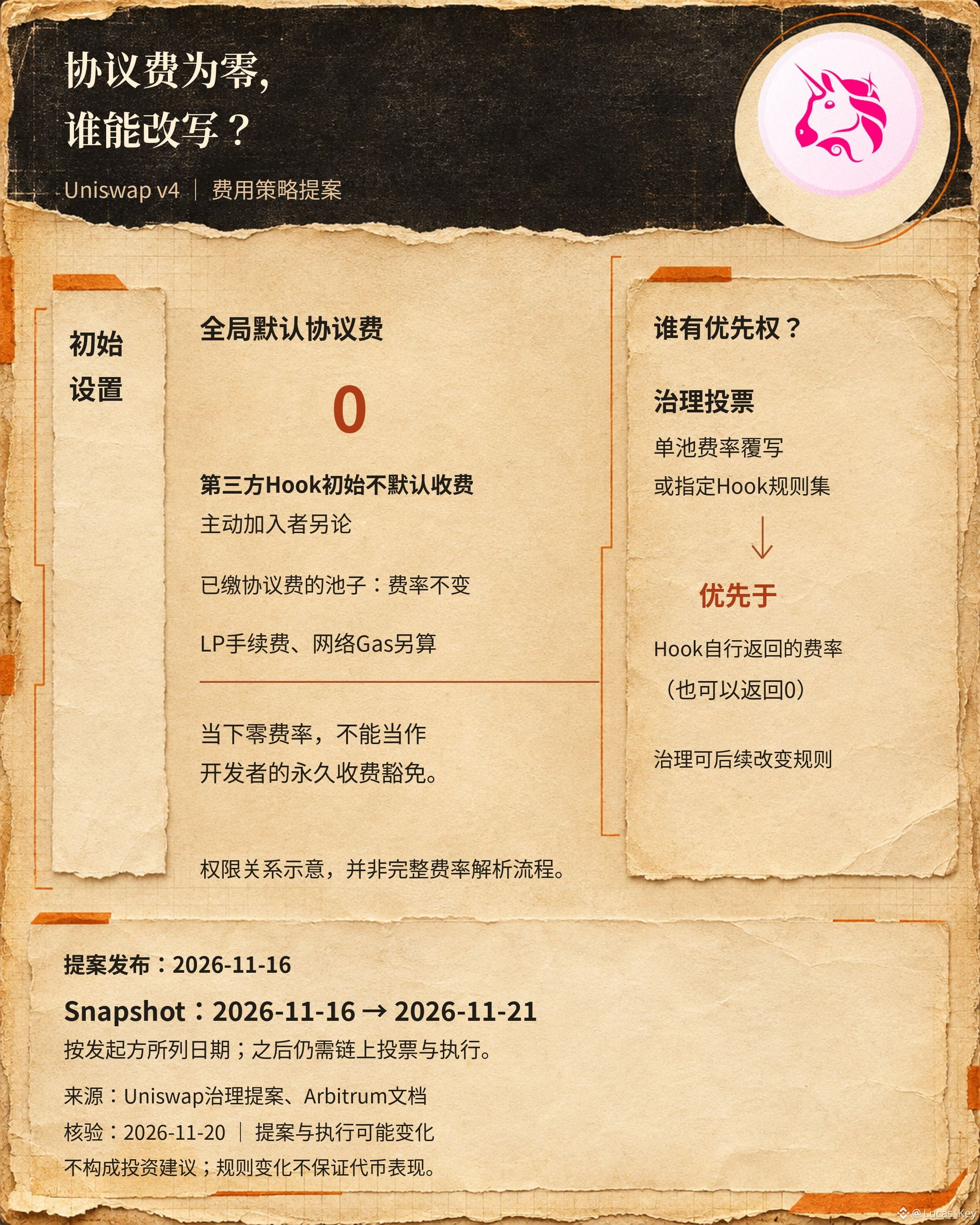
The number easiest to overlook in this round of Uniswap v4 fee-upgrade proposals is 0. $UNI 's protocol-fee mechanism is becoming more flexible, but don't translate that as “all Hook pools will be charged fees.”
In its November 16 proposal, Uniswap Labs stated that the global default protocol fee would be set to 0, third-party Hooks would not be charged by default initially, and opting in would be a separate matter; pools already paying v4 protocol fees would keep their current rates. A Hook is a contract that adds custom behavior to a pool, and different Hooks may use different fee structures.
Follow the decision-making authority up the chain, and you'll find a more interesting boundary. A Hook can return its own fee rate, including 0; but a per-pool fee rate set by a governance vote, or a rule set assigned to a Hook, takes precedence over the Hook's own value. Developers have choices, but they cannot interpret the current zero rate as a permanent exemption. This 0 refers only to the protocol fee; LP fees and network Gas do not also drop to zero as a result.
The case for the upgrade is that shared rules can accommodate more static, dynamic, or custom-fee pools, reducing the duplicated development work across different Hooks. The point to be cautious about is that the greater the flexibility, the more important it becomes to have clear authority, review, and predictable processes when governance changes the boundaries of fees in the future. Otherwise, developers and liquidity providers will find it difficult to price for the long term.
$ETH and $ARB are also part of this relationship: both Ethereum and Arbitrum are within the scope of the policy change, and transaction Gas on Arbitrum is still paid in ETH. Uniswap protocol fees from pools, demand for using the chains, and the value of the ARB ecosystem cannot be combined into a single source of revenue. The initiating party gave a Snapshot voting window of November 16–21, after which an on-chain vote and execution would still be required. I track new strategy addresses, actual permissions, and the fee rates applied to individual pools, rather than counting the proposed expansion as revenue before it happens. Sources: Uniswap governance proposal and Arbitrum documentation, verified November 20, 2026. Risk disclosure: The proposal and its implementation may change; this is not investment advice. This post may receive platform creator rewards.