By Friday afternoon, the European session was already open. Some people saw a SOL ecosystem aggregator hit its weekly high during the day, then get cut by about 15% and end up near its intraday low, and took that to mean DEXs had already been flushed out and the ecosystem had conceded defeat. The numbers don’t tell that story: on one side, longs pulled back from about 58% to about 54%, while the inverted funding rate paid an unusually hefty subsidy, far beyond the commonly seen cap; the price fell about 15% in a day, but contract count still climbed about 7.4%. On the other side, the main chain fell only about 3%, yet longs rose from about 77% to about 78%, are still paying funding, and contract count edged up.
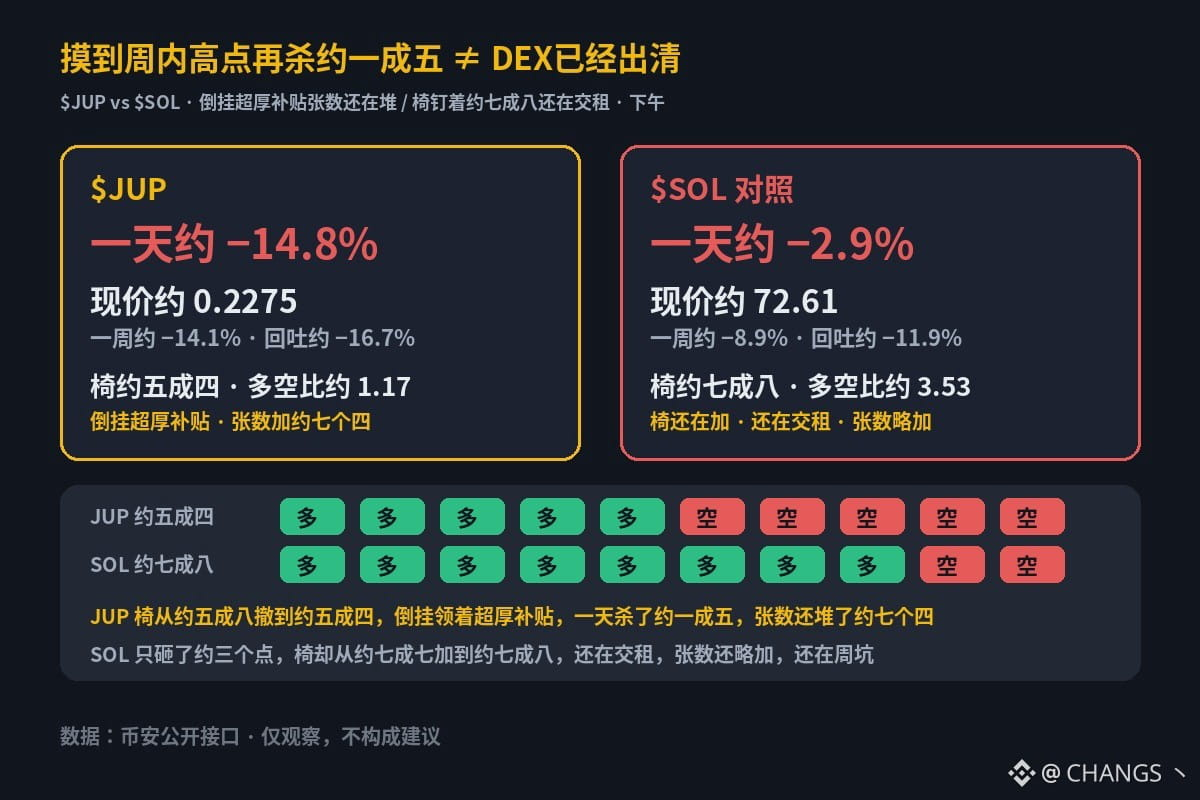
$JUP: down about 14.8% in a day and about 14.1% in a week; current price around 0.2275. Weekly high around 0.2731 (also the intraday high), now down about 16.7% from there. Account long-short ratio around 1.17 (about 54% long; around a day ago it was about 1.39/58% long, so longs are pulling back). Funding is inverted at around −0.0296%/4h, paying an unusually hefty subsidy far beyond the commonly seen cap. OI contract count is up about 7.4% over the past day (USD-margined OI is down about 8.0%, likely because the price fell while contract count increased). The price slid from the intraday high of about 0.2731 (also the weekly high) and is now near the intraday low of about 0.2266, still near the weekly lows. Longs have pulled back from about 58% to about 54%; the inverted funding rate is paying an unusually hefty subsidy, and contract count has still climbed about 7.4%. Don’t take a roughly 15% daily drop from the weekly high to 0.2275 as proof that DEXs have already been flushed out; much less should a slight retreat in longs, with funding paying an unusually hefty subsidy, be taken as proof that the ecosystem has conceded defeat.
In the same period, $SOL was down about 2.9% in a day and about 8.9% in a week, with a current price around 72.61. Its weekly high was around 82.38, putting it about 11.9% below that. Longs are around 78% (long-short ratio about 3.53; around a day ago it was about 3.32/77% long, so longs are adding). Funding is around +0.0032%/8h, so longs are still paying. OI contract count is up about 1.7% over the past day (USD-margined OI is down about 1.1%, likely because the price fell while contract count edged up). The price slid from the intraday high of about 75.63, touching a daytime low around 71.55, and is still near the weekly lows. Longs have risen from about 77% to about 78%, they’re still paying funding, and contract count has edged up.
On one side, longs pulled back from about 58% to about 54%, while the inverted funding rate paid an unusually hefty subsidy, far beyond the commonly seen cap; the price fell about 15% in a day, but contract count still climbed about 7.4%. On the other, the main chain fell only about 3%, yet longs rose from about 77% to about 78%, are still paying funding, and contract count edged up. Does an aggregator hitting its weekly high and then dropping about 15% mean DEXs have already been flushed out and the ecosystem has conceded defeat? Or is it simply still near the weekly lows, with positions continuing to build on one side as inverted funding pays an unusually hefty subsidy, while longs remain pinned around 78% on the other and keep paying funding? Drop a counterexample in the comments.
$JUP: down about 14.8% in a day and about 14.1% in a week; current price around 0.2275. Weekly high around 0.2731 (also the intraday high), now down about 16.7% from there. Account long-short ratio around 1.17 (about 54% long; around a day ago it was about 1.39/58% long, so longs are pulling back). Funding is inverted at around −0.0296%/4h, paying an unusually hefty subsidy far beyond the commonly seen cap. OI contract count is up about 7.4% over the past day (USD-margined OI is down about 8.0%, likely because the price fell while contract count increased). The price slid from the intraday high of about 0.2731 (also the weekly high) and is now near the intraday low of about 0.2266, still near the weekly lows. Longs have pulled back from about 58% to about 54%; the inverted funding rate is paying an unusually hefty subsidy, and contract count has still climbed about 7.4%. Don’t take a roughly 15% daily drop from the weekly high to 0.2275 as proof that DEXs have already been flushed out; much less should a slight retreat in longs, with funding paying an unusually hefty subsidy, be taken as proof that the ecosystem has conceded defeat.
In the same period, $SOL was down about 2.9% in a day and about 8.9% in a week, with a current price around 72.61. Its weekly high was around 82.38, putting it about 11.9% below that. Longs are around 78% (long-short ratio about 3.53; around a day ago it was about 3.32/77% long, so longs are adding). Funding is around +0.0032%/8h, so longs are still paying. OI contract count is up about 1.7% over the past day (USD-margined OI is down about 1.1%, likely because the price fell while contract count edged up). The price slid from the intraday high of about 75.63, touching a daytime low around 71.55, and is still near the weekly lows. Longs have risen from about 77% to about 78%, they’re still paying funding, and contract count has edged up.
On one side, longs pulled back from about 58% to about 54%, while the inverted funding rate paid an unusually hefty subsidy, far beyond the commonly seen cap; the price fell about 15% in a day, but contract count still climbed about 7.4%. On the other, the main chain fell only about 3%, yet longs rose from about 77% to about 78%, are still paying funding, and contract count edged up. Does an aggregator hitting its weekly high and then dropping about 15% mean DEXs have already been flushed out and the ecosystem has conceded defeat? Or is it simply still near the weekly lows, with positions continuing to build on one side as inverted funding pays an unusually hefty subsidy, while longs remain pinned around 78% on the other and keep paying funding? Drop a counterexample in the comments.