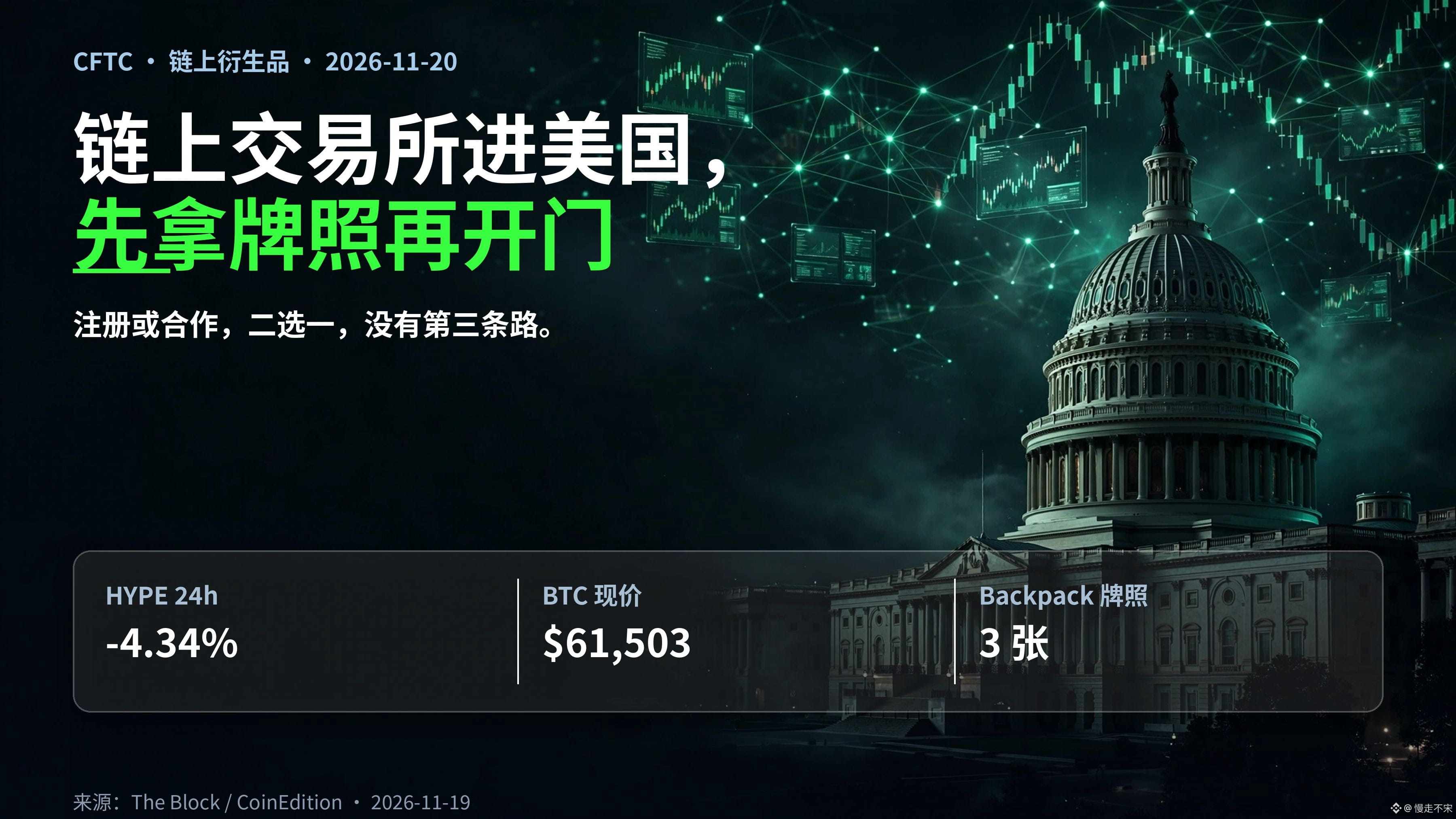
U.S. regulators have just drawn a line for on-chain exchanges: to enter the U.S. retail market, get licensed first.
CFTC Chairman Selig put it plainly at a congressional crypto forum yesterday: on-chain platforms like Hyperliquid must either register as an exchange themselves or partner with an already licensed exchange—those are the only two options. They can keep using on-chain technology, but they still have to follow the rules: anti-money laundering, segregation of customer funds, market surveillance—none of these are optional.
Someone has already taken the first route: Backpack secured all three licenses this week—a designated contract market, a derivatives clearing organization, and a futures commission merchant. It obtained the first two on November 16 and the last one on the 18th, becoming the first crypto-native exchange to secure the full set of licenses.
Someone is also taking the other route: ICE and TradeXYZ announced a partnership on October 29 to build a perpetual futures market for U.S. retail investors using Hyperliquid’s HIP-3 technology, but it still needs regulatory approval.
But to be clear: Hyperliquid itself still hasn’t received any approvals, and yesterday Hong Kong’s Securities and Futures Commission added it to its list of suspicious platforms.
$HYPE is currently at $64.87, down 4.34% over 24 hours, with a low of $64.77 today; $BTC is currently at $61,503, down 3.23%.
The next thing to watch: when the ICE partnership gets regulatory approval—that will be the real first day of on-chain perpetual futures in the U.S. Not investment advice.