$ZEC $BTC $ETH
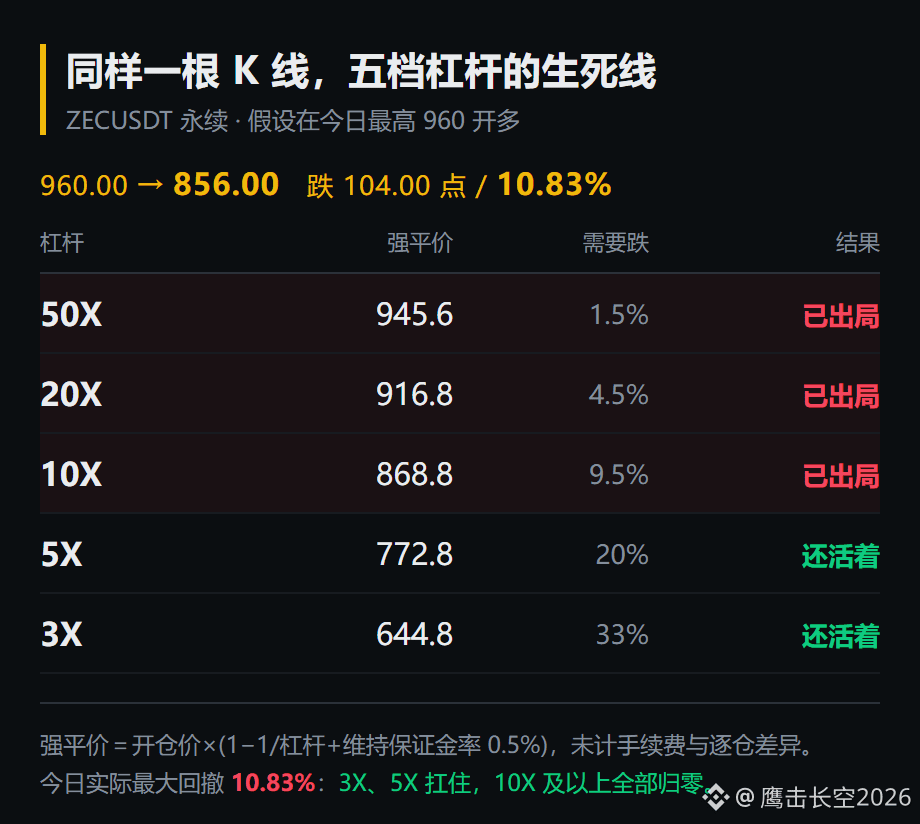
It took just four 4-hour candles for ZEC to fall from 960 to 856. Not a single 10x long survived.
Today, ZEC went from 960.00 to 856.00—a 104-point move, or 10.83%. On the same day, BTC went from 64,080.8 to 61,290.58—a 2,790-point move, or 4.36%. Both trades were at 10x, but the BTC position was still breathing while the ZEC one was already gone.
This wasn’t a matter of luck. There were four steps, and you got three of them wrong.
Step one: choosing what to trade. You picked the coin with the biggest range today. 10.83% versus 4.36% isn’t just “a bit more movement”—at the same leverage, the distance to the danger line is two and a half times greater. You’d already lost at this step, regardless of whether you were bullish or bearish.
Step two: choosing your leverage. The market app’s home screen said ZEC was “-8.18%,” so you thought it was down eight points and that 10x was no big deal. But that figure is over a 24-hour period. From today’s high of 960, it had already moved 10.83%. The mistake was using the 24-hour percentage change as your measure of risk.
Step three: setting your stop-loss. At 10x, the liquidation price is 868.8, just 91.2 points below 960. You set your stop at 890, leaving a 21.2-point buffer. The 10:00 1-hour candle fell from 889.35 and closed at 867.83—a 21.52-point move in a single candle, without pausing. The mistake was assuming your stop would get hit first. At over 10x, your stop-loss and liquidation price are often one and the same.
Step four: adding to your position. The price fell to 900, you thought it was cheap, and doubled your position to average down. Your average entry dropped to 930 and your liquidation price moved down to 841.65. The buffer seemed to grow from 2 points to 24, so you thought you were safe. The price is now 856.01, just 14.36 points above 841.65. And after doubling your position, the same 5% drop would cost you twice as much. The mistake was treating averaging down as a way to fix the trade—it only changed your liquidation price, not the direction of the market.
Here’s the simplest calculation: with 10,000 U and a fully margined 10x position, a 10% move against you wipes you out. ZEC moved 10.83% today. This isn’t a black swan. It’s Thursday.
At 3x, the liquidation price in this move would have been 644.8, leaving a 211-point buffer. My rule for ZEC is: on days when a coin’s range exceeds 8%, use no more than 3x leverage and no more than 30% of your capital. Its 1-hour RSI is now 20.24, its 4-hour RSI is 22.74, four consecutive 4-hour candles have closed down, six-hour buying pressure is 0.849—below the daily reading of 0.953—and its funding rate is still at +0.01%, the highest on the board. Shorts may belong here, but they shouldn’t be using 10x either.
There’s no seat belt between your stop-loss and liquidation—only leverage.
Li Qi, “Song of the Old Campaign”: “Year after year, warriors’ bones lie buried beyond the wastes; all we see is grapes brought into the Han realm.”
What leverage is your position at, what’s your liquidation price, and how many points away is it from the current price? Send me those three numbers and I’ll help you see if there’s still time.
If you want to calculate your liquidation price, visit my profile and join Eagle Soars to the Sky · Crypto Study Club. Send me your leverage and I’ll reply.