Anthropic’s Founder Doesn’t Want to Become the Next Jensen Huang: Behind the Biggest IPO in History, Who’s Betting—and Who Pays the Bill
Fresh off the upheaval over Jensen Huang losing control of Nvidia, Anthropic ($ANT ) made its first move when it listed on Nasdaq on November 19: it firmly locked down its founders’ control.
I. Why They Don’t Want to Become the Next Jensen Huang
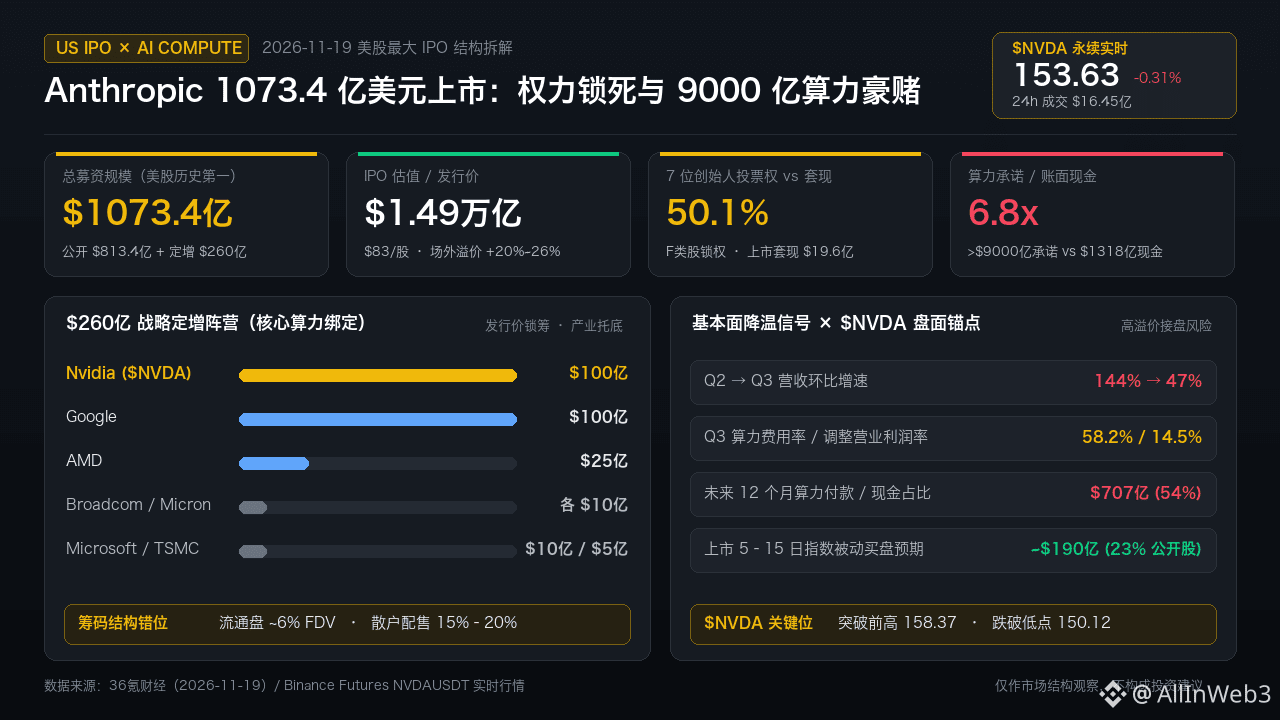
Anthropic’s seven co-founders used Class F shares to lock in 50.1% of shareholder voting rights, while using a long-term benefit trust to control appointments to a majority of the board seats—keeping outside Wall Street capital out of corporate governance. Yet in a striking contrast, while loudly championing their mission and control, the seven founders also cashed out about $1.96 billion at the time of the IPO.
II. A $107.34 Billion IPO—the Biggest in History. What Are the Giants Betting On?
The offering price was set at $83 (above the $70–$78 range), raising $81.34 billion in the public offering, plus a $26 billion strategic private placement (Google and $NVDA each invested $10 billion, AMD invested $2.5 billion, Broadcom, Micron, and Microsoft each invested $1 billion, and TSMC invested $500 million). Total proceeds came to about $107.34 billion, surpassing SpaceX to set a new record in U.S. market history, with an offering valuation of about $1.49 trillion. Computing-power giants collectively backstopping the stock at the $83 offering price is, in essence, a closed-loop industry tie-up: upstream players take equity, while downstream players lock in orders.
III. The Computing-Power Black Hole Behind the Stunning Growth
The growth on paper is indeed explosive: annualized revenue hit $81 billion in October, net dollar retention reached as high as 900%, and the company serves more than half of the Fortune Global 500. But cracks are showing in growth and margins—revenue growth quarter over quarter plunged from 144% in Q2 to 47% in Q3. Management has touted a long-term target of an adjusted operating margin of 35%+, but the actual figure in Q3 was just 14.5%. Computing costs rose further to 58.2% of revenue, dragging GAAP profits back into the red, while revenue generated per dollar of computing spend fell from 2.08x to 1.72x. More damaging still is the cash-flow mismatch: as of the end of September, total computing commitments exceeded $900 billion, 6.8 times the $131.8 billion in cash on the books. The company will have to pay $70.7 billion over the next 12 months alone (54% of its cash), and Goldman Sachs expects free cash flow to remain negative through 2030.
IV. Who’s Betting, and Who Pays the Bill?
Only about 6% of the total valuation is in the public float, yet an unusually large 15% to 20% of the allocation has been offered to retail investors. Although passive index buying of about $19 billion could arrive 5 to 15 trading days after the listing, the “winner’s curse” of buying in at a high premium was already apparent on day one: $ANT opened sharply higher at 111.5, surged to 115.1, then slid all the way to 92.72, closing at 97.17 (down 12.9% from the open) and falling another 2.7% after hours.
Industry giants get low-priced shares at $83 in exchange for computing-power orders; the founders lock in 50.1% of the voting rights and cash out $1.96 billion; those who pay the highest premium and take the final leg are always the momentum chasers. Going forward, only if $ANT holds above the $100 mark on heavy volume and financial results show that returns on computing investment are outpacing the cost ratio can the trillion-dollar valuation narrative hold. If it breaks below the first-day low of 92.72 on heavy volume, the price will continue to gravitate back toward the $83 offering price.
Fresh off the upheaval over Jensen Huang losing control of Nvidia, Anthropic ($ANT ) made its first move when it listed on Nasdaq on November 19: it firmly locked down its founders’ control.
I. Why They Don’t Want to Become the Next Jensen Huang
Anthropic’s seven co-founders used Class F shares to lock in 50.1% of shareholder voting rights, while using a long-term benefit trust to control appointments to a majority of the board seats—keeping outside Wall Street capital out of corporate governance. Yet in a striking contrast, while loudly championing their mission and control, the seven founders also cashed out about $1.96 billion at the time of the IPO.
II. A $107.34 Billion IPO—the Biggest in History. What Are the Giants Betting On?
The offering price was set at $83 (above the $70–$78 range), raising $81.34 billion in the public offering, plus a $26 billion strategic private placement (Google and $NVDA each invested $10 billion, AMD invested $2.5 billion, Broadcom, Micron, and Microsoft each invested $1 billion, and TSMC invested $500 million). Total proceeds came to about $107.34 billion, surpassing SpaceX to set a new record in U.S. market history, with an offering valuation of about $1.49 trillion. Computing-power giants collectively backstopping the stock at the $83 offering price is, in essence, a closed-loop industry tie-up: upstream players take equity, while downstream players lock in orders.
III. The Computing-Power Black Hole Behind the Stunning Growth
The growth on paper is indeed explosive: annualized revenue hit $81 billion in October, net dollar retention reached as high as 900%, and the company serves more than half of the Fortune Global 500. But cracks are showing in growth and margins—revenue growth quarter over quarter plunged from 144% in Q2 to 47% in Q3. Management has touted a long-term target of an adjusted operating margin of 35%+, but the actual figure in Q3 was just 14.5%. Computing costs rose further to 58.2% of revenue, dragging GAAP profits back into the red, while revenue generated per dollar of computing spend fell from 2.08x to 1.72x. More damaging still is the cash-flow mismatch: as of the end of September, total computing commitments exceeded $900 billion, 6.8 times the $131.8 billion in cash on the books. The company will have to pay $70.7 billion over the next 12 months alone (54% of its cash), and Goldman Sachs expects free cash flow to remain negative through 2030.
IV. Who’s Betting, and Who Pays the Bill?
Only about 6% of the total valuation is in the public float, yet an unusually large 15% to 20% of the allocation has been offered to retail investors. Although passive index buying of about $19 billion could arrive 5 to 15 trading days after the listing, the “winner’s curse” of buying in at a high premium was already apparent on day one: $ANT opened sharply higher at 111.5, surged to 115.1, then slid all the way to 92.72, closing at 97.17 (down 12.9% from the open) and falling another 2.7% after hours.
Industry giants get low-priced shares at $83 in exchange for computing-power orders; the founders lock in 50.1% of the voting rights and cash out $1.96 billion; those who pay the highest premium and take the final leg are always the momentum chasers. Going forward, only if $ANT holds above the $100 mark on heavy volume and financial results show that returns on computing investment are outpacing the cost ratio can the trillion-dollar valuation narrative hold. If it breaks below the first-day low of 92.72 on heavy volume, the price will continue to gravitate back toward the $83 offering price.