
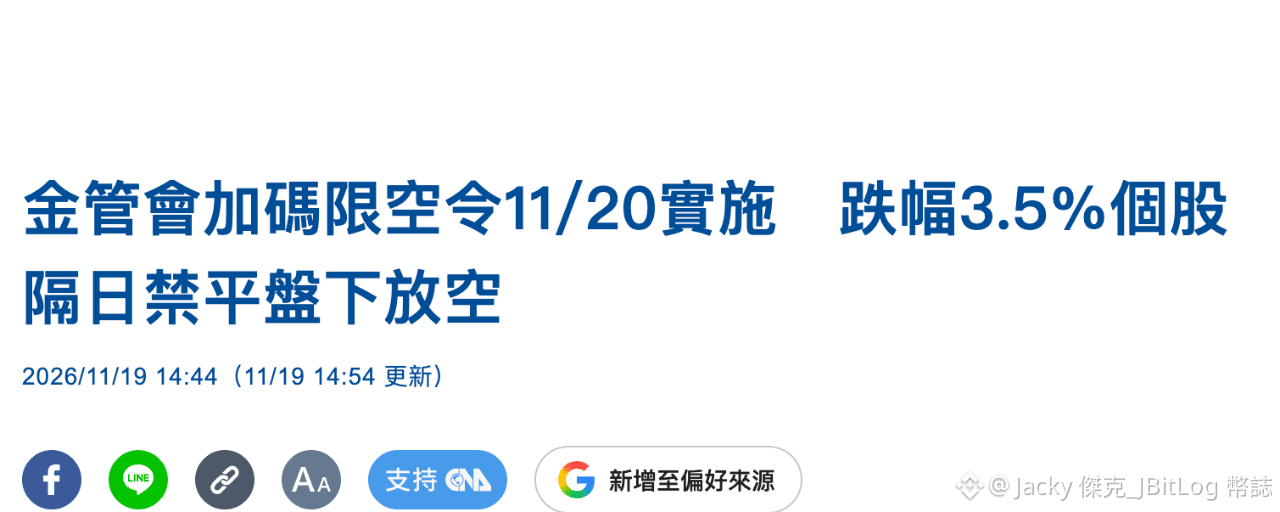

On January 20, the Financial Supervisory Commission’s tightened short-selling restrictions took effect, but Taiwan stocks still plunged in early trading. According to a Central News Agency report, by 10:22 a.m., the TAIEX had fallen 2,095 points to 36,331. This was the second time the commission had stepped in within 11 days.
So what exactly do short-selling restrictions limit?
Short selling means borrowing shares from someone else and selling them first, then buying them back after the price falls and returning them—pocketing the difference. So the more sharply a stock price drops, the more short sellers stand to profit, and the more willing they are to keep selling.
The Financial Supervisory Commission’s first round of measures on November 9 cut the amount of stock that could be borrowed for short selling each day from 30% to 3% of the average trading volume over the previous 30 business days. On November 20, the second round cut it further to 1%. It also barred short selling of a stock the next day at a price below its previous closing price if it had fallen by more than 3.5% at that day’s close.
The Financial Supervisory Commission’s reasoning is that Taiwan’s stock market fundamentals remain fairly solid and listed companies’ revenue has hit a record high, but international political and economic conditions have shaken investor confidence.
Put simply, they don’t want short sellers making things worse when everyone is panicking.
◆◆◆
What about crypto?
Bitcoin has also plunged this month. According to Fortune, Bitcoin hit an all-time high of around $126,198 on October 6, 2025, but had fallen below $62,000 by November 19—nearly half its value.
Crypto markets have no short-selling ban or circuit breakers, and trade 24 hours a day. But look a little closer, and you’ll see that even if crypto markets did impose a short-selling ban, it might not do much to stop the decline.
That’s because the first group selling consists of long positions being forcibly liquidated.
According to FXStreet, in the 24 hours leading up to November 13, $1.64 billion (around NT$54.1 billion) worth of positions across the market were forcibly liquidated. Of that, $1.46 billion—about 89%—were bets on prices going up.
The second group selling consists of investors in Bitcoin ETFs.
According to Farside’s data, U.S. spot Bitcoin ETFs saw total net outflows of around $2.89 billion from November 2 to 18, equivalent to about NT$95.2 billion.
Neither of these two groups, in fact, consists of short sellers covered by a short-selling ban.
◆◆◆
So what can people who still hold crypto do?
From what I’ve seen, in a crypto market where nobody can hit pause for you, there are two things you should think about before worrying whether there’s a short-selling ban.
First, are your Bitcoin holdings in futures or spot?
If you hold spot Bitcoin, you decide whether to sell when the price falls. But if you’re trading futures, the exchange will sell your position as soon as the price drops below your liquidation price—just like those $1.46 billion in long positions mentioned above. There’s no time to think it over. So if you’re trading futures, at the very least, make sure you know your liquidation price.
Second, does your trading strategy clearly specify at what price you’ll add to your position, and at what point you’ll stop?
No matter how panicked Taiwan’s stock market gets, it still closes at 1:30 p.m., leaving you at least one night to cool off. But crypto markets trade 24 hours a day, and Bitcoin can keep falling in the middle of the night. By the time you wake up and decide what to do, the price may have already moved far from where it was. So it’s best to decide before placing an order where you’ll add to your position, when you’ll stop, and how many batches you’ll buy in.
If crypto markets introduced a short-selling ban tomorrow, do you think you’d feel more at ease?
Feel free to share your thoughts with me~
⚠️ The content above is for reference only and does not constitute investment advice.