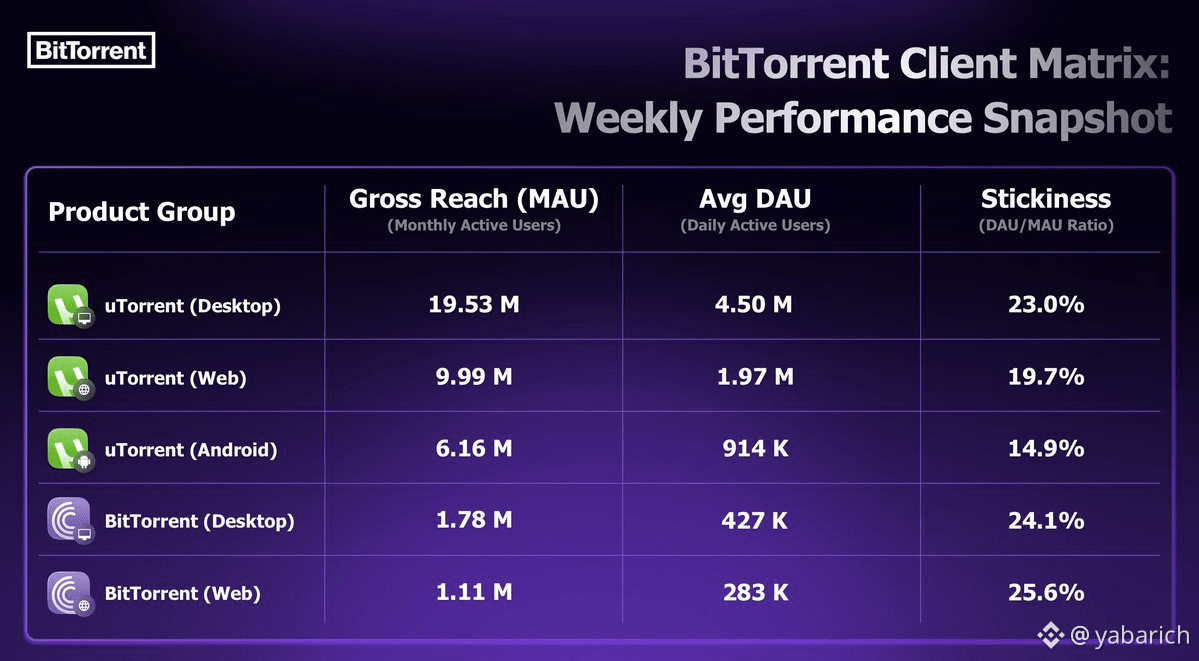
🔗 Behind BitTorrent’s reach of 40.76 million is an important advantage of the P2P ecosystem: cross-platform accessibility.
BitTorrent’s latest weekly Client Matrix data shows:
📊 Total reach: 40.76 million
👥 Average daily active users: 8.69 million
💻 µTorrent desktop: 4.5 million daily active users
🌐 BitTorrent Web: 25.6% user stickiness
📱 µTorrent Android: 6.16 million reach
What’s most noteworthy isn’t just the number of users.
It’s how different product interfaces meet the needs of different users.
💻 Desktop
A standalone application can meet the needs of users who want to manage files continuously and flexibly control transfer tasks.
🌐 Web
A browser-based interface offers users another way to use BT technology.
📱 Mobile
Android support means P2P file sharing is no longer limited to the traditional desktop environment.
💡 My take:
Whether P2P technology can maintain its value over the long term depends on more than just the underlying protocol.
It also depends on whether users can conveniently use it across different devices.
BitTorrent’s multi-platform presence makes it possible to accommodate different usage habits without requiring all users to adopt the same interface.
But reach, daily active users, and user stickiness are different metrics.
They shouldn’t be conflated or simply added together to estimate the number of unique users.
There’s another important distinction:
The scale of client adoption does not automatically prove adoption of BTT, BTTC, or other blockchain services.
Evidence worth watching next includes user retention across platforms, actual transfer activity, and verified links between client usage and adoption of decentralized services.
The broader takeaway is:
P2P technology is more likely to be widely used when software adapts to users, rather than requiring users to adapt to the infrastructure.
@Justin Sun孙宇晨 @BitTorrent_Official
#TRONEcoStar #BitTorrent #uTorrent #P2P #Decentralization