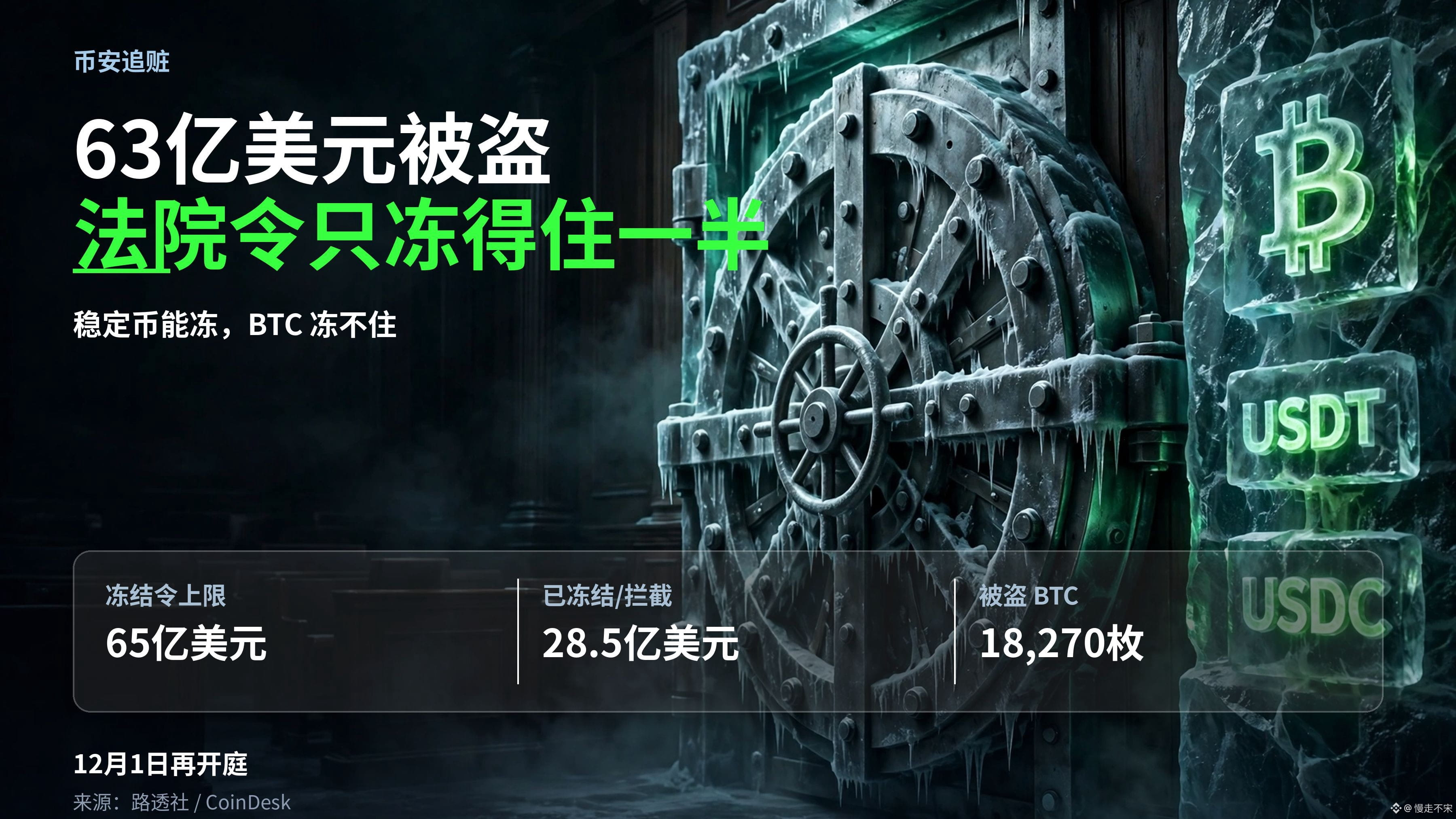
$6.3 billion in crypto was stolen, and a court order can freeze it—but only half of it.
On November 18, the Abu Dhabi Global Market Court granted Binance a worldwide freezing order capped at $6.5 billion, targeting the October 29 theft of approximately $6.34 billion—the largest ever. The FBI attributed it to North Korea’s TraderTraitor.
Eighteen companies were named and ordered to cooperate, including USDC issuer Circle, World Liberty Financial, behind USD1, and custodian BitGo. The court also said none of these companies was accused of wrongdoing; they were simply cooperating with the freeze.
So far, about $2.85 billion in assets—45% of the total stolen—has been frozen or intercepted by third parties. The U.S. Department of Justice has also separately been authorized to seize or restrict more than $1.2 billion.
But there’s a major limitation: the order can only freeze assets that their issuers can freeze. Stablecoins can be frozen, but Bitcoin and Ethereum cannot. The stolen assets included 18,270 BTC, about 970,000 SOL, and 233 million XRP.
Binance has already covered $6.34 billion in customer losses using its own funds, SAFU, and insurance payouts.
$BTC is now trading at $62,055, down 1.08% over 24 hours. The day’s high was $64,080 and the low was $61,428.
The next date to watch: another hearing on December 1, when the court will decide whether to extend the freezing order and whether to return the frozen assets. This is not investment advice.