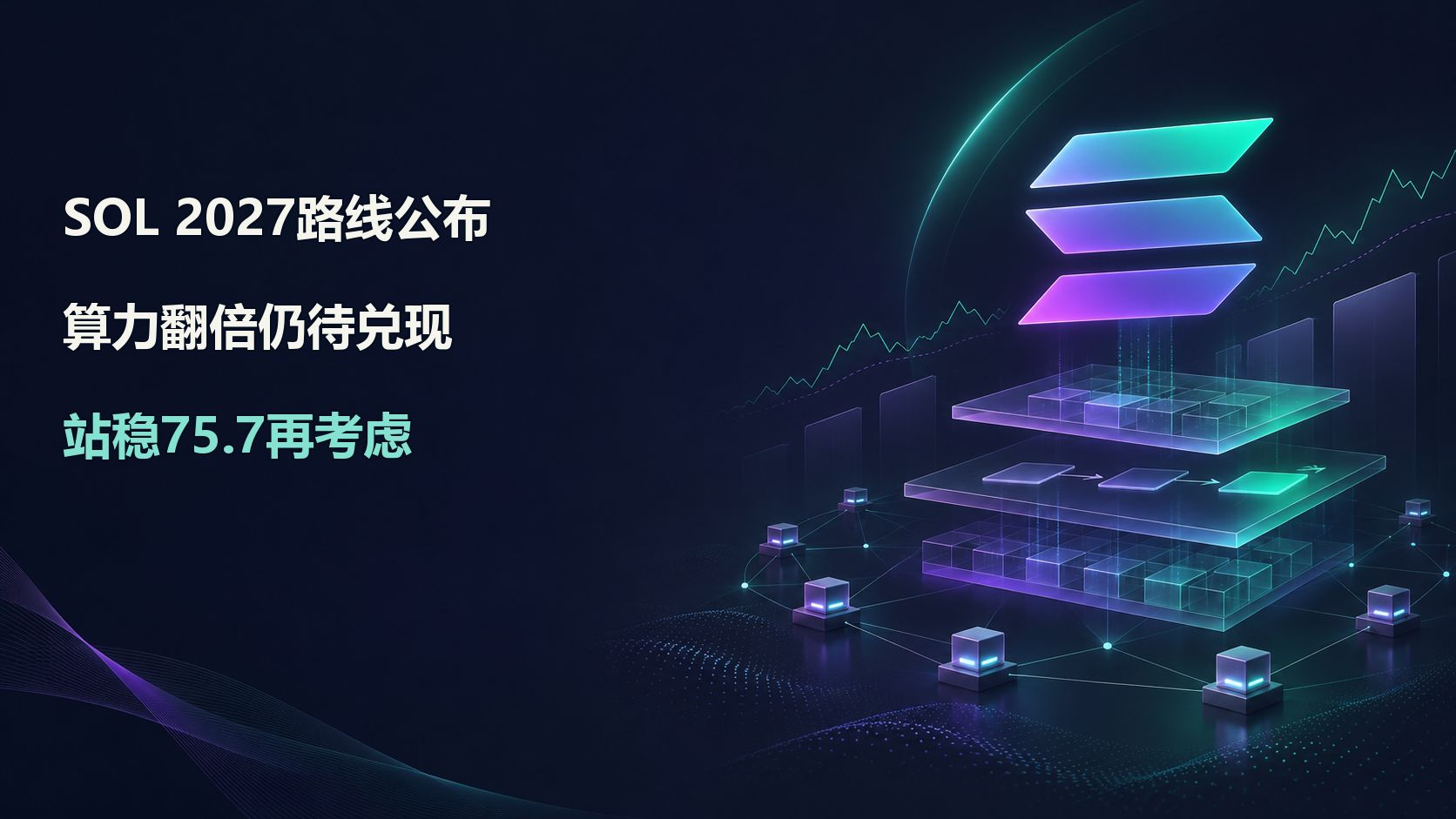
Solana proposes doubling computing capacity by 2027|Technical roadmap still to be delivered|Consider SOL only after it holds above 75.7
My stance is to follow the progress, but not chase news-driven candles. The hot topic #Solana2027RoadmapTargetsDoubleComputeCapacity is being discussed on Binance Square, and SOL also appeared among the Most Searched assets over the past 6 hours. On November 19, Solana’s official account shared the 2027 roadmap from core development team Anza: the goal is to double the network’s computing capacity and reduce the compute units consumed by token-account-related transactions by 80%. The roadmap also lists on-chain vector processing, increasing the number of accounts accessible per transaction from 64 to 96, improving block dissemination, and using Constellation to make ordering rules clearer. Binance’s official News account also repeated these goals, so the direction can be cross-checked.
The most important word here is “roadmap,” not “launched.” Doubling computing capacity means a goal for the amount of computational work the network can handle; it does not mean SOL’s price should double. Reducing the compute units consumed by token accounts by 80% does not mean every user’s fees will immediately fall by 80%, nor does it mean exchanges must buy more SOL today. Actual network fees are also affected by priority fees, demand, application design, and validator execution. If the new transaction ordering and more distributed competition among validators are implemented as planned, they could improve transaction execution certainty during peak periods. If the design fails testing or stability issues arise at launch, the market could instead lower its valuation expectations.
I’m more interested in three pieces of evidence to come: whether Anza publishes an implementation and benchmark tests that can be reviewed; whether the features go through validator and community processes; and whether real applications show improvements in failure rates, fees, and user numbers under heavy load. Goals mentioned in a presentation alone are still a long way from continuous, stable mainnet operation. Other news from the past day includes tighter expectations for macro interest rates and pending ETF flow data, so SOL’s candle cannot be attributed entirely to the roadmap. Farside’s current table shows total SOL fund flows of 0.0 on November 18; for the 19th, the individual products still show dashes. The automatic total of 0.0 should not be treated as confirmation of zero subscriptions or redemptions on the 19th.
The market reaction has not confirmed strength. At the time of writing, SOL/USDT on Binance was around $73.97, up about 0.27% over the rolling 24 hours, with a high of 75.65 and a low of 72.32; the price is still within the range. It needs to hold convincingly above 75.7, while around 72.3 is the lower boundary. I would reverse my short-term recovery view if key targets are later postponed by the official team, tests show no efficiency gains, or the price breaks below 72.3 and rebounds weakly. Conversely, holding above 75.7 alongside improvements in fund flows and on-chain usage would warrant closer attention.
If I were trading this myself, I would stay out for now, with a position size of zero; the only direction I’d consider is a leveraged-free spot long. I would enter with no more than 1% of total capital only after two complete 15-minute candles close above $75.7, the price then retests and holds between $75.2 and $75.7, and there is no new network security or outage announcement. I’d take half off at the first target of 77.4 and close the remainder at the second target of 79.2. After entry, if a 15-minute candle closes back below 74.7, I’d reduce the position by half; if it breaks below 73.9, I’d close the entire position at a stop loss. If the price first breaks below 72.3 before entry, I’d cancel the plan and remain out of the market. A plan is not a trade, nor does it guarantee a profit.
#Solana2027RoadmapTargetsDoubleComputeCapacity #SOL
The above is solely my personal market observation and does not constitute investment advice.