
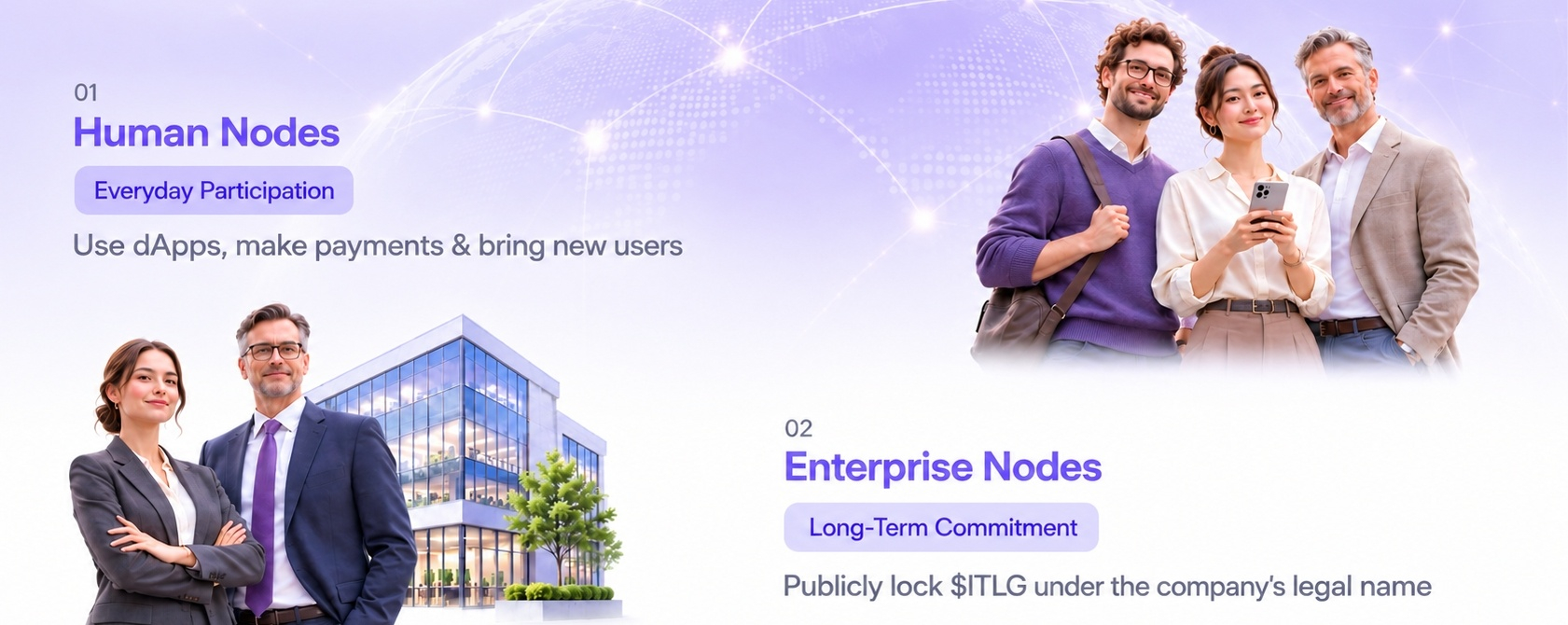

InterLink is introducing two types of participants in the $ITLG Staking Vault: Human Nodes and Enterprise Nodes.
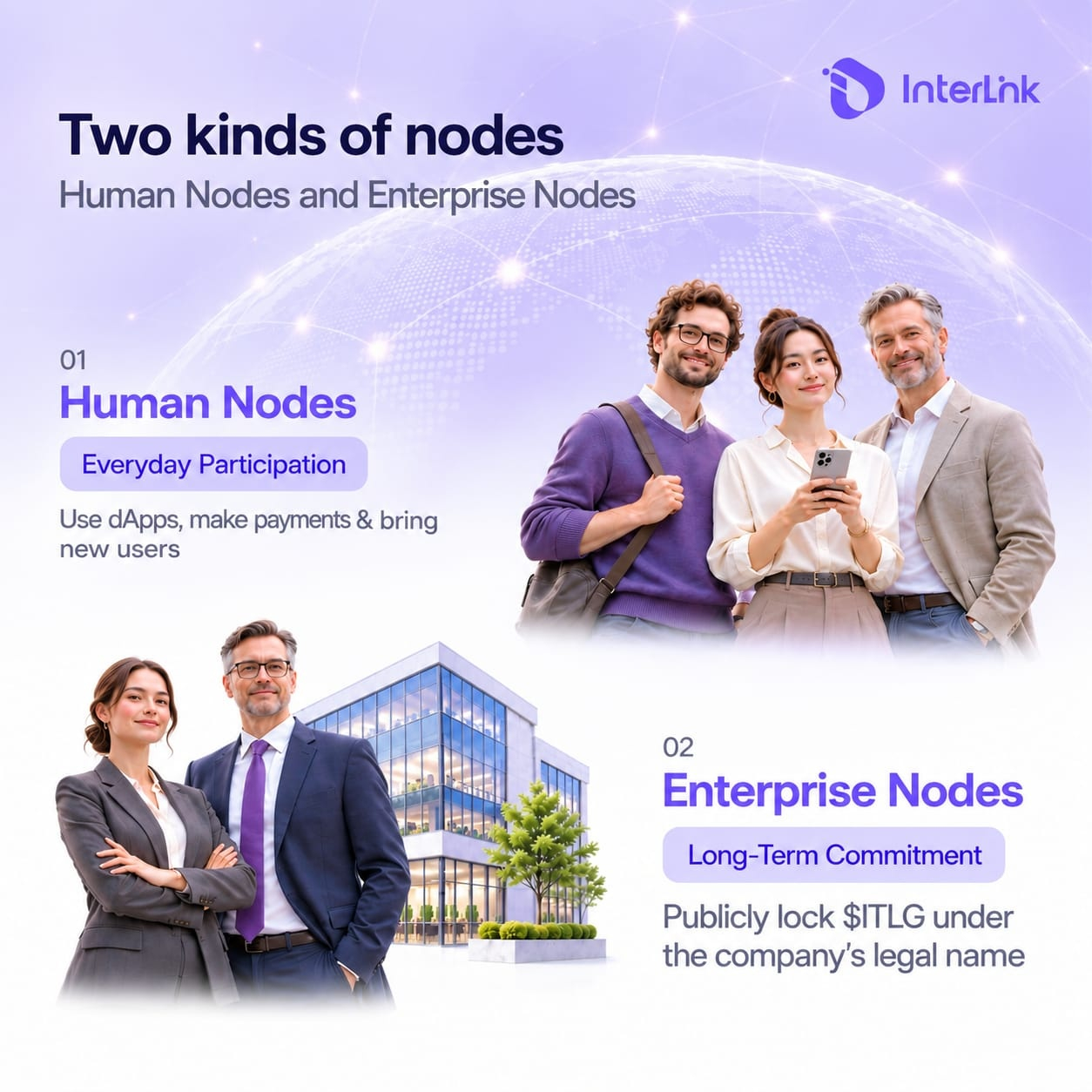
But what makes them different?
🔹 1. HUMAN NODES – Individual Participation
Human Nodes represent verified individuals within the InterLink ecosystem.
Every Linker who mines through the app already participates as a Human Node. With the Staking Vault, this participation moves on-chain.
After completing ITLG KYC and receiving transferable $ITLG, eligible Linkers can stake their tokens from the receiving wallet.
Their contributions include:
- Using ecosystem dApps.
- Making payments.
- Trading.
- Bringing new users into the ecosystem.
Human Nodes are part of the Human Network, which consists of 11 million Linkers built around the verification of real people.
🔹 2. ENTERPRISE NODES – Institutional Participation
Enterprise Nodes represent verified businesses, including publicly listed companies.
After completing KYB verification and registering their wallets, businesses can stake their $ITLG treasury in the Vault under their own legal company names.
Their contribution focuses on:
- Institutional credibility.
- Long-term commitment.
- Public accountability.
- Greater transparency in corporate participation.
This introduces the economic concept of Costly Signaling: a commitment that is expensive to make and difficult to reverse can serve as a stronger signal of credibility.
🔹 3. TWO ENTRY REQUIREMENTS
The Vault has two entry pathways:
• Human Nodes: A wallet belonging to an individual who has passed KYC.
• Enterprise Nodes: A registered business wallet that has passed KYB.
An unverified individual wallet cannot stake as a Human Node, and an anonymous wallet cannot become a Node.
WHY DOES THIS MATTER?
The idea is not simply to bring more capital into the ecosystem. It is about bringing verified identities, transparency, and accountability into the same economic structure.
Human Nodes contribute through everyday economic activity, while Enterprise Nodes bring institutional participation and long-term commitment.
Both stake the same asset: transferable $ITLG.
Two different roles. One shared ecosystem. Built around verified participation and transparency.
What do you think about this approach to connecting individual users and institutional participants?