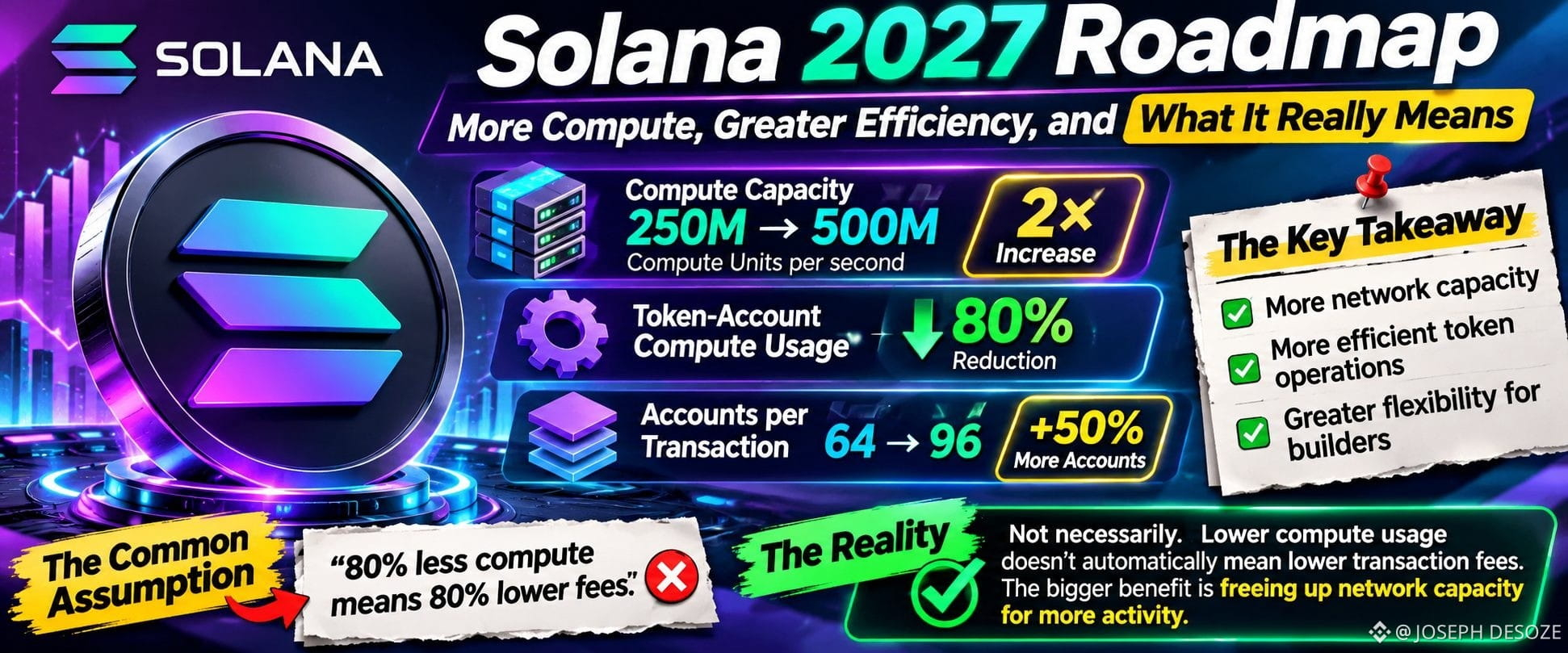

#Solana2027RoadmapTargetsDoubleComputeCapacity
The most interesting part of Solana's 2027 roadmap isn't just doubling compute capacity. It's the plan to make common token-account operations use up to 80% less computing power.
Here's why that distinction matters.
Anza wants to increase network compute capacity from 250 million to 500 million compute units per second. At the same time, it is targeting an 80% reduction in compute consumption for token-account-related transactions. BigGo Finance +1
At first, it's easy to assume that cheaper computation automatically means cheaper transactions for users. But that's not necessarily how it works.
Compute units measure the processing work required by the network. Transaction fees are a separate mechanism. So an 80% reduction in compute usage does not promise an 80% reduction in fees.
The bigger opportunity is efficiency.
If common token operations require less processing, more of the network's existing resources could become available for other transactions. Combine that with the planned increase from 64 to 96 accounts per transaction, and developers could have more room to build complex applications. Solana Media +1
That's what makes this roadmap interesting to me. Solana isn't only trying to process more activity; it's trying to make existing resources work harder.
But there's one thing worth watching: how much of the promised efficiency actually reaches mainnet, and whether real transaction workloads benefit as much as the roadmap targets suggest.
VERIFY BEFORE POSTING:
* 250M to 500M compute units per second is a roadmap target, not an achieved result.
* The 80% reduction applies specifically to token-account-related operations.
* Confirm the 64-to-96 account increase applies to v1 transactions and check activation status.
* Do not describe the compute reduction as an equivalent reduction in transaction fees.