The finality of $SOL has reached the roughly 150-millisecond range, so why might a swap still keep spinning? Solana’s official Breakpoint recap on November 18 again emphasized speed improvements. I’d rather take a closer look at how that time translates into the user experience.
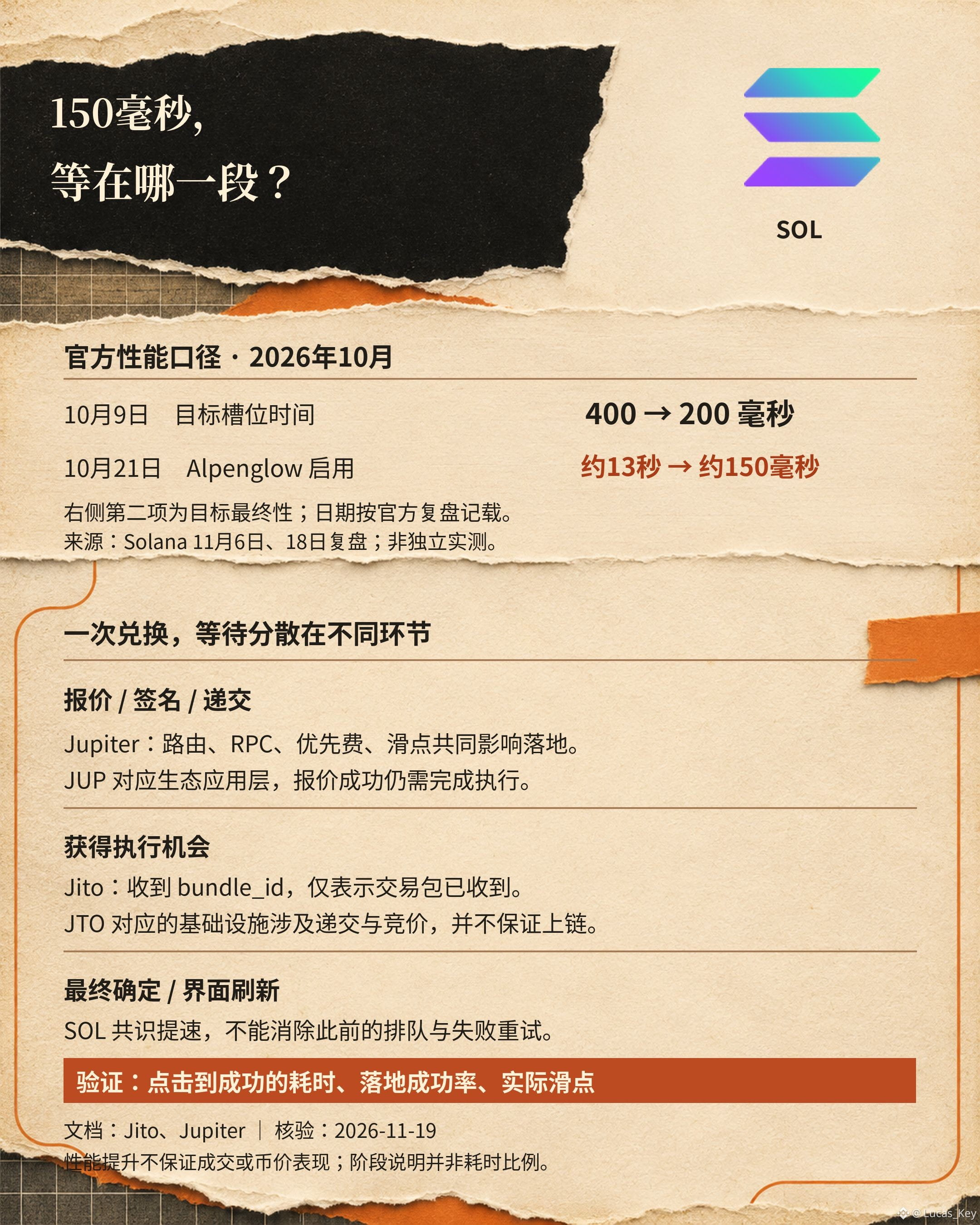
The evidence for performance improvements is solid: the official October recap recorded that the target slot time fell from 400 milliseconds to 200 milliseconds on October 9, and that Alpenglow was activated on mainnet on October 21, bringing target finality down from about 13 seconds to roughly 150 milliseconds. Slot cadence and transaction finality are two different metrics; these are figures published by the team on the protocol level, not the result of my own independent speed tests on every transaction tonight. Shorter settlement waits do create more room for payments and on-chain trading.
But after you tap confirm, the transaction still has to go through quoting, signing, submission, getting a chance to execute, finalization, and then a refresh of the interface. Jupiter’s docs clearly state that RPC quality, priority fees, and network conditions all affect whether a transaction lands, and that slippage set too tightly can also lead to failure. Jito’s docs put it plainly: receiving a bundle_id only means the transaction bundle was received; it does not guarantee that it has been processed or included on-chain. If you don’t make it into the queue at the start, faster consensus later can’t make up for that step.
That’s why $JUP and $JTO are worth watching together: Jupiter handles quote routing and submission, Jito-related infrastructure handles transaction bundle submission and bidding, and SOL provides the underlying execution and settlement. The three stages are connected, but the bottleneck could be at any one of them; tokens in the same ecosystem won’t necessarily be revalued in tandem with confirmation speed.
I’m more interested in whether, for comparable transactions under similar loads, the median time from click to success and the time taken by the slower transactions both improve, along with landing success rates and actual slippage. If only the protocol metrics get faster while failed retries and poor execution prices remain common, the improvement for ordinary users should be discounted. Sources: Solana’s official recaps from November 6 and 18, Jito and Jupiter docs; verified November 19. Risk notice: Performance improvements do not guarantee successful trades or price appreciation. This post may receive platform creator rewards.