“The U.S. government has 300,000 BTC and will never sell” is making the rounds again today. I think this is one of the most misunderstood numbers of the day.
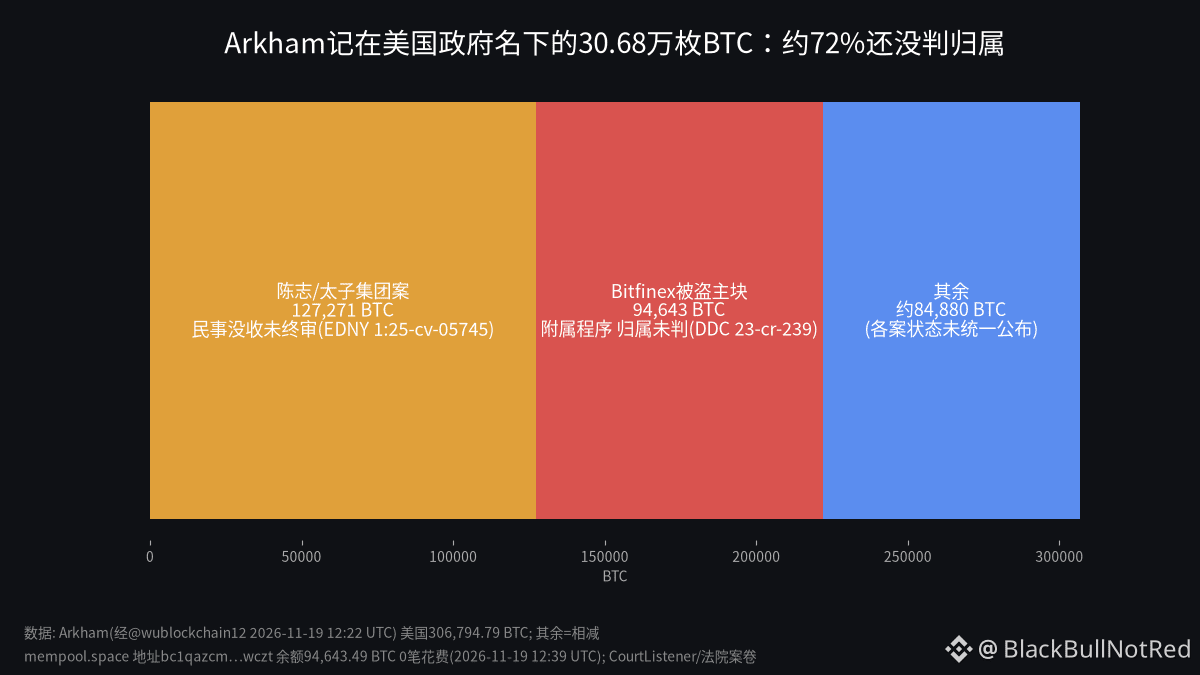
Arkham’s figures today: wallets linked to the U.S. government hold 306,800 BTC, or 79.9% of the total held by the six governments it tracks. But break it down:
The 127,271 BTC from the Chen Zhi / Prince Group case: the civil forfeiture case in the Brooklyn federal court is still unresolved, and the docket was still being updated on 11/11.
The main tranche of 94,643 BTC stolen from Bitfinex in 2016: in April 2025, a judge awarded Bitfinex zero in compensation and kicked the ownership question into ancillary proceedings. Bitfinex, former customers, and a claimant called XYZ (who says it’s claiming 2,770 BTC) have been fighting over it, and there’s still no ruling. I just checked this address, bc1qazcm…wczt: it holds 94,643.49 BTC, and not a single coin has been spent since it was transferred there in 2022.
Together, those two piles amount to 221,900 BTC, or 72% by Arkham’s count.
I looked up the original text of the March 2025 executive order: the Strategic Bitcoin Reserve only takes in BTC that is “finally forfeited.” The “shall not be sold” rule applies only to coins already deposited in the reserve. Legally, that 72% still tied up in litigation hasn’t even entered that vault. The executive order itself also leaves room for exceptions: the coins can be disposed of under a court order or returned to identifiable victims.
So the claim that “the U.S. will never sell” doesn’t apply to most of its holdings.
More interestingly, what happens if the Bitfinex coins are awarded back to it? In a public statement in 2022, Bitfinex reaffirmed the commitment in the LEO white paper: within 18 months of recovering the stolen BTC, it would use 80% of the net recovery to buy back and burn LEO. It could buy on the open market, buy OTC, or exchange BTC directly for LEO.
At the current price of $63,730, 94,643 BTC is worth about $6.03 billion, making the 80% ceiling about $4.83 billion. LEO’s circulating market cap is only $8.56 billion, and its 24-hour trading volume according to CoinGecko is less than $1 million. Spread $4.8 billion over 18 months, and it would need to buy about $8.8 million a day—more than nine times LEO’s entire daily trading volume. This couldn’t be done through the public market; it would basically have to go through OTC, where the execution price and counterparties would most likely remain out of public view.
And before that, RRT redemptions, various expenses, and successful customer claims would all have to be deducted. $4.8 billion is the ceiling, not the expected amount.
My take: For BTC, if these coins go from “sitting untouched in a government wallet for five years” to “a private company has to spend most of them within 18 months,” it probably won’t trigger a crash, but it would poke a hole in the narrative that “the national reserve only grows and never sells.” For LEO, this is the biggest pending buyback commitment in the industry, but with this execution method, retail investors will probably just have to watch from the sidelines. If you’re going to keep an eye on one thing, watch whether the bc1qazcm address moves—and where it moves to.
#BTC #LEO