$ETH
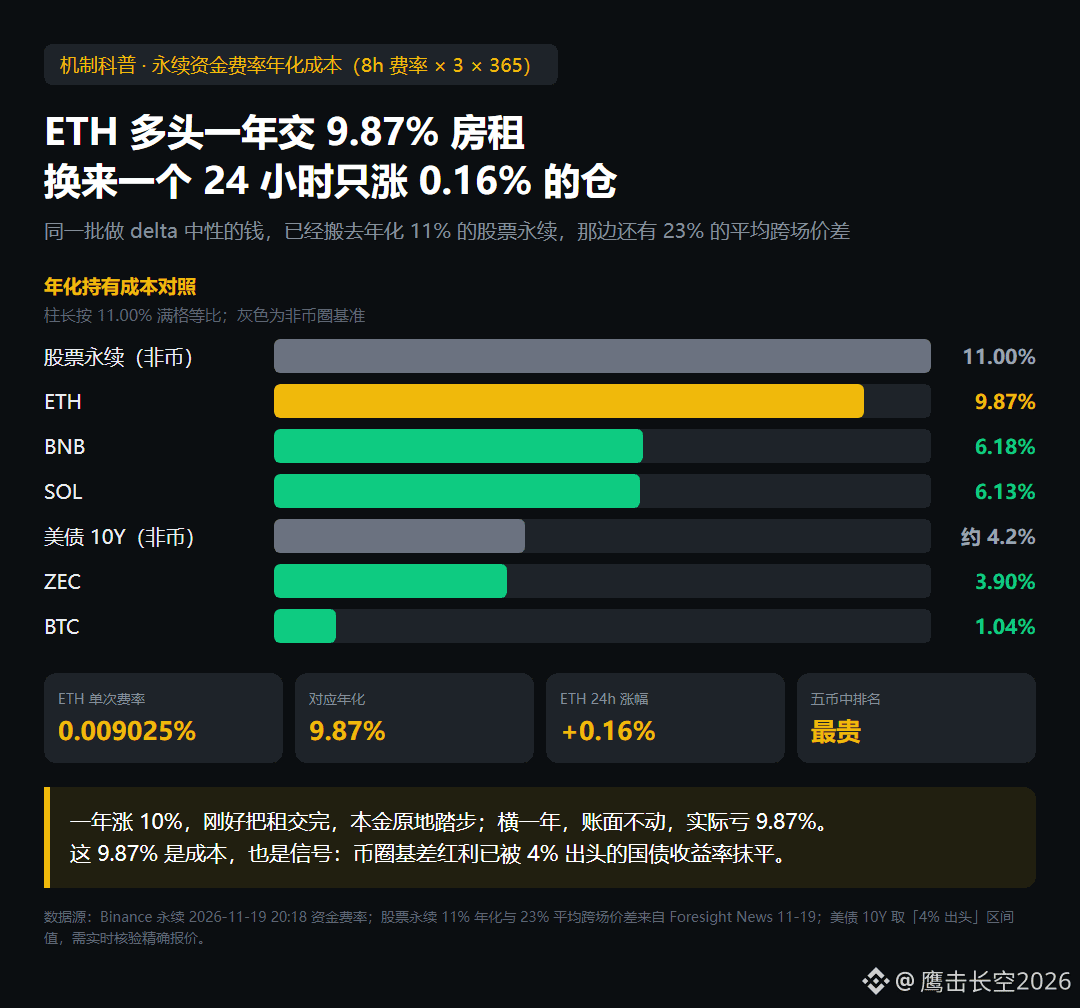
ETH longs pay 9.87% annual rent for a position that only rises 0.16%
Start with one number: the funding rate on ETH perpetuals is currently 0.009025%, settled every eight hours.
Annualized, that’s 0.009025% times 3 times a day times 365 days, which equals 9.87%.
Longs have to hand over nearly a tenth of their position’s value each year as “rent” to shorts. And how much has ETH risen over the past 24 hours? 0.16%.
That’s what I most want to talk about today: perpetual contracts aren’t free leverage. They’re a house that charges rent by the hour.
At the same time, I pulled up four others: BTC at 1.04% annualized, ZEC at 3.90%, SOL at 6.13%, and BNB at 6.18%. ETH’s 9.87% is the highest of the five—more than 50% above second place.
Why is ETH the most expensive? Because among major coins, it’s the one retail traders are most willing to “be bullish on long term but too lazy to buy spot.” The more crowded the long side gets, the higher the rate. That’s how the mechanism works; nobody’s levying a tax. Every penny you pay goes into the pockets of your counterparties on the short side.
Let’s do some rough math. Say ETH rises just 10% in a year. You, as a long, spend twelve months working away, only to have paid exactly enough rent for your principal to stay where it is. If it moves sideways for a year, your balance won’t budge, but you’ll have lost 9.87% in real terms.
The side-by-side comparison is what really stings. A report from Foresight today says that after Bitcoin basis trades failed to outperform US Treasuries, the delta-neutral crowd moved their business to stock perpetuals—where annualized funding rates are 11%, and cross-platform spreads average 23%.
Same people, same playbook. On one side, 9.87% rent in crypto; on the other, 11% rent on stock perpetuals, plus a 23% cross-market spread. I don’t need to calculate which way the money will flow.
So ETH’s 9.87% isn’t just a cost. It’s a signal: the basis-trading premium in crypto has already been wiped out by the just-over-4% yields on US Treasuries. Smart money is comparing markets horizontally now, not betting on direction.
ETH is now at 1,803.38, with a 24-hour range of 1,813.13 to 1,731.42. The last twenty candles are all crammed into a $15.75 box between 1,797.38 and 1,813.13.
My view is simple: I wouldn’t go long here. It’s not that I’m bearish; this 9.87% holding cost gives me no reason at all to open a position that could move sideways for a month.
A: 9.87% is a bubble tax. Get out
B: It’s worth it as long as it rises more than 10% in a year
C: I never look at funding rates, only candlestick charts
#以太坊 #资金费率 #Arbitrage
ETH longs pay 9.87% annual rent for a position that only rises 0.16%
Start with one number: the funding rate on ETH perpetuals is currently 0.009025%, settled every eight hours.
Annualized, that’s 0.009025% times 3 times a day times 365 days, which equals 9.87%.
Longs have to hand over nearly a tenth of their position’s value each year as “rent” to shorts. And how much has ETH risen over the past 24 hours? 0.16%.
That’s what I most want to talk about today: perpetual contracts aren’t free leverage. They’re a house that charges rent by the hour.
At the same time, I pulled up four others: BTC at 1.04% annualized, ZEC at 3.90%, SOL at 6.13%, and BNB at 6.18%. ETH’s 9.87% is the highest of the five—more than 50% above second place.
Why is ETH the most expensive? Because among major coins, it’s the one retail traders are most willing to “be bullish on long term but too lazy to buy spot.” The more crowded the long side gets, the higher the rate. That’s how the mechanism works; nobody’s levying a tax. Every penny you pay goes into the pockets of your counterparties on the short side.
Let’s do some rough math. Say ETH rises just 10% in a year. You, as a long, spend twelve months working away, only to have paid exactly enough rent for your principal to stay where it is. If it moves sideways for a year, your balance won’t budge, but you’ll have lost 9.87% in real terms.
The side-by-side comparison is what really stings. A report from Foresight today says that after Bitcoin basis trades failed to outperform US Treasuries, the delta-neutral crowd moved their business to stock perpetuals—where annualized funding rates are 11%, and cross-platform spreads average 23%.
Same people, same playbook. On one side, 9.87% rent in crypto; on the other, 11% rent on stock perpetuals, plus a 23% cross-market spread. I don’t need to calculate which way the money will flow.
So ETH’s 9.87% isn’t just a cost. It’s a signal: the basis-trading premium in crypto has already been wiped out by the just-over-4% yields on US Treasuries. Smart money is comparing markets horizontally now, not betting on direction.
ETH is now at 1,803.38, with a 24-hour range of 1,813.13 to 1,731.42. The last twenty candles are all crammed into a $15.75 box between 1,797.38 and 1,813.13.
My view is simple: I wouldn’t go long here. It’s not that I’m bearish; this 9.87% holding cost gives me no reason at all to open a position that could move sideways for a month.
A: 9.87% is a bubble tax. Get out
B: It’s worth it as long as it rises more than 10% in a year
C: I never look at funding rates, only candlestick charts
#以太坊 #资金费率 #Arbitrage