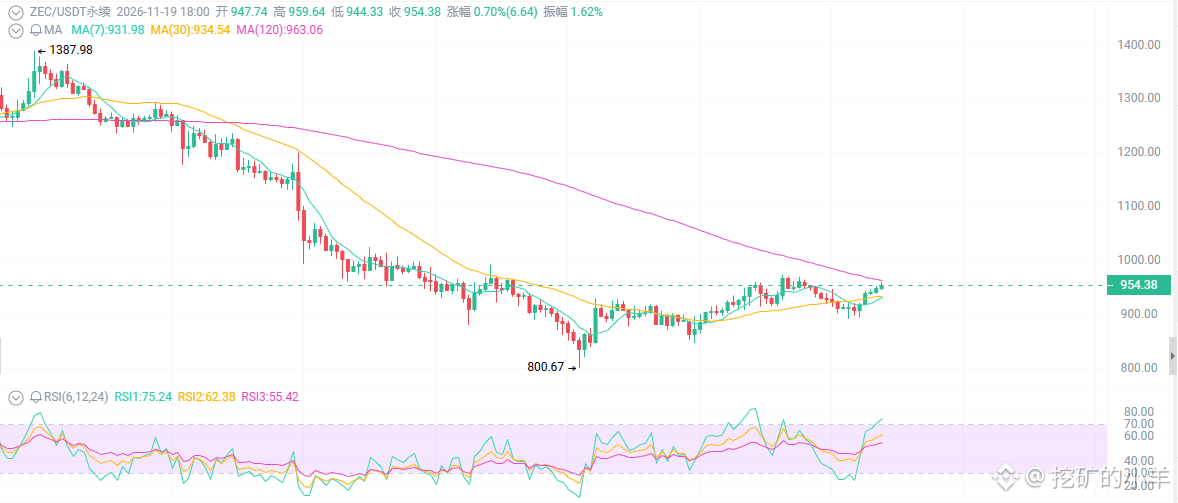
ZEC at $955—would you still dare to touch it?
It plunged from 1,700 to 800, getting cut in half, then cut in half again. Everyone said privacy coins were dead. But just now, Arthur Hayes included it among the “Four Horsemen,” Bitwise filed an application for a spot ETF, and the NU7 upgrade quietly went live. Is this just a dead-cat bounce, or a comeback against the odds for the privacy sector?
First, the surface picture: it’s been falling for six months, but the price hasn’t completely collapsed.
From its September high of 1,700, it plunged all the way to 800–860, losing nearly half its value. But look at the recent action—it bounced hard from the lows back to 955. The 24-hour range was 890–970, and trading volume picked up during the rebound. The candlestick chart tells you that 920–900 is both the starting point of this rebound and the bulls’ line in the sand.
First up: the NU7 upgrade is live, but the market hasn’t caught on yet
On November 6, NU7 activated on mainnet. Block times were cut from 75 seconds to 25, making transaction confirmations three times faster. 60% of transaction fees will go into a reserve, then be distributed to miners starting in 2031—the total supply remains 21 million, not one coin more.
This means ZEC is moving from “geek toy” to “usable money.” What’s the biggest pain point for privacy coins? They’re slow, hard to use, and nobody uses them. NU7 is meant to fix that. But right now, the market is panicking over BTC falling below 64,000, and no one feels like reading ZEC’s upgrade announcement—that’s a classic case of “good news emerging amid panic.”
Second: the community is voting on a proposal that could lock up 50,000 ZEC
Community voting is underway through the end of November. The key proposal: redirect some ZCG subsidies to NSM, potentially locking around 50,000 ZEC into a sustainable mechanism.
How much is 50,000 ZEC worth? At $955, nearly $48 million. That would directly reduce the circulating supply.
Think about it: for a coin with a $16 billion market cap, suddenly locking up tens of millions’ worth of circulating supply means less selling pressure. And this isn’t the project team making a snap decision—it’s being decided by a community vote. Decentralized scarcity is worth ten thousand times more than centralized hype.
On top of that, Bitwise has filed an application for a spot ZEC ETF with the Texas Stock Exchange, and Grayscale also holds ZEC.
Third: the technical picture has reached a point where a decision has to be made.
The long-term trend is intact, but the short term is still recovering.
On the 4-hour chart: RSI is around 40, neutral to slightly weak, with no overbought conditions. Trading volume increased during the rebound, but its staying power remains to be seen.
Resistance: 970–1,000 → 1,050–1,100 → 1,200+
Support: 920–900 → 880–860 → 800–750
ZEC has already hit a wall at 1,000 several times. On the fourth attempt, will it break straight through, or get knocked back to 900 again?