$SOL
A token that shorts semiconductors 3x has higher trading volume than SOL perpetuals
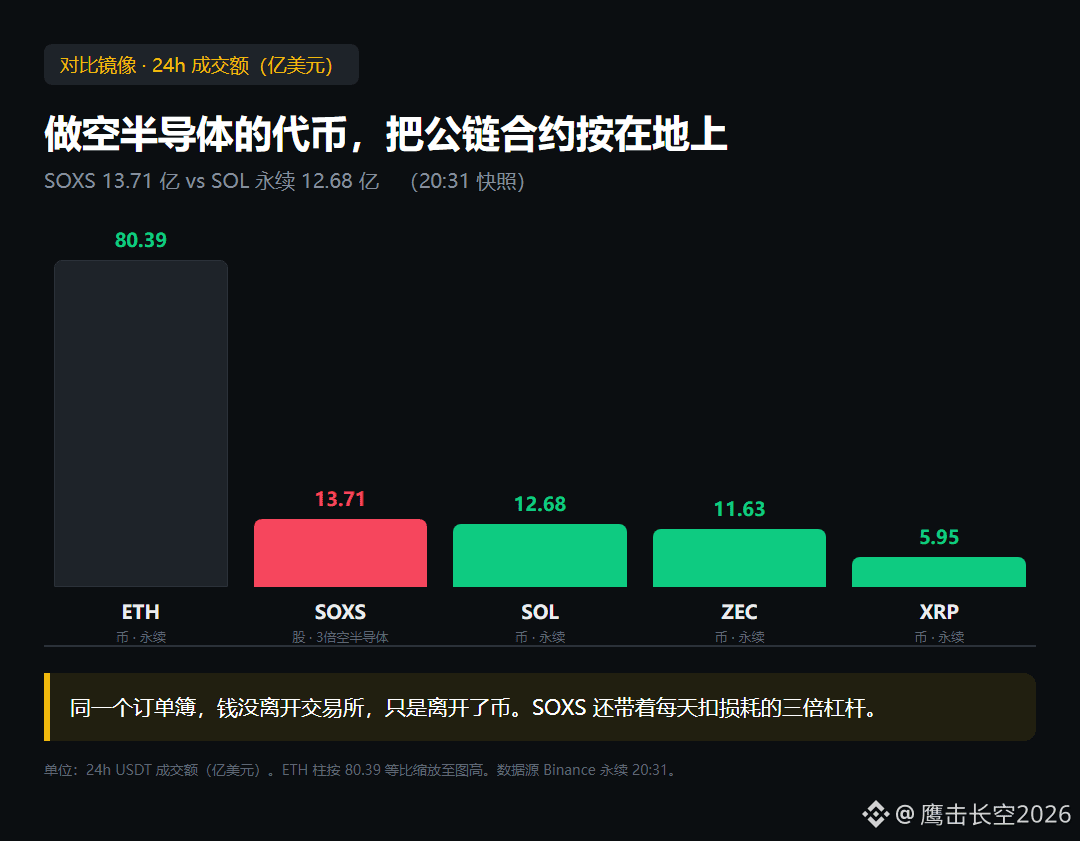
SOXS traded $1.37 billion today, versus $1.27 billion for SOL perpetuals. A 3x short semiconductor ETF token is putting the contracts of the crypto market’s third-largest blockchain to shame.
This isn’t a joke—I just dug it out of a snapshot of the entire market. Out of 151 contracts with over $20 million in trading volume, SOXS made the top ten losers, down 4.92% with $1.371 billion in volume. At the same time, SOL perpetuals had $1.268 billion in volume, up 0.31%.
SOXS is down, which means semiconductors are up. Nvidia was up 1.6% premarket, SK Hynix was up nearly 5%, and memory stocks were awash in green. The money is really flowing over there.
Here’s an even starker comparison: SOXS’s $1.371 billion is equivalent to 17% of ETH perpetuals, 11.8 times ZEC, and 55 times BNB.
And what it’s tied to is a 3x leveraged ETF that bleeds value every day. Hold it overnight, and rebalancing and fees alone eat away at your principal. It’s the asset least suited to “buy and hold” in the entire market, yet its trading volume is higher than that of a major blockchain.
What does that tell us? The money hasn’t left this exchange; it’s just moved away from crypto. It’s all on the same order book—the attention has simply shifted.
Let me also break down the decay. The decay of a 3x leveraged ETF doesn’t compound linearly; the more volatile the market, the faster it loses value. If the underlying asset fluctuates by an average of 2% a day and goes nowhere for a month, a 3x product could lose 10% to 15% of its value. So a large chunk of SOXS’s $1.371 billion in volume is probably intraday trading back and forth—not people actually shorting semiconductors.
SOL is the most direct victim here. Trading volume is $1.268 billion, the funding rate is 6.231e-05, and over the past 24 hours it moved from 75.31 to 72.16. Over the last 20 candles, it ranged from 74.24 to 75.31. It’s now at 74.69, sitting 62% of the way through the range.
74.24 is the lower bound of this range. If it breaks below that, this rebound is basically invalidated; only a move back above 75.31 would count as a real breakout. The level matters more than the direction, so I’m staying out while it’s above 74.24.
A: The money has just moved to another table; it’ll come back
B: This is the start of a capital drain; crypto is being sidelined
Which one do you choose?
#SOL #股票代币 #CapitalRotation