


Prepared by
Steven McWhirter, Global Policy Lead
Diego Montes Serralde, Global Policy Manager
Binance Global Policy Insights | November 2026
Main Takeaways
CeFi and DeFi are increasingly finding synergies, with clearer pathways that let users choose when to use each model. A CeDeFi approach is emerging which combines CeFi’s accessible interfaces, access, scale, and operational safeguards with DeFi’s on-chain transparency and permissionless innovation, while seeking to maintain a clear boundary between custodial services and self-custody experiences.
Binance’s Hybrid Ecosystem: Binance provides examples of CeFi–DeFi synergies through an ecosystem that brings together a leading CeFi platform with access to public blockchain infrastructure. Binance’s centralised exchange offers liquidity, security features, and user-friendly access, while BNB Chain is a public, decentralised blockchain ecosystem that supports on-chain applications and innovation. Users can connect between account-based services and on-chain activity through bridging infrastructure and wallet integrations, including Binance Wallet, which can help users move assets across supported networks with reduced friction.
Bridging Products and Services: Binance’s major products illustrate CeDeFi interplay. Binance Launchpad helps new blockchain projects reach millions of users through the exchange, then flourish on decentralised networks. Binance Launchpool lets users lock assets on the CeFi platform to receive token rewards, connecting centralised participation with projects that may subsequently develop broader on-chain utility. Institutional custody and settlement arrangements can also provide more controlled pathways through which eligible institutions access exchange-linked liquidity and, where appropriate, on-chain opportunities. Binance Wallet integration is an easily accessible self-custodian tool, allowing users to access dApps and other DeFi features.
A Potential Blueprint for Finance: CeDeFi’s hybrid approach may serve as a blueprint for the broader industry. CeDeFi suggests that access to decentralised yield opportunities can be structured alongside compliance frameworks, and that institutional trust and open innovation can reinforce each other rather than conflict. Institutions can access on-chain opportunities through more structured risk management pathways, while retail users retain greater choice over how and where they interact with decentralised applications.
1 / Introduction
For years, the crypto industry framed CeFi and DeFi as competing models. CeFi emphasized convenience, liquidity, and familiar account-based experiences, while DeFi prioritized transparency, programmability, independence and user-controlled assets.
In practice, most users want elements of both. They want straightforward onboarding, deep markets, and strong operational standards, while also having the option to access permissionless applications on public blockchains. This article looks at how that convergence is unfolding, using Binance’s ecosystem as a practical example of how CeFi and DeFi can connect in one user journey and what it implies for the allocation of custody, execution, and risk across services.
2 / What Do We Mean by CeFi and DeFi?
CeFi and DeFi describe where custody, execution, and control sit in a financial experience. One model is not inherently “better” for every use case, and the most effective systems increasingly combine them.
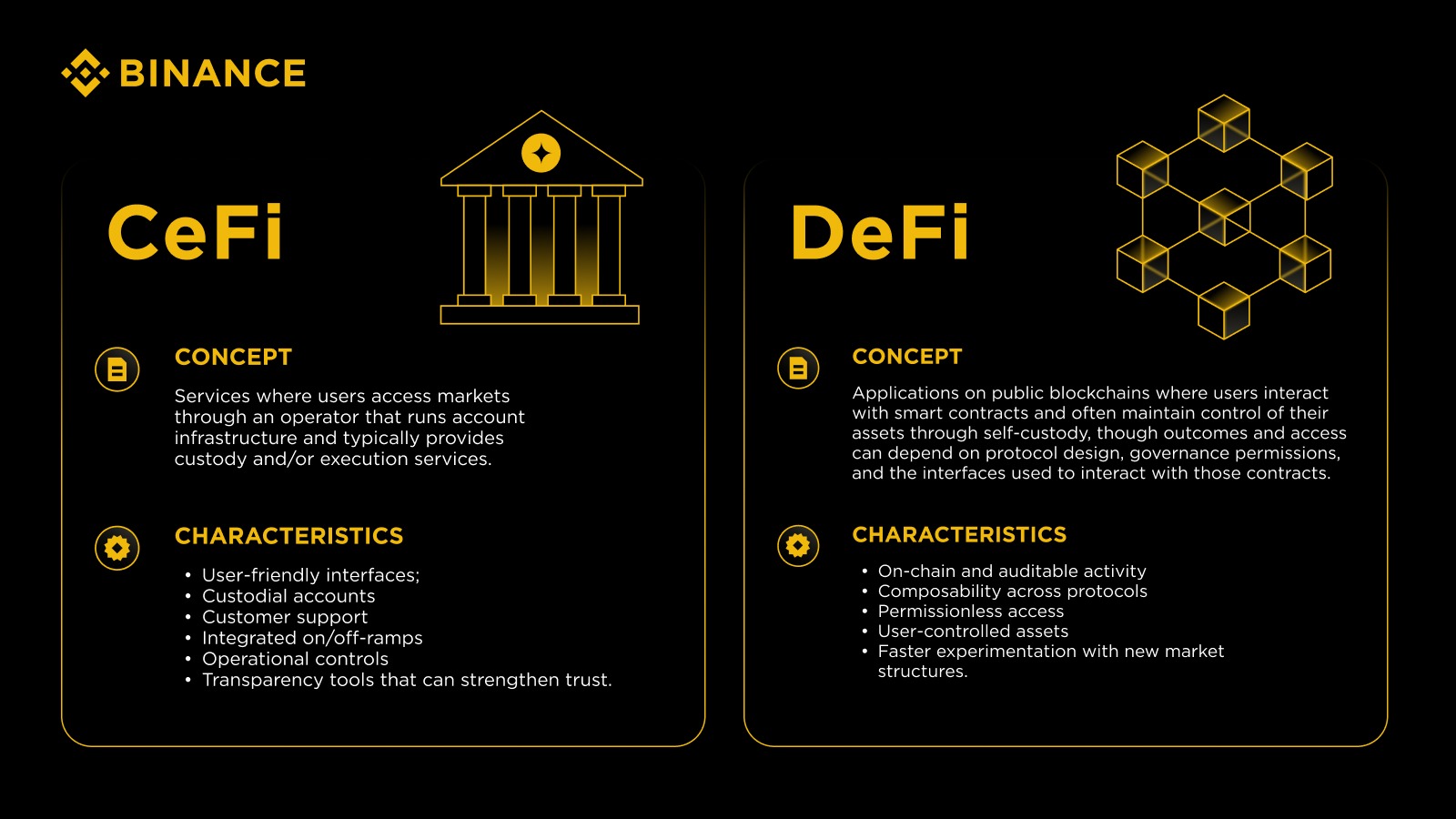
In regulatory discussions, the distinction between CeFi and DeFi increasingly turns not only on the decentralised nature of the underlying technology, but also on the governance and functions surrounding it. The FATF’s 2026 analysis, for example, distinguishes the underlying smart-contract technology from the broader DeFi arrangement and focuses on whether identifiable persons exercise control or sufficient influence over how financial services are provided.
CeFi and DeFi from competition to convergence
The industry is moving beyond a binary “CeFi versus DeFi” debate. The more strategic question is how to combine strengths in a way that improves outcomes for users and supports institutional participation.
Where there is clear functional and legal segregation between the underlying infrastructure and persons providing financial services around it, regulatory treatment can reflect the actual allocation of control, influence and risk. Hybrid models may raise more complex questions where centralised entities facilitate access to DeFi arrangements, particularly where they exercise control or sufficient influence over the services provided or actively facilitate activities that fall within the scope of financial regulation.
This blended approach is often described as CeDeFi. In practice, CeDeFi is often described as a design pattern: it connects CeFi’s usability and liquidity with DeFi’s open infrastructure and programmable markets. It aims to make on-chain participation more accessible without stripping users of the option to self-custody and interact directly with protocols.
The enabling layer for this convergence is infrastructure. When networks are scalable and wallets and bridges are secure and easy to use, moving between custodial services and on-chain applications becomes a normal product flow.
3 / Binance’s Hybrid Crypto Ecosystem
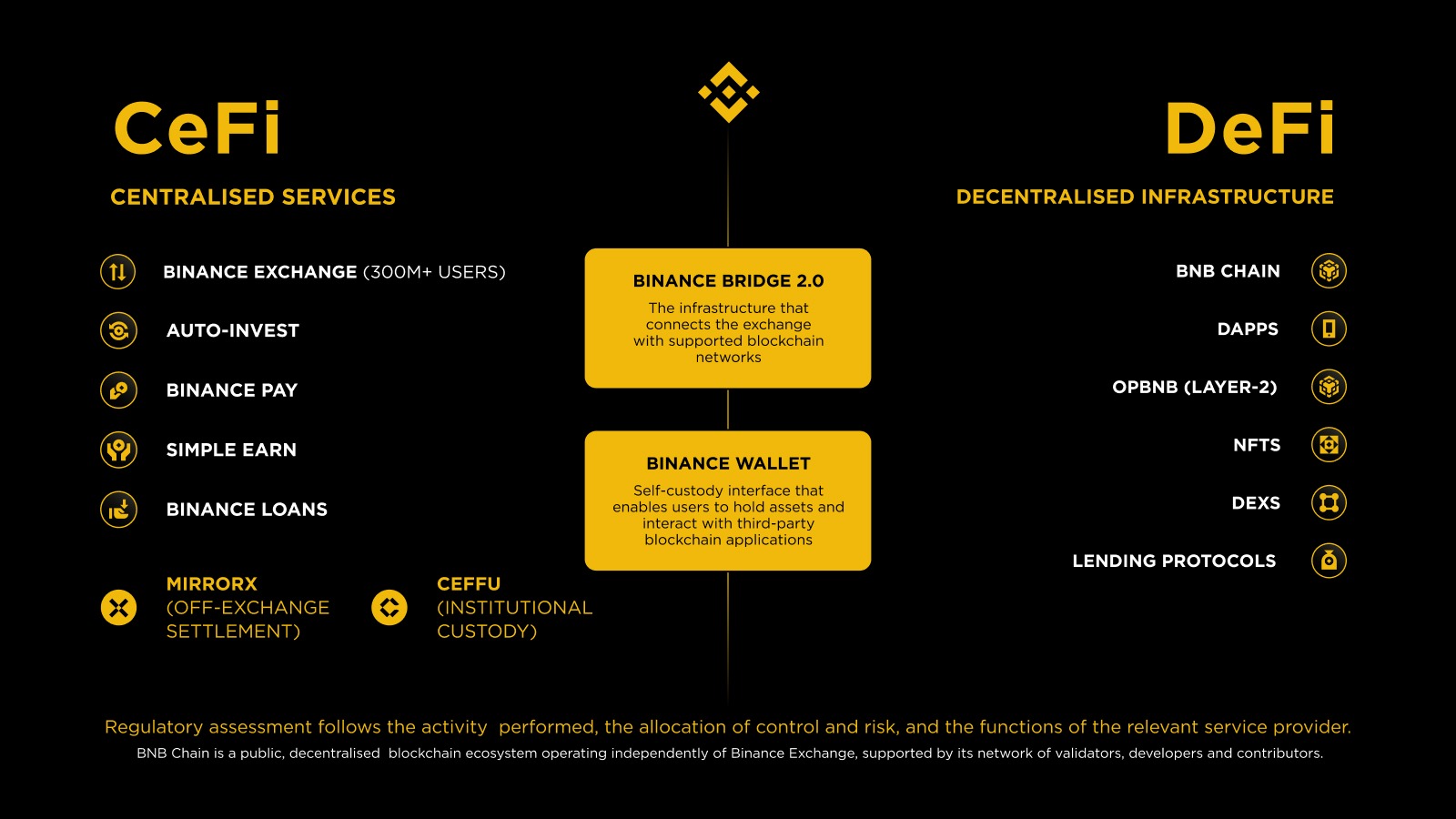
Binance brings together centralised financial services and technical interfaces that facilitate access to independent public blockchain ecosystems, including BNB Chain. Through its exchange, wallet integrations and supported cross-chain connectivity, Binance helps users move between custodial services and on-chain applications while preserving the distinct governance, control and risk characteristics of each environment.
A. CeFi pillar: Binance’s centralised services
The foundation of Binance’s ecosystem is the Binance Exchange. This is a centralised cryptocurrency exchange at massive scale, serving over 300 million users globally, where users can trade hundreds of cryptocurrencies in a custodial setting. The Binance Exchange provides centralised market access, liquidity, and an account-based experience that many users rely on for trading and portfolio management.
At its core, the Binance Exchange provides high-performance spot, margin, and derivatives venues, integrated with reliable fiat on- and off-ramps so newcomers can buy their first asset in a familiar environment while advanced users execute complex strategies at scale.
This layer is underpinned by a trust architecture built for operational assurance. Assets are safeguarded through robust custody controls, a public proof-of-reserves program intended to provide transparency regarding asset backing, and the Secure Asset Fund for Users (SAFU) as an additional contingency. Together, these controls provide transparency, loss-absorption capacity, and day-to-day resilience.
For institutions, independent custody and settlement providers can offer additional pathways to access exchange liquidity. Ceffu provides institutional custody solutions, while its MirrorX offering enables eligible institutions to access Binance Exchange liquidity through off-exchange settlement arrangements, with assets remaining in Ceffu's custody subject to the applicable operational and legal framework.
On the portfolio side, Simple Earn offers flexible and locked options for earning rewards by depositing digital assets, Auto-Invest supports recurring accumulation, and Binance Loans, including VIP facilities, supports over-collateralized liquidity without forcing users to unwind core positions. These tools let users manage returns, build positions methodically, and unlock funding from a single account.
Beyond trading and earning, CeFi can support real-world utility. Binance Pay is positioned as a crypto payments technology for sending and receiving crypto and paying merchants in supported contexts.
B. DeFi pillar: BNB Chain and decentralised platforms
On the decentralised side, BNB Chain provides public blockchain infrastructure for smart contracts and applications. It is a public, open-source smart contract ecosystem supported by a distributed ecosystem of validators, developers, and contributors, designed to host a wide range of decentralised applications (dApps). BNB is used as the network’s gas token for transactions and as the staking asset within its validator-based consensus model. BNB Chain operates independently of Binance Exchange. Its underlying infrastructure is maintained through its decentralised validator ecosystem, and Binance Exchange does not own or control the network.
Over recent years, BNB Chain has developed into a sizable and active DeFi ecosystem. Users can trade on decentralised exchanges, mint NFTs, play blockchain games, and use lending and other on-chain applications. Depending on network conditions, users may also experience lower transaction costs and faster confirmations relative to some other networks.
To support additional scalability, opBNB is a Layer-2 built using Optimistic Rollup technology and the OP Stack framework. It executes transactions off the base layer and periodically batches and posts results back on-chain, helping increase throughput and reduce fees for end users.
In short, Binance supports users across both models. It operates a CeFi exchange and provides tools that connect users to on-chain ecosystems, including BNB Chain. The value of this approach becomes clearest when users can move efficiently between account-based services and on-chain activity through secure bridging mechanisms.
4 / Connecting the Dots: Bridges, Wallets, and User Connectivity
Convergence only becomes real when users can easily move value between environments without specialist knowledge. Binance’s ecosystem includes two core connectors that support this portability:
Binance Bridge 2.0: One of the core pieces of infrastructure that connects the exchange with supported blockchain networks. Binance Bridge 2.0 provides a way to bridge listed and selected unlisted tokens from supported blockchains to BNB Smart Chain as BTokens, enabling use in the BNB Chain ecosystem and conversion back when needed. This can help users move assets from account-based services into on-chain applications on BNB Chain, including for assets that did not originate on BNB Chain. As with cross-chain mechanisms generally, bridges introduce additional operational, security and financial crime considerations, and appropriate safeguards should reflect the risks associated with moving assets across networks.
Binance Wallet: Binance Wallet is positioned as a self-custody wallet experience that uses MPC technology, removing the need for a traditional seed phrase, while still functioning as a gateway designed to facilitate user access to third-party blockchain-based applications. With this wallet, users can access multiple blockchains, trade thousands of tokens on decentralised exchanges, earn yield on DeFi platforms, and interact with dApps, all without needing to switch to external wallet software. The wallet is designed to operate on a user-directed, non-custodial basis, where users retain control of their assets and transaction approvals. Binance Wallet is designed to provide a self-custody experience through which users retain control over their assets and authorise transactions. Depending on the functionality used, the interface may facilitate access to third-party applications, aggregate liquidity or available execution routes, and support user-authorised trading features. The relevant allocation of control and responsibility should therefore be assessed by reference to the specific service and functions performed, including any transaction-routing or automated execution features.
From a regulatory perspective, these interface, routing and other access layers are increasingly assessed as potential points of intermediation*. The analysis typically turns on whether providers exercise discretion over transaction execution or routing, direct or influence user activity toward specific venues or counterparties, or otherwise perform functions analogous to financial intermediaries, as opposed to providing neutral, user-directed software tools.
*Regulatory treatment of wallet and interface providers is fact-specific and turns on the functions performed. In the U.S., relevant broker-dealer considerations may include whether a provider takes custody, exercises discretion or control over execution or routing, brings together counterparties, or otherwise performs functions associated with intermediation. In the U.K., the ‘arranging’ perimeter distinguishes between arranging transactions and making arrangements with a view to transactions, with the analysis depending on the nature and role of the arrangements and their relationship to the relevant transaction. In both jurisdictions, the use of decentralised or non-custodial infrastructure is not, by itself, determinative.
Where functionality is limited to neutral, user-directed technical access, the regulatory analysis should therefore focus on the functions actually performed. Relevant considerations may include whether the provider takes custody, exercises control or sufficient influence, actively facilitates regulated financial services, determines transaction routing, or otherwise performs intermediary-like functions.
To illustrate how Binance’s CeFi and DeFi offerings interplay, consider a few scenarios:
Retail path
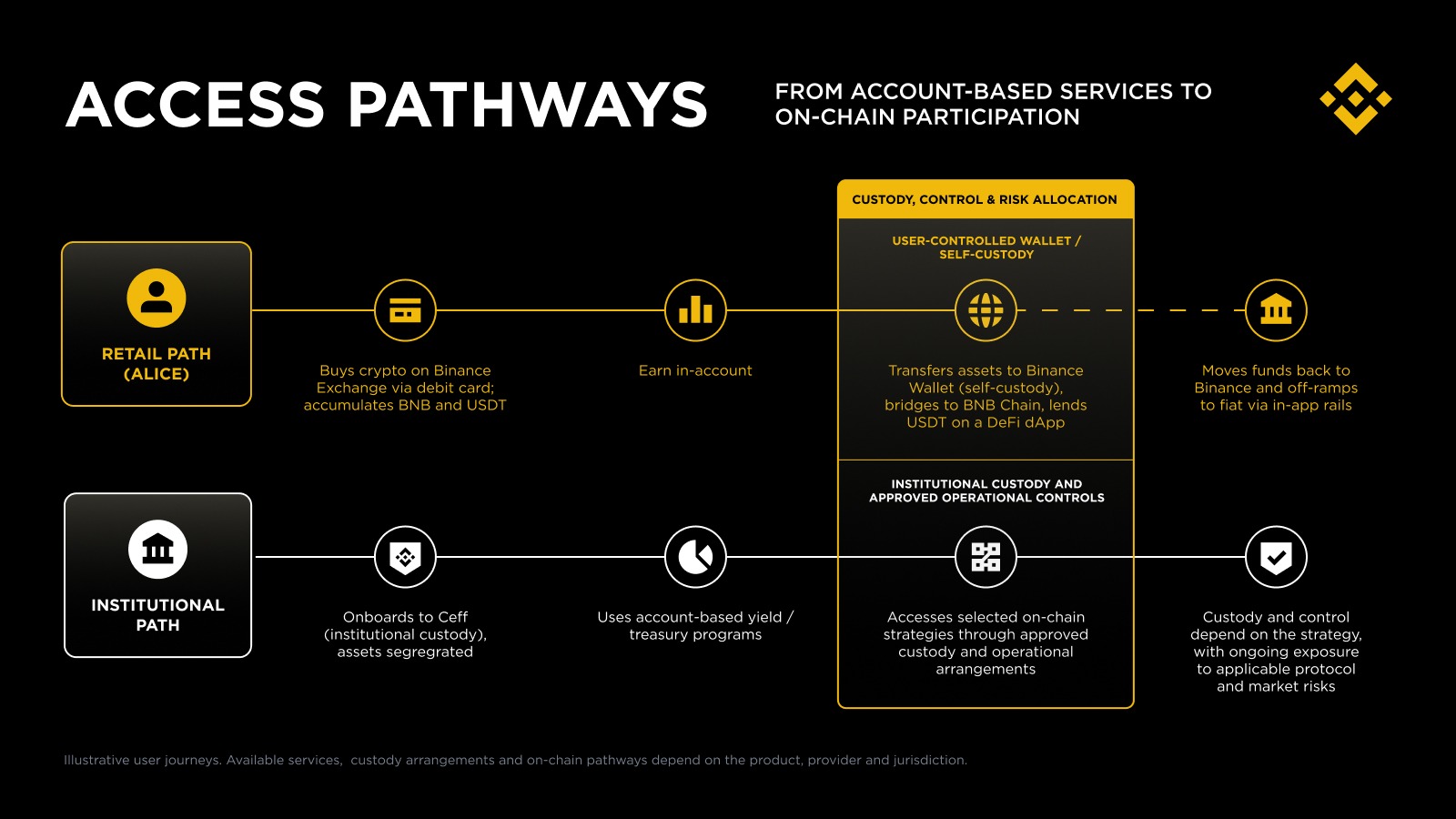
Alice is a retail user who buys some crypto on the Binance Exchange using her debit card. After trading and accumulating BNB and USDT in her Binance account, she wants to earn higher yields. Using Binance’s Wallet feature, she transfers a portion of her BNB and USDT to her self-custody wallet. She then accesses a DeFi lending dApp on BNB Chain, and lends out her USDT to earn interest.
The process required no complex setup, with supported bridging functionality and the wallet interface enabling Alice to move assets onto BNB Chain. Later, if Alice wants to try a new DeFi application or access an NFT marketplace, she can do so through the wallet interface.
Alice’s journey reduces setup friction by connecting wallet access and supported cross-chain pathways through a familiar interface. At the same time, the risk and control profile changes depending on where assets are held. This may also extend to differences in product type, where users are presented with distinct disclosures and contextual information reflecting the nature and purpose of specific activities.
In a custodial CeFi account, the platform is responsible for key management and certain operational controls, while the user relies on the platform’s safeguards and processes. In self-custody, the user controls the wallet keys and transaction approvals, and assumes greater responsibility for verifying addresses, transaction details, and the risks of interacting with smart contracts and protocols.
Where assets move between a regulated service provider and a self-custody wallet, the platform may also apply risk-based transaction monitoring and other safeguards depending on the transaction, asset and applicable requirements.
If Alice later wants to convert some earnings back to fiat, she can move funds back to her Binance account and use available in-app off-ramp options to sell crypto into fiat and withdraw to a supported bank account or card, depending on her jurisdiction and available rails.
Institutional path
A large asset manager is interested in yield opportunities in crypto, but due to fiduciary duties, they require secure custody and regulatory compliance.
The asset manager onboards to Ceffu for institutional custody and deposits assets, using custody arrangements designed for professional clients, including segregation and governance controls that support institutional risk management requirements. From there, the institution can access a range of yield and treasury-management pathways depending on its mandate and risk appetite. Some allocations may remain in account-based programs available to eligible users, while others may be deployed to on-chain strategies through structured access models and approved operational workflows.
Where intermediaries provide curated, managed, or structured access to DeFi strategies on behalf of clients, they may remain responsible for applicable regulatory and compliance obligations notwithstanding the decentralised nature of the underlying protocol, including where such access is provided through structured or discretionary workflows. This may be particularly relevant where institutions access DeFi through managed interfaces, as regulators may assess whether such access models involve intermediary functions despite the use of non-custodial or on-chain infrastructure.
This direction is increasingly reflected in international AML/CFT policy. The FATF’s 2026 DeFi report calls for financial institutions and VASPs interacting with DeFi arrangements to assess the risks of the relevant products and apply proportionate mitigation measures. The assessment may include the governance and AML/CFT controls of the DeFi arrangement, the nature of the underlying users and, where appropriate, ongoing blockchain monitoring.
For instance, an institutional custody provider can support client participation in on-chain staking on BNB Chain, or structured access to selected on-chain strategies, using defined operational workflows. The institution’s assets remain within an institutional custody framework, which can mitigate direct private key management and operational key-handling risks, while exposure is deployed to on-chain protocols where returns remain subject to smart contract, market, liquidity, and operational risks, as well as any protocol-specific governance or counterparty dependencies.
This model may therefore provide institutions with a phased route into on-chain participation, allowing exposure to decentralised markets through controlled operational and governance frameworks rather than requiring immediate direct protocol interaction.
This illustrates how institutional access pathways may develop within Binance’s infrastructure without requiring institutions to adopt the full operational complexity of direct DeFi participation on day one.
5 / Summary of Key Components and How They Integrate
Service or Access Layer | Public Blockchain or On-chain Activity | How They Connect |
Binance Exchange | BNB Chain | Bridges and wallet workflows enable moving assets for on-chain utility and back for liquidity and account-based management. |
Binance Wallet | Multiple blockchain networks | Self-custody gateway designed for interacting with third-party on-chain applications. |
On-chain token utility post-distribution | Launchpad is an IEO platform that supports project fundraising and distribution within an exchange context. | |
On-chain token exposure and distribution dynamics | Launchpool allows users to lock assets to receive token airdrops, connecting centralised participation to broader on-chain ecosystems. | |
Binance Custody (Ceffu) | DeFi and exchange-linked liquidity access patterns | MirrorX is described as an off-exchange settlement that can reduce the need to move assets onto an exchange while accessing liquidity. |
6 / Strategic Value of Convergence
The strategic value of convergence is that CeDeFi can help address certain structural limitations on both sides.
CeFi can strengthen usability and onboarding, but it can also concentrate operational risk and limit portability if users cannot move freely into self-custody and on-chain markets. DeFi expands openness, choice and composability, but the user experience and risk management burden can be higher, especially for newcomers and institutions.
A CeDeFi approach aims to bring these strengths together. It supports access and safety for a broad user base while providing structured access to permissionless innovation. It also aligns with the institutional direction of travel: institutions typically begin with established venues and providers that offer robust governance, controls, and risk assessment, then broaden into on-chain activity as infrastructure, custody models, and operational standards mature. In that context, integrated ecosystems can help institutions move step-by-step, rather than relying on fragmented or untested access points.
This also aligns with emerging regulatory approaches that focus on activity and risk rather than labels such as ‘centralised’ or ‘decentralised’. In practice, this may also require clear segmentation between different categories of activity within a single platform, supported by appropriate user disclosures and risk framing, particularly where products or use cases differ materially in economic function, risk profile, or regulatory treatment.
Accordingly, the regulatory treatment of CeDeFi models is likely to depend less on whether the underlying infrastructure is described as decentralised and more on the functions performed across the value chain. Relevant considerations increasingly include practical control or sufficient influence, governance and administrative rights, active facilitation of financial services, and the nature of the relationship with users.
7 / Current Use Cases
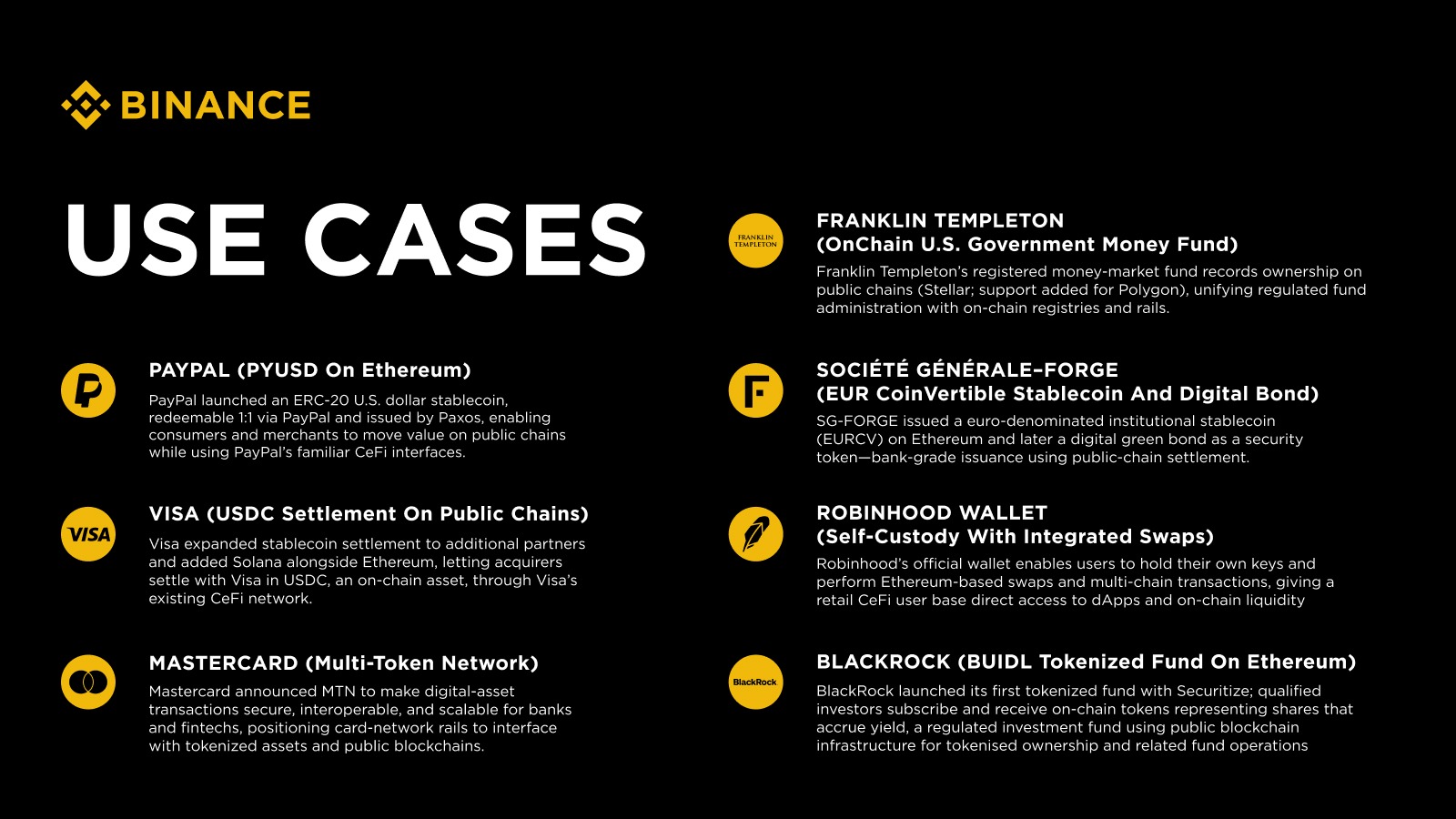
Convergence is not theoretical. It is visible in how major financial and technology firms are using public chains for issuance, settlement, and tokenized cash-like instruments.
PayPal (PYUSD on Ethereum). PayPal launched an ERC-20 U.S. dollar stablecoin, redeemable 1:1 via PayPal and issued by Paxos, enabling consumers and merchants to move value on public chains while using PayPal’s familiar CeFi interfaces.
Visa (USDC settlement on public chains). Visa expanded stablecoin settlement to additional partners and added Solana alongside Ethereum, letting acquirers settle with Visa in USDC, an on-chain asset, through Visa’s existing CeFi network.
Mastercard (Multi-Token Network). Mastercard announced MTN to make digital-asset transactions secure, interoperable, and scalable for banks and fintechs, positioning card-network rails to interface with tokenized assets and public blockchains.
BlackRock (BUIDL tokenized fund on Ethereum). BlackRock launched its first tokenized fund with Securitize; qualified investors subscribe and receive on-chain tokens representing shares that accrue yield, a regulated investment fund using public blockchain infrastructure for tokenised ownership and related fund operations.
Franklin Templeton (OnChain U.S. Government Money Fund). Franklin Templeton’s registered money-market fund records ownership on public chains (Stellar; support added for Polygon), unifying regulated fund administration with on-chain registries and rails.
Société Générale–FORGE (EUR CoinVertible stablecoin and digital bond). SG-FORGE issued a euro-denominated institutional stablecoin (EURCV) on Ethereum and later a digital green bond as a security token—bank-grade issuance using public-chain settlement.
Robinhood Wallet (self-custody with integrated swaps). Robinhood’s official wallet enables users to hold their own keys and perform Ethereum-based swaps and multi-chain transactions, giving a retail CeFi user base direct access to dApps and on-chain liquidity.
Not all of these examples constitute ‘DeFi’ in the strict sense; rather, they illustrate broader convergence between centralised financial interfaces and public blockchain-based infrastructure. However, these examples point to a consistent direction.
Public blockchain rails are increasingly used for settlement and tokenized instruments, while familiar ‘CeFi’ interfaces and regulated entities remain central to distribution, user experience, and operating models. Taken together, they illustrate a broader convergence in which centralised financial services increasingly interact with public blockchain infrastructure, while custody, execution and control may remain allocated across different participants and layers.
This broader convergence is also giving rise to the concept of ‘TriFi’, bringing together elements of traditional finance, centralised finance and decentralised finance within increasingly connected financial ecosystems. Rather than eliminating the distinctions between these models, TriFi highlights the importance of preserving clear functional, legal and regulatory boundaries as users move between them.
The relevant regulatory treatment should continue to follow the activity performed, the allocation of control and risk, and the role of the entities involved.
8 / Conclusion
CeFi and DeFi are converging because users and institutions prefer accessibility, flexibility and portability. This next phase of crypto adoption will be shaped by ecosystems that let users move between custodial services and self-custody experiences while maintaining appropriate safety standards, market access and usability.
Binance's vision for a unified crypto ecosystem is built around making the transition between CeFi and DeFi more accessible, secure and practical. Through its centralised exchange, Binance Wallet and supported cross-chain connectivity, alongside institutional access arrangements and independent public blockchain infrastructure such as BNB Chain, Binance provides users with pathways to trade, earn, pay and explore on-chain opportunities.
This approach combines the scale, liquidity and familiar user experience of centralised services with greater access to decentralised innovation, while preserving the distinct custody arrangements, governance structures and responsibilities of each environment.
The barriers between CeFi and DeFi are lowering. For Binance, the most important outcome is user benefit: safer access, clearer pathways for institutions, and a more scalable route to permissionless innovation. As traditional finance increasingly connects with both models, the key question is no longer whether finance is centralised or decentralised, but how users can safely and securely engage across these different environments.
This includes ensuring that users are able to distinguish between different categories of activity, supported by clear disclosures, appropriate segmentation, and proportionate safeguards aligned to the underlying use case.
A unified user experience does not require a unified regulatory classification
At the user-experience level, this may increasingly be reflected in ‘superapp’ models that provide more integrated access across these different financial environments while maintaining appropriate functional and regulatory segmentation between the underlying activities.
As regulatory approaches evolve, the treatment of hybrid CeDeFi and other hybrid models is likely to depend increasingly on the functions performed by front-end and access-layer providers, including whether they provide neutral technical access or exercise control or sufficient influence, actively facilitate financial services, or perform other intermediary-like functions. The central policy challenge will be determining where infrastructure ends and regulated financial intermediation begins based on the functions performed across the user journey.