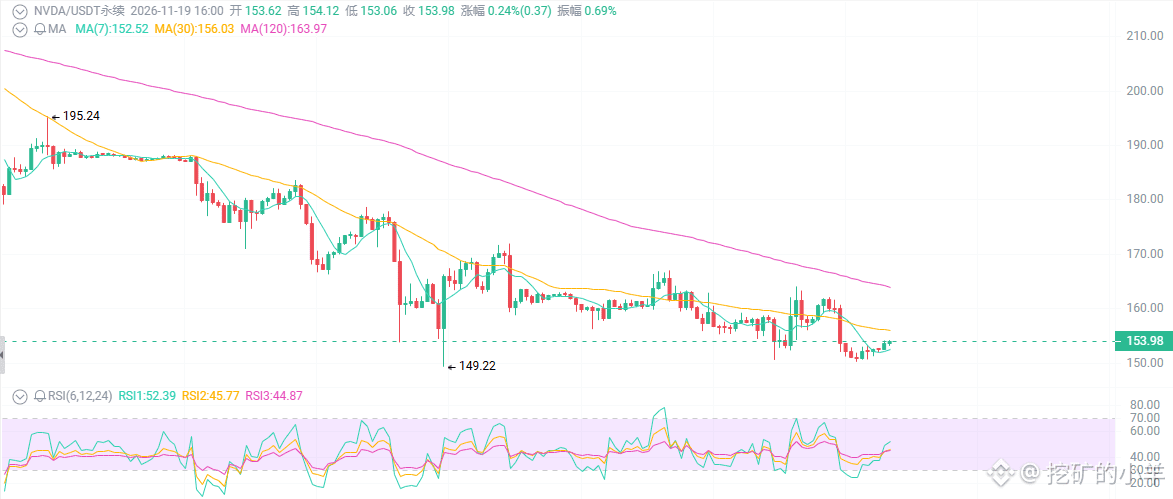
Nvidia at $154—would you catch it?
The most profitable AI company on Earth: Q3 revenue surged 103%, data center revenue doubled, and it authorized $150 billion in buybacks—yet the stock fell from $243 to $154, down nearly 40%. The reason wasn’t its results. It was the sudden departure of the man in the leather jacket. Is this a golden buying opportunity, or the beginning of a collapse in faith in AI?
First, the headlines: blockbuster earnings, but the stock fell.
Earnings report on November 17: Q3 revenue of $11.58 billion, up 103% year over year and far above expectations. Next-quarter guidance of $13 billion, up 90% year over year and above market expectations. FY2028 revenue growth outlook raised from 70% to 75%. An additional $150 billion in buyback authorization.
In any other year, numbers like these would send the stock soaring.
But on November 18, the stock closed down 2.9%. From its October 6 high of $243, it has fallen 36–38% overall.
Why? Because Jensen Huang is gone.
First: earnings are the bricks and mortar; the CEO is the foundation.
Last week, Jensen Huang suddenly left after violating rules of personal conduct. The board explicitly rejected his return, CFO Colette Kress took over on an interim basis, and a formal CEO search is underway.
This is the first time in more than 30 years that Nvidia has been without founder-like leadership.
Nvidia doesn’t just sell chips—it sells Jensen Huang himself.
He’s spent decades dining with TSMC’s Morris Chang, is on brotherly terms with the CEOs of Microsoft, Google, and Meta, and chats easily with politicians in Washington.
Second: the valuation is ridiculously cheap—but there’s a reason for that.
TTM P/E: 16–20x.
You read that right: the fastest-growing AI company on Earth has a lower P/E than Kweichow Moutai.
Gross margin is 75%, free cash flow is strong, and more than half of the $150 billion buyback authorization remains.
Although analysts have lowered their average price targets, they’re still significantly above the current price.
But the market isn’t buying it.
Why?
Because this sell-off isn’t about valuation—it’s about trust.
As long as the CEO vacancy remains unresolved, institutions won’t dare to take a heavy position.
Third: the charts tell you this isn’t the time to buy the dip.
The daily and weekly charts show a series of lower highs and lower lows. The stock broke below key support at 200 and 180, then accelerated down toward 150.
Short-term moving averages are bearishly aligned. The RSI entered oversold territory but hasn’t formed a bullish divergence.
Volume is rising on the way down and drying up on rebounds—the bears aren’t gone yet.
Support: 148–150 → 145
Resistance: 158–162 → 170–175 → 180+
148 is the 52-week low and the bulls’ last line of dignity. If it breaks, there’s nothing but open space below.
The most profitable AI company on Earth: Q3 revenue surged 103%, data center revenue doubled, and it authorized $150 billion in buybacks—yet the stock fell from $243 to $154, down nearly 40%. The reason wasn’t its results. It was the sudden departure of the man in the leather jacket. Is this a golden buying opportunity, or the beginning of a collapse in faith in AI?
First, the headlines: blockbuster earnings, but the stock fell.
Earnings report on November 17: Q3 revenue of $11.58 billion, up 103% year over year and far above expectations. Next-quarter guidance of $13 billion, up 90% year over year and above market expectations. FY2028 revenue growth outlook raised from 70% to 75%. An additional $150 billion in buyback authorization.
In any other year, numbers like these would send the stock soaring.
But on November 18, the stock closed down 2.9%. From its October 6 high of $243, it has fallen 36–38% overall.
Why? Because Jensen Huang is gone.
First: earnings are the bricks and mortar; the CEO is the foundation.
Last week, Jensen Huang suddenly left after violating rules of personal conduct. The board explicitly rejected his return, CFO Colette Kress took over on an interim basis, and a formal CEO search is underway.
This is the first time in more than 30 years that Nvidia has been without founder-like leadership.
Nvidia doesn’t just sell chips—it sells Jensen Huang himself.
He’s spent decades dining with TSMC’s Morris Chang, is on brotherly terms with the CEOs of Microsoft, Google, and Meta, and chats easily with politicians in Washington.
Second: the valuation is ridiculously cheap—but there’s a reason for that.
TTM P/E: 16–20x.
You read that right: the fastest-growing AI company on Earth has a lower P/E than Kweichow Moutai.
Gross margin is 75%, free cash flow is strong, and more than half of the $150 billion buyback authorization remains.
Although analysts have lowered their average price targets, they’re still significantly above the current price.
But the market isn’t buying it.
Why?
Because this sell-off isn’t about valuation—it’s about trust.
As long as the CEO vacancy remains unresolved, institutions won’t dare to take a heavy position.
Third: the charts tell you this isn’t the time to buy the dip.
The daily and weekly charts show a series of lower highs and lower lows. The stock broke below key support at 200 and 180, then accelerated down toward 150.
Short-term moving averages are bearishly aligned. The RSI entered oversold territory but hasn’t formed a bullish divergence.
Volume is rising on the way down and drying up on rebounds—the bears aren’t gone yet.
Support: 148–150 → 145
Resistance: 158–162 → 170–175 → 180+
148 is the 52-week low and the bulls’ last line of dignity. If it breaks, there’s nothing but open space below.