

Choosing a crypto exchange is not simply about finding the platform with the most security features. It is also about understanding how those features work, what they actually protect, and whether users can independently verify the information provided.
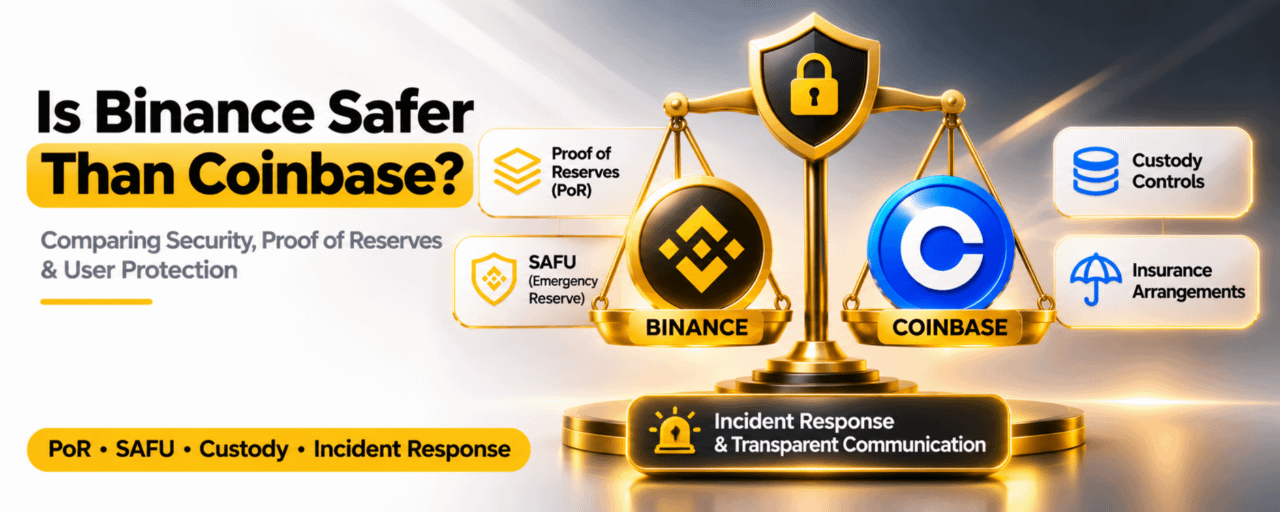
Binance and Coinbase take different approaches to security and transparency. Binance emphasizes user-verifiable Proof of Reserves (PoR) and its Secure Asset Fund for Users (SAFU), while Coinbase highlights its custody controls, financial disclosures, and insurance arrangements.
Neither platform should be considered completely risk-free. The more useful question is: Which protection mechanisms matter most to you, and how can you verify them?
1. How Do Binance and Coinbase Approach Security Differently?
Both exchanges use multiple layers of security, but their public disclosures emphasize different areas.
Binance provides account-level security features, wallet infrastructure controls, and a Proof of Reserves system that allows eligible users to check whether their account balances are included in a particular reserve snapshot. It also operates SAFU, an emergency reserve intended to help protect users in extreme situations.
Coinbase, meanwhile, emphasizes its custody architecture, cold storage practices, internal approval processes, and corporate reporting. Its public disclosures describe measures such as distributed-key controls, withdrawal limits, and anomaly detection.
These approaches are not directly interchangeable. A platform's published security features do not automatically establish that it is safer in every situation.
For users, it is worth examining three separate questions:
How does the exchange protect assets while they are held on the platform?
Can users verify information about the assets and liabilities?
What happens when a security incident occurs?
2. Proof of Reserves: Where Binance Offers a Different Type of Transparency
One of Binance's distinguishing features is its Proof of Reserves system.
Proof of Reserves uses cryptographic methods, including Merkle Trees and zero-knowledge proofs such as zk-SNARKs, to help users verify that their account balances are included in a published snapshot of exchange liabilities.
In practical terms, users do not have to rely entirely on a general statement that assets are backed. They can use Binance's verification process to check the inclusion of their own balances.
You can explore the system here:
https://www.binance.com/en/proof-of-reserves
Binance also provides instructions for checking individual balances:
https://www.binance.com/en/support/faq/detail/815b25f0cb054bdd9d35eccc408fe981
However, there is an important limitation.
Proof of Reserves is not the same as a complete independent audit of an exchange's financial condition. A snapshot provides information at a particular point in time. It does not necessarily establish that every liability, operational obligation, or off-balance-sheet risk has been accounted for.
Coinbase offers a different form of transparency through corporate financial reporting, custody disclosures, and third-party control assessments. These disclosures can help users understand how the company manages customer assets, but they do not provide the same individual, exchange-wide PoR verification mechanism.
The distinction is not that one form of transparency makes the other unnecessary. They answer different questions.
3. SAFU vs. Coinbase Insurance: Understanding the Difference
Another important comparison concerns how each platform approaches protection against losses.
Binance operates the Secure Asset Fund for Users, commonly known as SAFU. Established in 2018, SAFU is an emergency reserve designed to help protect users in extreme situations, including certain security incidents.
It is important to understand that SAFU is not equivalent to bank deposit insurance. Its existence does not mean every type of loss is automatically covered or that every affected user is guaranteed reimbursement.
Coinbase has also disclosed insurance arrangements covering certain digital assets held in its storage systems against specific theft and cybersecurity risks. However, coverage is subject to policy conditions, limits, and exclusions.
For example, insurance does not necessarily cover every possible loss, and compromised personal login credentials may fall outside the coverage.
Neither SAFU nor commercial insurance should be interpreted as an unlimited guarantee.
The useful question is not simply whether an exchange has a protection fund or insurance policy. Users should also understand what events qualify, what exclusions apply, and who is responsible for determining whether a claim is covered.
4. What Can We Learn From Binance's October 2026 Security Incident?
A comparison of exchange security would be incomplete without considering how each platform responds when something goes wrong.
On October 29, 2026, Binance experienced a major security incident involving approximately US$6.34 billion in digital assets. Binance's initial investigation described unauthorized transactions involving its internal wallet-signing infrastructure.
The incident had operational consequences. Binance temporarily suspended withdrawals while security checks and containment measures were carried out. The event raised important questions about internal access controls, transaction authorization, and the resilience of wallet operations.
Binance subsequently announced several response measures, including:
Rebuilding affected wallet infrastructure and strengthening access controls.
Enhancing wallet-service risk controls and behavioural anomaly detection.
Working with law enforcement, blockchain analytics firms, and industry partners to trace and freeze affected assets.
Engaging independent cybersecurity experts to review the incident and recommend further improvements.
Binance also announced that it had completed covering the affected assets using more than US$6.34 billion in company resources and other designated funds. A new Proof of Reserves snapshot dated November 12, 2026, covering 198 tokens, was also published.
These developments are important, but two things should remain separate: covering the financial impact of an incident and demonstrating that the underlying security weaknesses have been fully resolved.
The announcement also described withdrawals as resuming in phases. Users should therefore check the latest status of their specific asset and network rather than assume every withdrawal route is operating normally.
For the official incident and recovery announcements, refer to:
https://www.binance.com/en/support/announcement/detail/0729ad59cde74700b4eaa96c33441e71
The key lesson is that security should be assessed through both prevention and response. Strong controls matter, but so do transparent communication, effective recovery procedures, and independent review after an incident.
5. Which Exchange Offers Better User Protection?
There is no single answer that applies to every user. The available disclosures point to different strengths.
Binance stands out in individual Proof of Reserves verification. Its system gives eligible users a way to check whether their balances are included in a published snapshot. SAFU also provides an additional emergency reserve mechanism, although it should not be confused with universal insurance.
Coinbase emphasizes custody disclosures and corporate transparency. Its published information about cold storage, withdrawal controls, and insurance arrangements may be relevant to users who prioritize those areas.
These are comparisons of disclosed mechanisms, not independently measured security scores. A published feature alone cannot prove that a platform will never experience a breach or operational disruption.
Your choice should depend on which protections you value, how you use the exchange, and the legal entity responsible for your account.
6. What Should Users Check Before Choosing an Exchange?
Regardless of which platform you use, consider these practical checks:
Verify the legal entity: Check which company serves your account and whether it is authorized to provide the relevant services in your country.
Understand custody arrangements: Find out how customer assets are held and what protections apply.
Review transparency disclosures: Look beyond headlines and understand what a reserve snapshot or financial report actually demonstrates.
Check withdrawal controls: Review supported networks, withdrawal limits, and any restrictions that may apply.
Strengthen account security: Use passkeys or hardware security keys where supported, enable two-factor authentication, and consider withdrawal address allowlisting.
Follow official updates: Use verified platform channels and check the status of your specific asset before transferring funds.
For users in Indonesia, global availability or overseas regulatory licenses should not be treated as automatic proof of local authorization. Check the applicable OJK framework and the exact provider or entity serving your account.
Final Verdict: Is Binance Safer Than Coinbase?
Binance and Coinbase offer different security and transparency models, so declaring one universally safer would oversimplify the comparison.
Binance has a clear distinction in its user-verifiable Proof of Reserves system and its SAFU emergency reserve. Coinbase emphasizes custody disclosures, corporate reporting, and its own insurance arrangements.
The October 2026 Binance incident also demonstrates why users should look beyond published features. How an exchange responds to a serious security event, communicates progress, and independently reviews its systems matters just as much as its preventive controls.
Ultimately, the best exchange depends on your priorities, location, and intended use. And whichever platform you choose, remember that exchange security does not eliminate every risk associated with holding digital assets.
Frequently Asked Questions
Is Binance safer than Coinbase?
Neither exchange can be declared universally safer. Binance offers user-verifiable Proof of Reserves and SAFU, while Coinbase emphasizes custody disclosures, corporate reporting, and insurance arrangements. The right comparison depends on the protection features that matter to you.
Does Binance Proof of Reserves guarantee that my funds are safe?
No. Proof of Reserves helps users verify the inclusion of their balances in a particular snapshot. It is not a complete audit of every liability, operational risk, or possible source of loss.
Does SAFU guarantee reimbursement if Binance is hacked?
No. SAFU is an emergency reserve designed to help protect users in extreme situations. It should not be treated as universal insurance or a guarantee that every loss will be reimbursed.
What should I do before keeping crypto on an exchange?
Review the exchange's custody and transparency disclosures, check its legal status in your jurisdiction, enable strong account-security features, and understand the withdrawal process. For substantial long-term holdings, consider whether self-custody is appropriate for your circumstances and technical experience.
This article is for educational purposes only and does not constitute financial or investment advice. Cryptocurrency assets involve risks, including custody, operational, regulatory, and market risks.